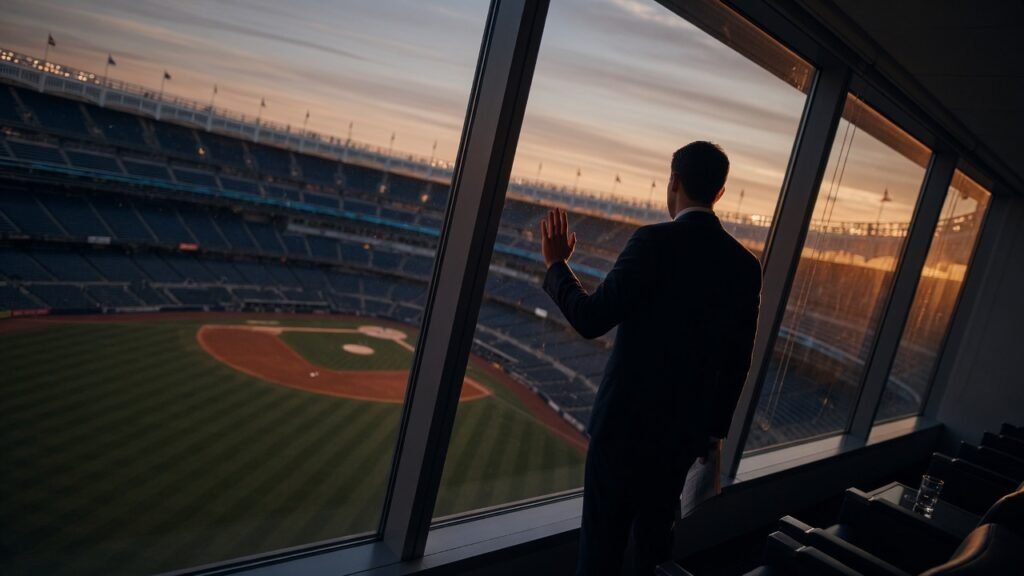
The Yankees just took $2.6 billion from Apollo, and if you think this is about patching a rotation or quieting the October ghosts, you are reading the wrong ledger. I read the announcement twice, then a third time, and the only honest reaction left is this: Hal Steinbrenner did not raise capital. He installed a second engine under a franchise that already sat near the top of the sport’s food chain and decided the ceiling was still too low.
Yankee Global Enterprises is the real subject here. The baseball team is the loudest asset inside it, not the whole story. YES Network, Legends Hospitality, a piece of New York City FC, a stake in AC Milan. Apollo Sports Capital is buying exposure to that entire machine through a mix of debt and equity, and the Steinbrenners keep the keys. Hal stays managing general partner. Control person status untouched. Apollo’s Al Tylis gets a newly created board seat and a view of the books. That is not a rescue. That is architecture.
“We are continually seeking ways to strengthen our positioning, and this partnership allows us to explore pursuing strategic opportunities,” Steinbrenner said in the news release. I have heard softer versions of that line from every owner who wanted dry powder without admitting they were turning a civic religion into a permanent capital platform. Hal just said it with better grammar and a bigger check.
They Barely Owed Anyone. They Still Took the Money.
Here is the detail that should rearrange how you hear this deal. The Yankees refinanced roughly a billion dollars of stadium debt back in 2016 and were believed to be carrying under $100 million of that load by the time Apollo showed up. You do not raise $2.6 billion to extinguish a rounding error. You raise it because you want room to move while the rest of the league is still arguing about luxury-tax brackets and regional sports network decay.
Forbes had them at $8.5 billion in March. Sportico’s spring number sat at $9.4 billion. People briefed on this transaction told The Athletic the baseball team itself is now being treated like a near-$10 billion asset, which would be a realized-record conversation for MLB if the equity slice ever gets fully unpacked. The structure makes clean math hard on purpose. Debt plus equity plus a parent company stuffed with media and hospitality and soccer means nobody hands you a simple price tag. That opacity is a feature. It lets Hal say the family still owns the Yankees while Apollo’s nearly trillion-dollar balance sheet hums underneath the pinstripes.
I keep coming back to 1973. George’s group bought this franchise from CBS for $10 million. Fifty-three years later the same family name is still on the door and the asset has been re-priced into the same neighborhood as sovereign vanity projects. That is not nostalgia. That is compounding with a logo.
The Board Seat Is the Quiet Threat
Al Tylis joining the Yankee Global Enterprises board is the sentence most fans will skip and the one I cannot stop circling. Private equity does not buy ceremonial chairs. MLB caps any single PE fund at 15 percent of a club, so the equity slice has a hard ceiling, but the influence does not live only in the percentage. It lives in the information rights, the growth mandate, and the quiet pressure to treat every underperforming asset like a spreadsheet line instead of a sacred object.
Apollo already took majority control of Atlético Madrid. It has other sports interests and a sports platform measured in the billions. This is its largest U.S. sports swing to date. I do not buy the fan-fiction version where that automatically means a $400 million payroll every winter and a blank check for every free agent with a pulse. PE money likes returns. Championships are wonderful branding. Predictable cash flow is oxygen. The Yankees already project among the highest payrolls in the sport. The question is whether the next dollar goes into another outfielder or into whatever “strategic opportunities” Hal was carefully not naming.
I lived through the Lakers getting bid into the stratosphere. Different sport, same gravity shift. Once a franchise crosses into that valuation air, the product on the field still matters, but it starts sharing the stage with media rights, international leverage, hospitality yield, and every adjacent business that can ride the logo. The Yankees just accelerated that timeline while insisting nothing essential changed.
Nothing essential changed on paper. Everything changed in the incentive stack.
Fans will want a clean moral. Either this is the death of the family franchise or the rebirth of the Evil Empire with infinite ammo. I think both readings are lazy. The Steinbrenners kept control because control is the last truly scarce asset in sports ownership. Apollo got a seat and a claim on growth because permanent capital is how you stop competing only inside baseball’s closed loop and start competing with every other entertainment conglomerate that wants a piece of global attention. The pinstripes remain the brand. The holding company just got louder.
If you are waiting for Hal to turn into George with a private-equity co-pilot and start lighting money on fire for vibes, adjust the expectation. The smarter, colder read is that the Yankees just bought themselves the right to stay expensive forever without ever having to sell the crown. That is not a bailout. That is a declaration that the franchise is too valuable to stay merely a baseball team.