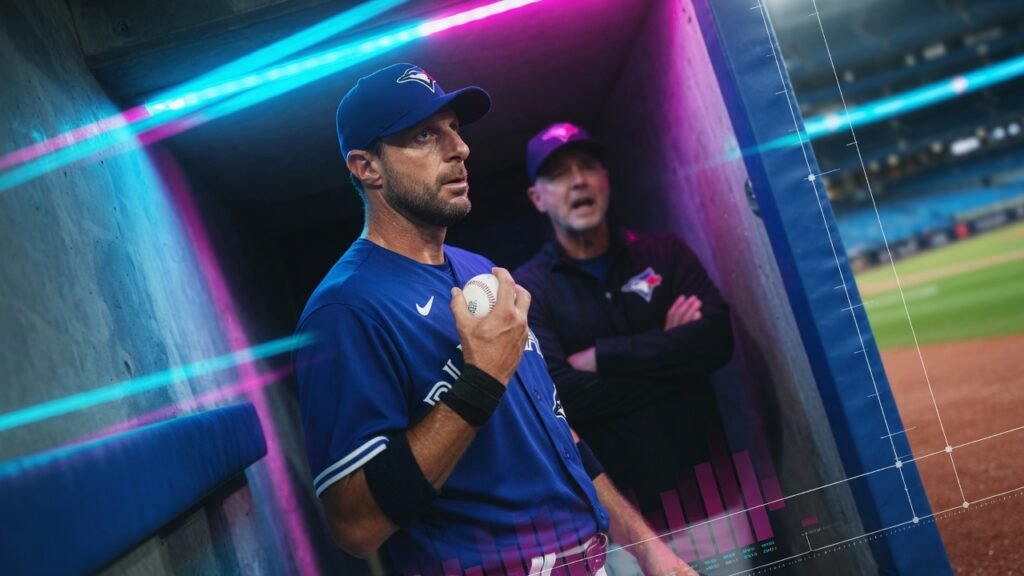
The manager walked out. Max Scherzer sent him back. That single sequence at Rogers Centre on Sunday told you more about a Hall of Fame career than the 5.74 ERA ever could.
At 42, on three days’ rest, already past 100 pitches, Scherzer stared down John Schneider in the seventh and kept the ball. The crowd of 42,131 booed the manager on the way out and roared when the right-hander stayed. Schneider later put it clean: “If that doesn’t sum up Max Scherzer, I don’t know what does.” Then he added the line that will travel farther than the box score: he would not want any other “42-year-old psychopath” on his team.
Scherzer finished the inning, started the eighth, walked the leadoff man, and finally handed the ball over with a smile and a hug. Seven innings, one earned run, six hits, one walk, seven strikeouts, 114 pitches. Career win No. 225. Career strikeout No. 3,557, ninth all-time, three behind Justin Verlander. Classic Mad Max, compressed into one afternoon that might close the book.
The Pitch Count Was Never the Point
The surface numbers from 2026 look ugly. A 4-9 record and a 5.74 ERA do not sell October. But the mechanism underneath Sunday’s start explains why the standing ovations felt earned rather than ceremonial.
He skipped his bullpen and upper-body lifting to give himself “maximum chance to be able to be the best today I can possibly be.” He threw 77 of 114 pitches for strikes. Terry Francona, managing the other dugout, noted roughly 21 first-pitch strikes and told reporters his young pitchers needed to watch: short rest, heavy innings already banked, still competing at that level. “He’s been so much of what’s good in baseball, and you’ve got to respect that.”
That is the through-line. Scherzer’s entire career has run on the same operating system. The velocity dips. The ERA climbs. The will does not. Schneider had already told him before the game he wanted to pull him mid-inning so the crowd could recognize him properly. On the mound, Schneider asked how he felt. Scherzer said great. Schneider warned that if he got the next batter, he would have to come back out for the eighth. Scherzer’s answer, per the manager: “I know, and that’s what I’m doing.” Schneider turned around. “Okey dokey.”
Scherzer’s own read of the moment was simpler. “The whole place is booing him. I’m like, ‘Man, I want to stay in this game, too.’”
That is how you get 501 career appearances and 492 starts. You treat every pitch count as a negotiation you intend to win.
Three Days’ Rest at 42 Is the Real Flex
Context matters here. He had thrown 93 pitches across five innings in Baltimore on Wednesday. Coming back on short rest at this age is the kind of decision most organizations protect against. Toronto let him empty the tank in a meaningless September finale for a 79-83 club, and he responded with a season-high pitch count, his most since 2020.
He walked off to the ovation, tipped the cap, hugged teammates, then climbed into the stands to see his wife and kids. “Just a cool moment to be able to see them. I wanted to have them here.” The tableau looked like a farewell because it was built like one. Schneider even called the second trip to the mound “the weakest call to the bullpen ever,” done with a pinky finger.
Nothing is official. Scherzer said Saturday and again Sunday that the decision waits for the offseason. “I’ve talked to everybody in my inner circle, and we all kind of feel the same way. We don’t need to make a decision today. Get to the offseason and just see how things unfold.” He also flagged the labor cloud hanging over 2027. “We’ve also got a lot of uncertainty next year with all the labor issues, so you just don’t know how the season’s going to happen or unfold, or what opportunity is going to be in front of me.”
A lockout would freeze the calendar. A 20th season would require a team willing to bet on the competitor rather than the 2026 ERA. Both are live variables. Neither changes what Sunday already proved.
The Competitor Outlasted the Season
Scherzer called the Blue Jays experience a “hidden gem” and said he had fun. That tracks with the way he competed in a lost year. The 5.74 ERA is real. The seven-inning, 114-pitch statement on short rest is also real. One of those defines the résumé. The other defined the afternoon.
Francona hoped his young arms watched the first-pitch strikes and the short-rest grind. Schneider got the argument he expected and the psychopath he wanted. The Rogers Centre got the version of Mad Max that always showed up when the adrenaline hit.
“That was amazing,” Scherzer said. “The adrenaline starts kicking in, the fans start getting in, and that’s when I could start feeding off of the crowd here at the Rogers Centre. I really could just reach back and just felt like I was unlimited.”
Unlimited is the right word for the competitive core. The arm has miles on it. The operating system still runs hot. If that was the last start, it matched the career that produced it: stubborn, loud, and still fighting the manager for one more batter.