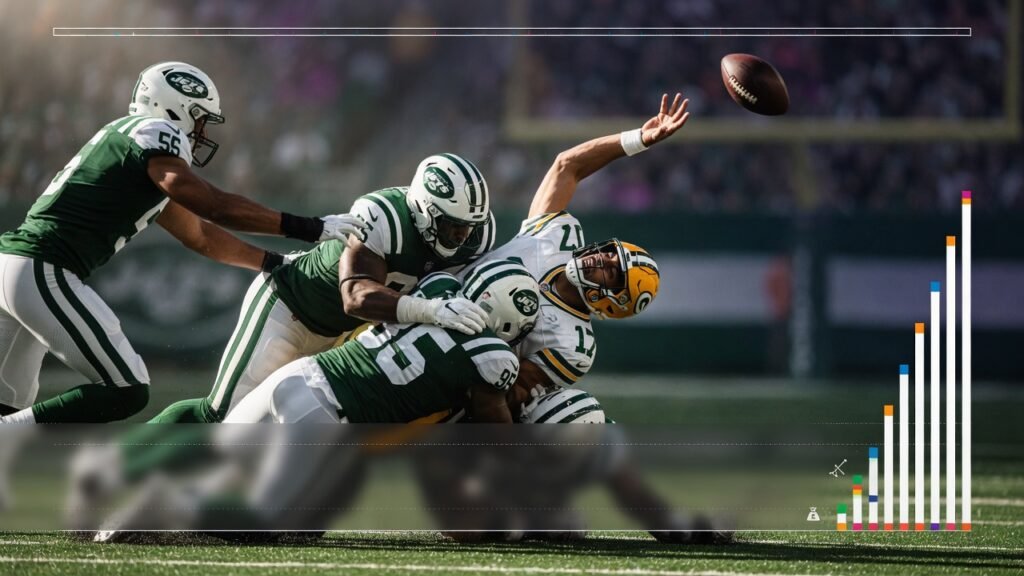
Aaron Glenn had two timeouts and roughly a minute left in a tied game, and he spent them on the idea that overtime was safer than one more possession. That is the decision that turned a 17-7 fourth-quarter lead into a 20-17 Packers win at MetLife, and Monday he stood on it again.
The sequence is simple. The Jets went for it on fourth-and-1 near midfield with about 1:20 left. Braelon Allen got nothing. Green Bay moved to the Jets’ 45. Christian Watson went down with about 1:02 remaining on fourth-and-5. Glenn still had both timeouts. He let the clock run. The Packers took a delay of game, ate the 10-second runoff, called timeout with two seconds left, and threw a Hail Mary. The Jets sacked Jordan Love. Overtime.
Matt LaFleur did not hide his reaction. “Oh yeah, I was really confused by that,” the Packers coach said afterward. “That’s why we called the timeout and tried a Hail Mary.” When the other sideline is confused enough to manufacture a desperation throw just to get to OT, the process already failed.
Playing for Overtime Is Not a Strategy
Glenn’s defense on Monday was pure process language. “When we have the punter at the logo, we don’t want to put ourselves in a situation where we get our guys in a backed-up situation,” he said, via the New York Daily News. “I know we are talking about getting our offense going in that situation. But the thing is, they also had two timeouts. I just felt like it was the right decision to do at that point. And we actually wanted to play for overtime when it came to that.”
Wanted to play for overtime. With the ball potentially coming back to Geno Smith, two timeouts, and a minute to work with. The risk he cited was a backed-up punt after a failed drive. The risk he accepted was giving Green Bay a free path to a field-goal try or a last-second heave without ever forcing them to stop the clock themselves. That is a coach protecting against the ugly look instead of hunting the win in regulation.
He went further when asked about regret. “There are always going to be decisions in that case,” Glenn said. “I think when the clock got to 11 seconds, I could have easily called a timeout there and forced a punt. We actually ended up getting a sack on the play, so there are other plays in that game that determined the outcome of that game.”
The sack is the alibi. It does not change the expected value of the decision. A timeout at 1:02 forces Green Bay to snap under pressure or burn its own resources. It also preserves the chance that a stop, a block, or a short field flips the possession. Crazier things happen with a minute and a timeout. Glenn chose the coin flip instead.
Then he won the coin flip and still chose wrong.
The OT Data Already Has a Preference
Under the current overtime rules, both teams get a possession. The market response has been clear. Teams that win the toss and defer sit at 11 of 16 (4-6-1). Teams that elect to receive, like the Jets did Sunday, are 2-3. Glenn became the fifth coach to take the ball first. His reasoning was clock control in a 10-minute OT. The Jets went three-and-out, took two sacks and a false start, punted, and watched Trey Smack knock through a 26-yarder with 5:23 left.
Control of the clock only works if the offense moves the chains. New York’s offense finished the day with 67 rushing yards on 27 carries. Breece Hall managed 29 yards on 16 carries. When the run game is that dead, receiving first just hands the opponent the last possession with better field position after the three-and-out. The league’s early sample already tilts toward deferring. Glenn’s explanation ignored that sample.
This also sits on a prior scar. In London last October against Denver, Glenn let the clock expire on a fourth-and-1 near the end of the first half rather than snap it. Sean Payton lit him up for it then. Pattern recognition is not narrative. It is the same preference for avoiding the messy play call over forcing the opponent to respond.
The Math of a Historic Collapse
The Packers won with 199 total yards, 133 penalty yards, and a minus-1 turnover margin. ESPN Research noted they were the first team since 1941 to win under that combination. Previous clubs in that spot were 0-44. Green Bay scored the final 13 points of the game after trailing 17-7 with 11:04 left in the fourth. The Jets forced four fumbles and still could not close. Thirteen accepted penalties for 156 yards did not help.
Glenn is right that one decision does not explain an entire loss. He is wrong that the late-game cluster is just noise. Fourth-and-1 aggression, refusal to stop the clock, and electing to receive in OT are three separate choices that all pointed the same direction: protect against the worst-case look rather than maximize the chance to end it. In New York, after a brutal first season as head coach, those choices get picked apart because they keep arriving at the same result.
The Jets are 1-1. The defense still has not intercepted a pass in a stretch that has reached 19 straight games by one count. The offense cannot run. And the head coach just told the city he wanted overtime when he still had a chance to finish the job in regulation. That is the standard he is setting for every close game the rest of the way. The Packers left MetLife with a win they had no business claiming on yardage alone. Glenn left with the same explanations he brought into Monday. The clock is still running on both.