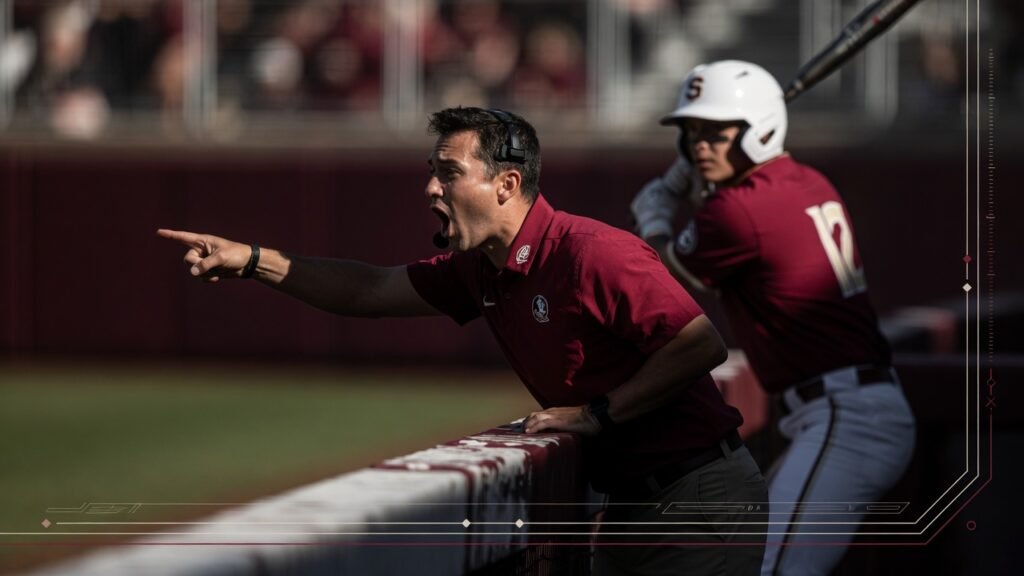
Florida State just lost 70 percent of its plate appearances and an entire weekend rotation in one draft cycle, and Link Jarrett is already rebuilding like this is the new normal. Because it is.
The Seminoles finished 40-19 and 19-11 in the ACC, earned a national seed, hosted the Tallahassee Regional, and then got bounced by St. John’s twice, including a 5-4 regional final that ended their season short of a Super Regional for the first time since 2023. That hurts more when you have back-to-back Super Regional runs and a 2024 College World Series appearance still sitting in the rearview. Jarrett said it plainly after the exit: “The hurt is something you can never describe. I hadn’t been in a dugout that was that eerie and that silent after a loss like that, and the locker room was worse.”
Then the draft hit. LHP Wes Mendes went 57th overall to Houston. LHP Trey Beard to Miami. RHP Bryson Moore to Pittsburgh. The whole weekend staff gone. First baseman Myles Bailey, limited to 26 games by a season-ending ankle injury after hitting .363 with a .582 OBP, .913 slugging, 13 homers and 33 RBI in just 80 at-bats, signed with the Cubs for $1.9 million as the 75th pick. Outfielder Brayden Dowd and more arms followed. Add the portal exits—catcher Hunter Carns to Georgia, outfielder Chase Williams to UCF, infielder Gabe Fraser to Wake Forest, plus others—and you get the D1Baseball number that defines the offseason: 70 percent of plate appearances walked out the door.
The Weekend Staff Vanished and the Math Got Ugly
College baseball under the current draft-portal rules does not reward continuity. Jarrett already lived a version of this entering 2026, when he returned roughly 44.6 percent of position-player games started after eleven players went in the 2025 draft. He still won 40 games. The difference this time is scale. Losing the Friday-Saturday-Sunday starters removes the innings backbone. Bailey’s production, even in a short sample, was elite power and on-base skill that the lineup leaned on before the ankle gave out. When 70 percent of your PA disappear, you are not tweaking a lineup. You are constructing a new offense from scratch while hoping the arms that stayed can hold the line.
The arms that stayed matter. RHP John Abraham was not drafted. Neither were Chris Knier, Payton Manca, or Cooper Whited. That is the quiet draft luck that keeps a staff from total freefall. Abraham becomes the named piece in fall ball conversations for a reason—he is the bridge between what left and whatever Jarrett can manufacture next. Proven college innings beat hope every time in February and March.
Portal Haul Has to Replace Production, Not Just Bodies
Jarrett and his staff hit the portal hard. DH/1B Jackson McKenzie from FAMU. SS Cooper Malamazian from Indiana. OF Ty Peeples from Georgia. 1B Nick Barron from Northwestern. INF Callum Early from Texas. C Coy Clements from Pearl River CC. LHP Cayden Suchy from UConn. More arms from FGCU, Penn State, and Cal. The names show clear targets: middle infield stability, left-handed bats to balance a right-hand heavy group that struggled with pop and RISP execution in 2026, and innings that can slot behind the returning starters.
I look at portal construction the same way I look at a salary-cap reset. You do not need every addition to be a star. You need enough quality at-bats and enough strike-throwers to get back to a regional host profile. Malamazian and Early give the infield options. Peeples and McKenzie address the offensive profile. Suchy is the kind of arm that can stabilize midweek or slide into a weekend spot if the development curve hits. Fall ball, which opened late summer into early fall with the 2027 roster already public, is where those bets get stress-tested against live arms instead of scouting reports.
Jarrett himself framed the bigger picture in the D1Baseball pre-fall dispatch: “In all of my imagination of what it would be like to coach, never could you dream of this is where it’s landed.” That is the honest admission. The job is no longer developing a core for three or four years. It is annual reconstruction under draft pressure and free-agency-level portal movement. Programs that treat it like a feature instead of a bug keep hosting regionals. Programs that whine about continuity fall behind.
The 2026 offensive issues—lack of consistent power, RISP failure, a right-handed tilt—are exactly what the portal haul is built to fix. Bailey’s career line at FSU (.337/.488/.734 with 32 homers in 82 games) set a production standard the next first-base and DH options have to chase. If McKenzie and Barron can even approach half of that on-base and slug, the lineup stops being a liability. If they cannot, the returning outfield pieces like Brody DeLamielleure and John Stuetzer plus Cal Fisher in the infield will be asked to do too much.
I am not buying the idea that a 40-win team with a national seed simply collapses because the draft hit. Jarrett has already proven he can win with heavy turnover. The mechanism is clear: keep enough pitching to stay competitive early, inject portal bats that raise the floor of the order, and let fall ball sort the depth chart before ACC play starts demanding answers. The Seminoles do not need to replace Mendes-Beard-Moore with three first-round arms. They need enough quality innings and enough quality plate appearances to get back to hosting and then finish the job they left incomplete against St. John’s.
Seventy percent of the plate appearances are gone. The weekend rotation is gone. The regional silence in the dugout is still fresh. What remains is the returning arms, a portal class built for specific holes, and a coach who has already done the annual rebuild once and won 40 games doing it. Fall ball will show whether the new pieces can actually hit and throw. The 2027 ceiling still runs through that question, not through nostalgia for the guys who signed.