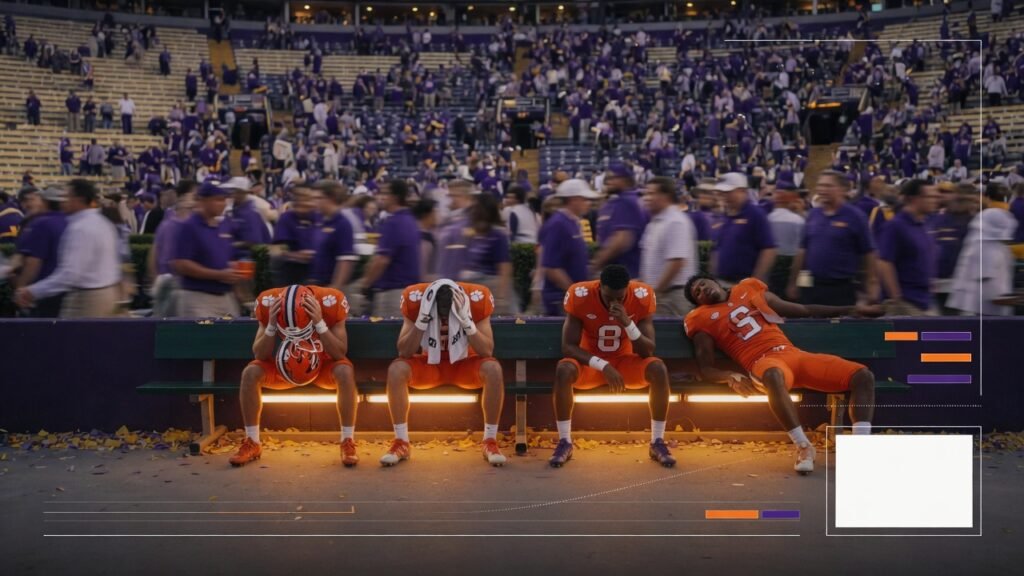
The pregame number never had a chance. LSU closed as a 10- to 10.5-point favorite over Clemson on September 5, and by the time Sam Leavitt scrambled into the end zone early in the second quarter the Tigers already sat on a 24-3 lead. Anyone who took the home side at the close cashed before halftime. The live line ballooned past -20.5 and kept climbing. That is not a slow grind. That is a statement that the market got Lane Kiffin’s debut badly wrong on the front end.
Tiger Stadium waited through a lightning delay and then watched Clemson’s offense vanish. The visitors managed 6-of-11 passing for 51 yards and one interception. Their ground game produced 2 yards on 11 carries. LSU answered with 195 rushing yards on 31 attempts and two touchdowns. Dilin Jones carried 18 times for 91 yards and the first score of the Kiffin era. Leavitt added 82 yards and a score of his own. The possession split told the rest: LSU held the ball and the edge while Clemson kept going three-and-out.
The Defense Paid the Ticket Before the Offense Did
Jordan Ross made the scoreboard tilt permanent. His interception of Christopher Vizzina and 30-yard return for a touchdown pushed LSU in front 17-3 late in the first quarter. That pick-six did more than add six points. It flipped the total and the spread in real time. Clemson’s offense never recovered its footing. Nick Coppola of the Greenville News put it cleanly during the onslaught: “LSU’s defense is completely dominating Clemson’s offense right now.” Alexander Turri at Clemson Wire called the whole first half “a bloodbath.” Both descriptions match the box.
I keep coming back to the schematic mismatch. Kiffin’s group ran power and misdirection behind a rebuilt line and forced Clemson into negative plays. The Tigers’ front seven generated six tackles for loss and a sack while holding Clemson under 55 total yards through large stretches of the first half. Last year’s 17-10 LSU win in Death Valley was a heavyweight scrap. Dabo Swinney said afterward it came down to “a couple plays” in a fight. This rematch never became a fight. The early script looked like a mismatch the books underpriced by a full touchdown.
Public tickets had leaned the Clemson dog in spots, sometimes 53 to 65 percent. Handle still found the favorite. The sharp money that took LSU -10 or -10.5 walked away winners the moment the lead hit three scores. Live bettors who faded the inflated number after the Ross return or the Leavitt scramble were playing catch-up against a clock that already belonged to Baton Rouge.
Kiffin’s Debut Just Reset the Early CFP Math
Both programs finished 7-6 a year ago. Kiffin arrived from Ole Miss with a transfer-heavy roster and Leavitt under center. The first half showed exactly why that portal haul mattered. LSU controlled the line of scrimmage, won the explosive-play battle on the ground, and turned one defensive takeaway into six points. Clemson, still sorting its own offensive identity behind Vizzina, looked a step slow in every phase.
The cover itself is the cleanest data point. A closing spread of roughly a touchdown and a half turned into a three-score lead before the break. Bettors who trusted the home favorite against a Clemson team that has spent recent Septembers looking ordinary cashed early and loudly. The live market’s jump to -23.5 and beyond simply confirmed what the yardage already said.
I watched the same pattern in other Week 1 openers where a new staff’s first script hit faster than the oddsmakers allowed. This one hit hardest. LSU’s rush average sat north of six yards per carry while Clemson’s sat near zero. That gap does not reverse in the second half without a complete defensive collapse, and nothing in the first 30 minutes suggested LSU would allow one.
The ticket is already paid. The only remaining question is how far the final margin stretches and whether the same defensive front keeps generating negative plays once the calendar turns to conference play. For one night in Baton Rouge the answer was already on the board at 24-3, and the people who bet it slept easy.