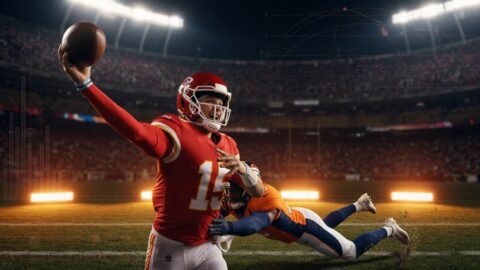
Laying 41 points with Oklahoma against UTEP on a Friday night in Norman feels like the kind of number that only exists to separate recreational money from its wallet. Then you pull the actual Week 0/1 track record and the argument flips.
Steve Makinen’s long-running VSiN system has huge home favorites of minus-36 or more in FBS-versus-FBS openers since 2013 sitting 24-0 straight up and 18-6 against the spread. Average final score in the sample: 54.3 to 8.3. Average line: minus-39. Oklahoma at home against UTEP, Indiana against North Texas, Texas A&M against Missouri State, and Ohio State at a cartoonish minus-50.5 against Ball State all clear the threshold. The public is already stampeded onto those sides at 80-plus percent of tickets and handle. Prediction markets price the Sooners’ win probability near 99 percent and the cover chance right around a coin flip. That is the clash in one frame: history and the books saying the chalk is still playable, a loud minority insisting nobody covers 40 when the next opponent is Michigan.
The Cover Rate Is the Real Edge, Not the Scoreboard Optics
Makinen’s explanation is mechanical, not vibes. “When the opening week lines approach this lofty favorite level, it’s clear that oddsmakers perceive a massive difference between two teams in talent. In addition, the better team was always playing at home in these games as well, and that comes with an additional level of motivation, as these hosts are anxious to get their promising seasons off to a good start against an opponent that is essentially powerless to stop them.”
That is the how. Talent gap plus home opener motivation plus an opponent that cannot stop the run or the pressure produces blowouts that keep rolling past the number. The 18-6 ATS mark is not noise. It is what happens when the better roster treats the first Friday like a statement and the lesser roster is still sorting its own identity.
The fade case is real and I hear it every September. Oklahoma has Michigan next week. Starters get pulled. The second half becomes a scrimmage. Chase Kiddy leaned UTEP plus the points and the under for exactly that reason, noting Oklahoma has little incentive to empty the playbook in what is functionally a Week 1 dress rehearsal. Seth Orlemann went further: “BET UTEP +41.5 (-108). While the Sooners have every advantage possible, with a seasoned quarterback, an established playoff-worth team, and home field advantage to name a few, this margin is too wide to not take the visitors.” SportsLine’s model gave the Miners a 79 percent chance to cover and a B grade. Those are not unserious arguments.
They just run into the sample. When the line sits in the high 30s or low 40s in Week 1 at home, the favorite has covered three out of every four times. The “they’ll take their foot off the gas” story shows up every year and still loses more often than it wins.
Public Money and the Next-Week Trap Are Not the Same Thing
I am not ignoring the schedule. Oklahoma’s coaches will protect John Mateer and the skill pieces once the game is decided. That is rational. It is also already priced. The line opened near 40.5 and has barely moved. Books are not scared of the fade. They are collecting the 80-to-90 percent of tickets hammering the Sooners and daring the underdog bettors to prove the historical edge is dead.
The same pattern repeats across the board. Ball State as a 50-point dog is the first FBS number that large since Hawaii got 53 against Michigan in 2022. Indiana and Texas A&M sit in the same minus-40 neighborhood. South Carolina is only a few points lighter against Kent State. In each case the public is max-long the favorite. In each case the counter is the same: early-season rust, empty second halves, and the sheer difficulty of hanging 50. The data keeps answering with 54-8 average scores.
John Williams’s Sooners Wire projection of Oklahoma 56, UTEP 0 is the extreme version of the chalk case. Bill Bender’s 51-7 is the more restrained version that still clears the number cleanly. Both treat the Miners’ recent scoring-defense rankings (bottom-20 territory the last two seasons) as the real matchup problem, not the “will they cover” philosophy debate.
I am taking the historical side. The system does not care about narrative. It cares that when oddsmakers hang these numbers in the first week and the better team is at home, the result has been easy covers more often than not. Oklahoma minus 41.5 is the cleanest current example because the talent gap is obvious and the home motivation is fresh. If the Sooners are up 35 at half, the second-half script still has to overcome a decade of evidence that these games keep producing points after the backups enter.
The clash will resolve Friday night in Norman the same way it has resolved most of these openers since 2013. One side will feel smart for laying a number that looks ridiculous on a board. The other side will explain why this time was different. The average score in the sample already told you which explanation shows up more often.