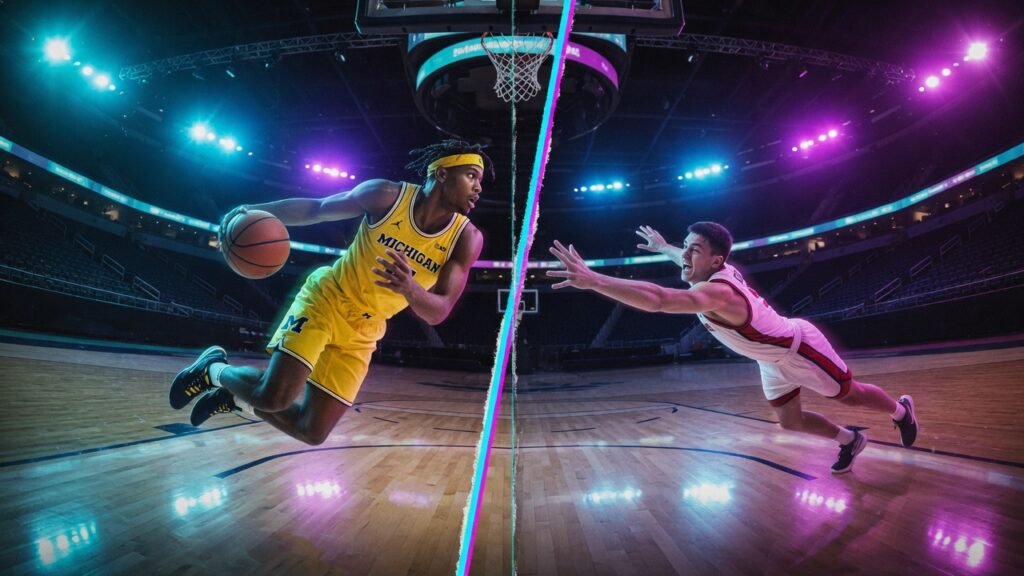
Roddy Gayle Jr. followed the NCAA’s rulebook like a student who never skipped a class, and the reward for that compliance is a locked door with his name on it.
He graduated high school in 2022. He enrolled right away. He played four full seasons — two at Ohio State, two at Michigan — and helped deliver a national championship in Ann Arbor. Then, in June, the NCAA adopted its five-in-five eligibility model and carved the class of 2022 out of the deal. Gayle’s lawsuit, filed Aug. 31 in Niagara County Supreme Court, asks a New York judge to stop the association from declaring him ineligible for 2026-27. According to the filing, he seeks no damages and no forced roster spot. He wants only the chance Michigan has already said it will give him if the court clears the path.
I have covered enough eligibility fights to know when a governing body is protecting a principle and when it is protecting a convenient cutoff. This one lands on the second shelf.
The Rule Reaches Everyone Who Waited
The summons does not dance around the hypocrisy. “The new model reaches athletes who delayed enrollment,” it reads. “It reaches athletes who spent a year in preparatory school. By the NCAA’s own Bylaws, it reaches athletes who spent years playing basketball for money outside the NCAA, and it charges them nothing for it. It does not reach the athletes who graduated high school in 2022, enrolled immediately, and played. It does not reach Roddy. He is excluded solely because he complied with the old rule.”
Read that again. Prep school delays count. Foreign pro tours count. Sitting out a year counts. Showing up as an 18-year-old and playing through four seasons does not. The association that spent decades lecturing kids about amateurism now draws the line against the ones who treated college basketball like college.
Gayle put the timeline in plain English in his statement to the court: “I did not leave college for professional basketball. I completed four seasons, I graduated, and the NCAA’s new carve-out told me I could not play a fifth. Only then did I turn to professional basketball.” He went undrafted in June 2026. Around June 25 he signed summer-league paperwork with the Detroit Pistons. He played four exhibition games in July and collected a stipend under $2,000. He has never drawn a regular-season pro salary. He is still enrolled at Michigan, still practicing, still on the Europe trip roster, still tracking toward a May 2027 degree.
Mike Boynton Jr. has already said the Wolverines will take him back if eligibility allows. The only obstacle is an organization that rewrote the future and left the present class holding the old receipt.
A Champion Reduced to a Stipend Argument
Last season Gayle played 39 games for a title team, averaging 7.3 points, 3.3 rebounds and 1.3 assists in 21.1 minutes. Career numbers sit at 146 games and 72 starts across Ohio State and Michigan. He is not some fringe walk-on chasing a fifth year for the Instagram post. He is a rotation piece on a reigning champion who stayed in school, stayed enrolled, and watched the NCAA invent a pathway that stops one class short of him.
I said this when the five-in-five language dropped in June: any model that rewards delay and punishes prompt enrollment is going to end up in court, and the association will lose on fairness grounds even if it wins a procedural stay. A federal injunction in Colorado briefly opened the door for the class of 2022 before the Tenth Circuit stayed it in late August. Gayle’s New York filing is the next wave. He is not asking a judge to invent eligibility. He is asking the court to stop the NCAA from enforcing a carve-out that, by the association’s own new logic, has no coherent defense.
The stakes are larger than one guard’s minutes. Every high-schooler who enrolls on time is watching. Every coach trying to build a roster around continuity is watching. And every future settlement negotiation will carry the memory of how the NCAA treated the first class that finished four seasons under the old clock while the new clock was being printed.
Gayle’s closing request in the filing is almost modest: “I am not asking the Court to order any school to put me on its roster. I am not asking the NCAA for money, and I seek no damages. I am asking only that the NCAA be restrained from declaring me ineligible, from interfering with Michigan’s decision to let me play, and from punishing Michigan, its coaches, or my teammates for following this Court’s order, so that I may compete for a spot on the same terms as every other player.”
Same terms. That is the entire argument. Michigan wants him. He never cashed a pro paycheck. He never left campus. The NCAA’s new model already admits five years is the right number. The only remaining justification for freezing him out is calendar spite aimed at kids who did what the handbook told them to do in 2022.
I will say it straight. If a $1,700 summer-league stipend is enough to erase a national champion’s fifth year while multi-year foreign contracts get waved through, the system is not protecting amateurism. It is protecting a line on a spreadsheet. Roddy Gayle Jr. showed up early, stayed late, and won a title. The association that wrote the rules now has to explain why that resume is the one that does not count.