Rich Paul just admitted he kept Peyton Watson off the floor in a playoff series, and I cannot stop replaying the timing. Denver needed bodies against Minnesota. Aaron Gordon dragged a hamstring into three games. Watson sat the entire first round, then walked into a four-year, $88 million deal in Cleveland via sign-and-trade. Paul went on his Game Over podcast and said the quiet part like it was Tuesday.
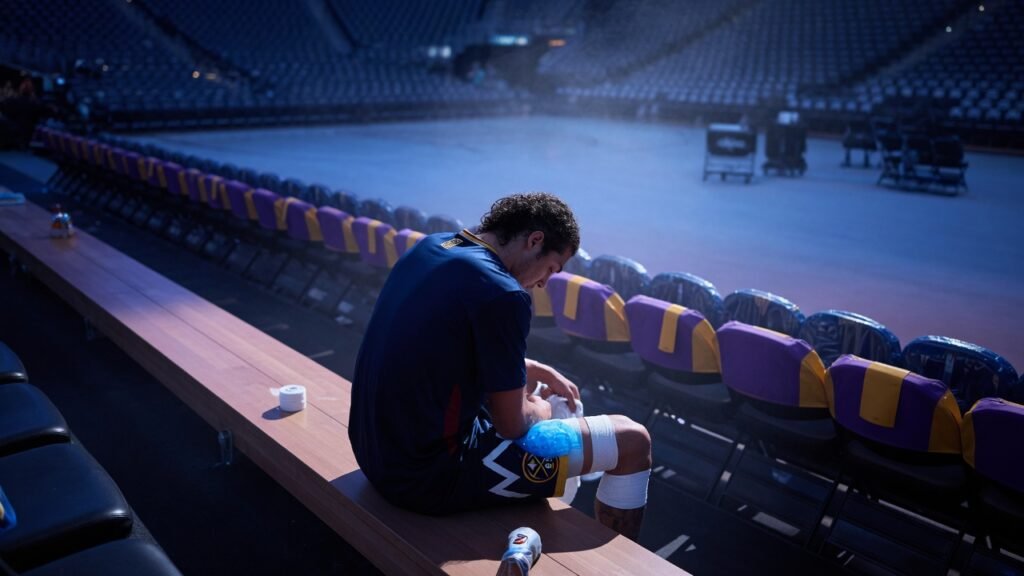
“You’ve got to remember, he didn’t finish the season. He didn’t play in the playoffs. He was dealing with a hamstring injury, soft tissue injury. And when you’re dealing with those injuries, you have to be very careful in your return. Guys want to play, and you have to protect them from themselves in that moment. Because you’re up for a contract and it’s the playoffs, and I’ve had a pretty good year, so I need to play. And it’s important to protect that.”
I heard that and immediately thought about every teammate who watched Gordon try to will a series into existence while Watson stayed in street clothes. Reports during those playoffs said Nuggets players were frustrated Watson would not push through. Paul just handed them the receipt.
The Bag Outranked the Series
Watson put up a career year before the injury: 54 games, 14.6 points, 4.9 rebounds, nearly a steal and a block a night, 41 percent from three. He looked like a real two-way piece when Nikola Jokic sat stretches. Then the Grade 2 left hamstring hit in early February against the Knicks. He missed weeks, came back for a handful of restricted minutes, and got shut down again in early April. Soft tissue is real. I am not arguing that. I am arguing that Paul framed the decision as asset management first and basketball second, and he did it on a microphone months later while the money was already wired.
Denver reportedly offered around $70 million over four years. Watson wanted more. He got more in Cleveland, complete with a player option and a trade kicker. Second-apron math boxed the Nuggets in, sure. But Paul made the calculus public: contract year plus lingering hamstring equals sit. Gordon made a different calculus. Same injury family. Different outcome. Gordon made the different calculus and stayed in the fight. Watson just cashed an $88 million check on the other side of the conference.
I keep a running ledger of front-office and player decisions that smell like self-preservation dressed up as medical caution. This one just got a signature from Klutch. Paul is not wrong about the job description. Agents protect clients. Soft tissue can re-tear. A rushed return in April can wreck a summer payday. That is the business. It just lands different when your franchise is already hanging on by a Jokic MVP and role players who keep getting hurt.
Teammates Felt It Before the Podcast
David Adelman said it back in February after another body went down: “I just feel bad for the guys in the locker room. It’s deflating when you keep seeing people go down around you when you’re trying to build towards something.” That was before anyone knew Watson would stay dark through the postseason. By May the frustration had a name. Now it has a podcast clip.
Nuggets fans are not inventing the betrayal narrative. They watched Gordon limp through minutes that mattered and then watched Watson’s camp prioritize the next contract. Loyalty talk is cheap in a league that moves money this fast, but chemistry is not fake. Denver lost that series. Watson’s minutes might not have flipped it. The principle still stings. You either buy the idea that every max-adjacent wing should sit when free agency looms, or you admit the locker room notice when one guy chooses differently.
Paul did what good agents do. He insulated the asset. Watson’s offensive flash last season and his length on the wing just bought him a real payday. Cleveland needs that exact profile next to Donovan Mitchell and James Harden. Perimeter stops. Occasional scoring pops. A body that can switch. The Cavs did not pay $88 million for the version that sat May. They paid for the January version that looked like a building block.
Cleveland Owns the Soft Tissue Now
Here is the part nobody in the podcast room said out loud. If the hamstring barks again in April 2027, Paul will protect him again. That is the model. Denver already lived it. Cleveland just bought the risk at a higher number. Watson has to prove the scoring bump was real and the defense travels. Harden and Mitchell can create. They cannot guard every wing by themselves.
I used to believe playoff availability was the purest test of a role player’s value. Paul just reminded me the purest test is the summer after. Watson finished the year on the trainer’s table, skipped the games that decide reputations, and still walked into the biggest contract of his life. Gordon played. Denver lost. Watson got paid. That sequence is the league in one paragraph, and Rich Paul was honest enough to narrate it.
Eighty-eight million dollars later, the only people still arguing about loyalty are the ones who stayed in Denver.