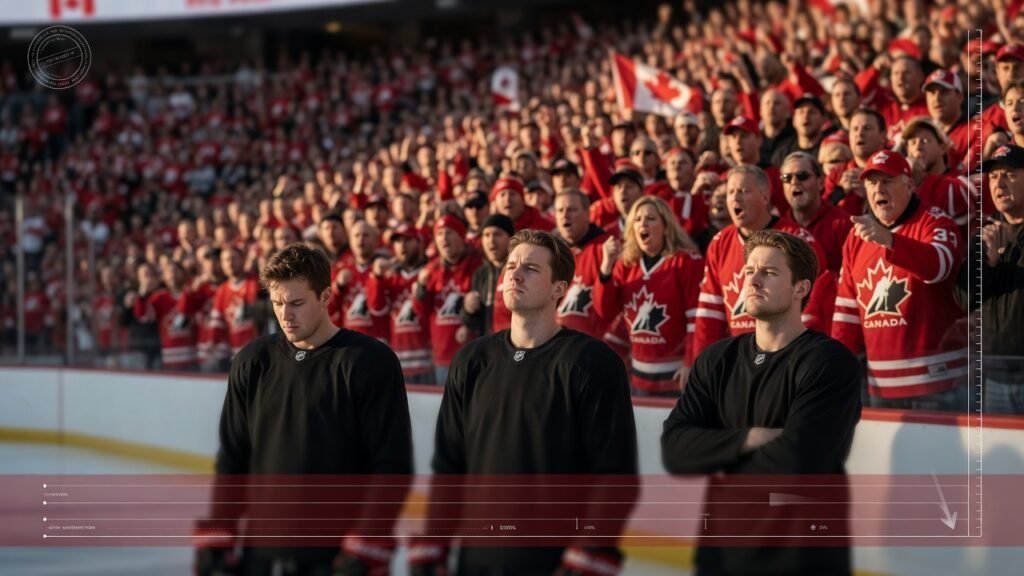
Acquitted in criminal court does not hand you the maple leaf. The appeal board just made that distinction brutal and permanent.
On August 12, an independent panel of three former justices confirmed what Hockey Canada’s own process had already found: Michael McLeod, Carter Hart, Dillon Dubé, Cal Foote, and Alex Formenton all breached the organization’s code of conduct stemming from the June 2018 hotel incident in London, Ontario. The criminal case ended July 24, 2025, with Justice Maria Carroccia acquitting all five after an eight-week trial. She could not treat the complainant’s evidence as reliable and ruled the Crown failed to prove lack of consent beyond a reasonable doubt. That closed the courtroom file. It did not close the jersey.
Hockey Canada accepted the appeal board’s staggered reinstatement calendar for its own programs only. Formenton is eligible immediately. Foote waits until November 10, 2026. Hart until November 10, 2027. Dubé until November 10, 2028. McLeod until November 10, 2030. No other 2018 teammates were found in breach. The matter, Hockey Canada said, is closed.
The Calendar Is the Verdict
I keep coming back to those dates. They are not random. A board that found every one of the five in breach still sorted them across a multi-year calendar. That is a graded finding under a private code, not a second criminal trial. Criminal law demands proof beyond a reasonable doubt. Organizational membership can, and often does, set a lower bar around conduct, reputation, and the integrity of the national program. Hockey Canada is exercising the second standard after the first one cleared the players.
The NHL already drew its own line and then stepped over it. The league’s statement after the acquittals said the players’ conduct fell “woefully short of the standards and values that the League and its Member Clubs expect and demand.” Then it set an October 15, 2025 contract window and a December 1, 2025 game eligibility date after nearly two years on the shelf. Hart signed in Vegas, played, and reached the 2026 Stanley Cup Final. Dubé landed with St. Louis after AHL time. Foote’s Swedish deal got yanked under public pressure. Formenton and McLeod stayed overseas. The NHL absorbed the reputational hit and moved on. Hockey Canada looked at the same night in Room 209 and decided the maple leaf still costs more.
That split is the real story. League clubs need roster spots and cap flexibility. A national federation that nearly lost its federal funding, sponsors, and leadership in 2022 after the civil settlement became public cannot afford the same math. The civil claim sought roughly C$3.55 million. The settlement, the National Equity Fund scrutiny, the parliamentary hearings, and the resignations rewired the organization’s survival instincts. Extended code suspensions after an acquittal are the predictable product of that rewiring.
Two Systems, One Night, Different Prices
People calling this a nullification of the court are confusing systems on purpose. Carroccia’s ruling binds the criminal process. It does not bind a voluntary association’s eligibility rules for World Juniors, world championships, or Olympic rosters. Formenton’s immediate reinstatement and McLeod’s ban into 2030 tell you the panel saw different degrees of code violation even while finding all five crossed the line. I read that calendar as the closest thing we will get to a public ranking of responsibility under Hockey Canada’s standards.
Hart’s situation crystallizes the gap. He can chase another Cup with Vegas while remaining ineligible to represent Canada until late 2027. That is not double jeopardy. That is two institutions with different risk tolerances and different constituencies. The NHL’s “woefully short” language already conceded the conduct problem. Hockey Canada simply refused to treat the acquittal as a full organizational reset.
The reforms since 2022, including the move toward the Canadian Safe Sport framework, only raise the stakes. If Hockey Canada had rubber-stamped immediate reinstatement for everyone after the not-guilty verdicts, every sponsor and every Sport Canada official who walked away in 2022 would have had a fresh reason to stay gone. The staggered bans are how the organization proves the culture work was not just press-release language.
I do not need the players’ private appeal arguments to see the mechanism. The board heard them. It still kept four of the five out of the national program on a timeline that stretches to 2030 for McLeod. Formenton alone walks back in now. That is the decision. Everything else is noise around it.
Canadian international hockey will keep selecting teams without these four for years. The NHL will keep employing the ones clubs still want. Those two facts can sit next to each other without one canceling the other. The maple leaf was never a participation trophy for surviving a criminal trial. The appeal board just wrote the eligibility rules to match that reality, and the dates are the only part of this story that still has teeth.