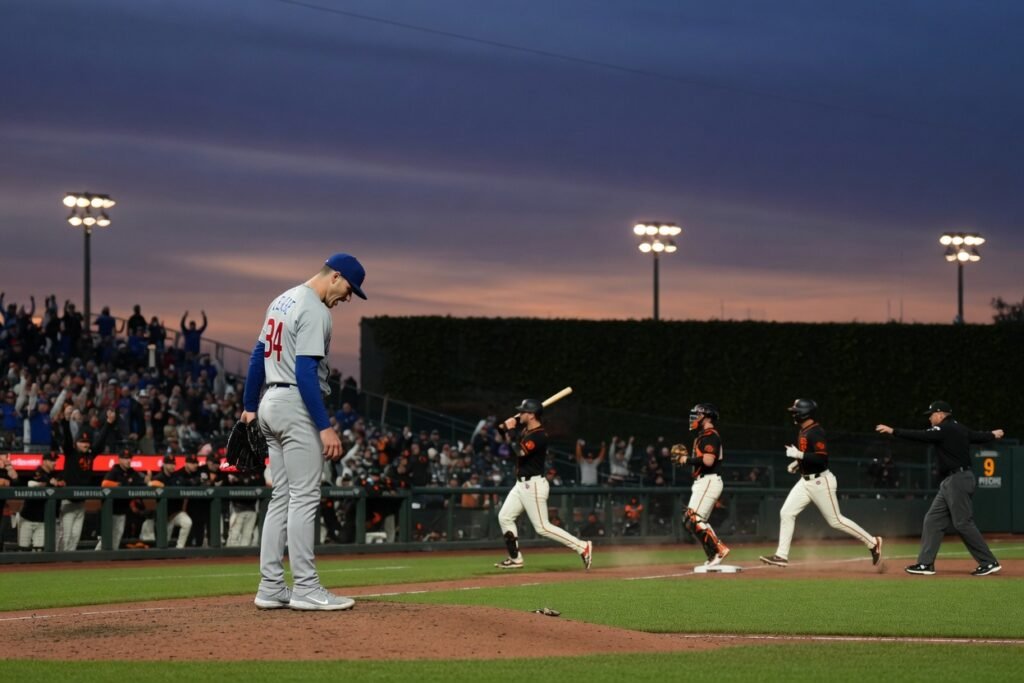
Dylan Cease, you beautiful chaotic bastard, you almost did it. You were out there, dealing, carving up the Giants lineup like a Thanksgiving turkey, carrying a no-hitter into the ninth inning. And then, just like that, Heliot Ramos slaps a single to center, and the dream dies. The Blue Jays win 10-0, everyone claps for Cease, and the corporate sports media machine rolls out the “valiant effort” takes.
I’m not here for the participation trophy.
I’m here to tell you that what happened to Dylan Cease isn’t just about a pitcher losing a no-hit bid. It’s about everything that’s cooked the soul out of modern baseball. It’s about the L energy that permeates every front office, every coaching staff, every “analytics” department that thinks a spreadsheet knows more than a man with a dawg in him, standing on a mound, smelling blood.
I watched that game, after putting the kids down, and I felt that familiar, creeping dread. Not dread for Cease, but dread for the sport itself. Because the real story here isn’t the hit that broke it up. The real story is that we’re even *talking* about a manager “letting” a guy try for a no-hitter.
John Schneider, the Blue Jays skipper, is out here getting praised for his magnanimity. “I’m a fan of baseball,” he said, oozing that corporate PR vibe. “I think if a guy has a chance to throw a no-hitter, I think you let him do it and I think you make adjustments after that.”
“I’m a fan of baseball.” Wow, profound. Thanks, Captain Obvious. Next, you’ll tell me water is wet and that most baseball players prefer not to strike out. That’s the kind of bland, focus-group-tested garbage I expect from a dude on ESPN in a polo shirt, not from someone actually in the dugout. What a low bar we’ve set. “Oh, he let a guy pursue history! What a visionary!” My guy, that should be the *default*. The fact that it’s noteworthy is a war crime against the sport’s spirit.
Schneider even qualified it: “Maybe not every single time, but as long as I’m allowed to.”
*Allowed to?* By who? The pitch-count overlords? The injury-risk Illuminati? The algorithm that dictates exactly when a human being’s arm will spontaneously combust if he throws one more slider? I know what you’re about to type in the comments. “But Ryan, pitch counts protect pitchers! Long-term health! The modern game!”
Shut it down.
This “long-term health” glazing has completely nerfed the game. It’s turned pitchers into fragile, coddled specimens whose careers are meticulously managed by nerds in front offices who’ve never thrown a fastball that broke 70 mph. Every pitcher is a porcelain doll, one pitch away from a season-ending injury, if you listen to these clowns. It’s an epidemic of risk aversion that has sucked the drama out of the sport.
Remember when pitchers were *pitchers*? When they went out there and were expected to finish what they started? When 130, 140, even 150 pitches in a start wasn’t a medical emergency, but just… a start? Now, a guy hits 100 pitches and the bullpen starts warming up like the damn apocalypse is nigh.
Dylan Cease, though. Dylan Cease is built different. He’s got that old-school swagger, that “him” factor that makes you stand up and pay attention. He *wanted* it. He literally told his manager he had more in the tank.
“Dylan came in after the sixth [inning] and said, ‘I’ve got 120.’ I said, ‘OK.’ And then after the seventh, he said, ‘I’ve got 130,'” Schneider recounted.
Cease wasn’t waiting for permission. He was making a declaration. “I kept saying, ‘Whatever it takes,'” Cease confirmed later. “I guess in my mind I thought maybe 130 at that point was what it was looking like.”
THAT is the energy we need more of in baseball. Not some calculated, data-driven decision to pull a guy at 90 pitches because his “spin rate variance” is up by 0.003%. Not some manager looking at his watch, wondering if the union rep is going to fine him for letting a guy be a competitor.
Cease already has a no-hitter from earlier in 2024. He knows what that feels like. He’s tasted that immortality. And he was chasing a second one, which would put him in an even more elite tier. Only 35 pitchers have multiple no-hitters, including playoffs. Mike Fiers was the last to do it in 2019. This wasn’t some rookie trying to prove himself. This was a dude with a ring, trying to get another. This was a man choosing violence on the mound.
And the Blue Jays, bless their perpetually underachieving hearts, haven’t had a solo no-hitter since Dave Stieb in 1990. Thirty-six years. That’s an entire generation of fans who haven’t seen that magic. You think that doesn’t add pressure? You think that doesn’t make every pitch in the 8th and 9th feel like a damn playoff game?
The moment Daulton Varsho made that incredible catch in deep left-center to start the 8th, robbing Bryce Eldridge, Cease knew. “When Daulton made that play,” Cease said, “it was like, ‘Man, that’s what happens in no-hitters.’ At that point, I really did it have it on my mind and I thought, ‘All right, we got this.'”
That’s the aura. That’s the narrative. That’s the *story* that gets lost when you pull a guy because the “next time through the order” metrics suggest he’s due for a regression. Baseball isn’t just numbers on a screen; it’s moments like that. It’s the collective gasp, the rising tension, the feeling that you’re witnessing something truly special.
Go ahead, @ me. Tell me I’m romanticizing it. Tell me injuries are real. I’m a dad, I get it. I worry about my kids’ scraped knees and bruised egos. But there’s a difference between protecting a player from career-ending recklessness and turning every outing into a sterile, pre-programmed exercise. We’ve gone too far. We’ve let the fear of what *might* happen overshadow the glory of what *could* happen.
Cease threw 118 pitches. His career high. So what? He’s 30 years old, in his prime. He gets the All-Star break to rest. This isn’t some 22-year-old phenom whose arm is still developing. This is a grown-ass man who knows his body, knows his stuff, and wanted to finish the job.
The fact that Schneider even had to *justify* his decision to let Cease go for it is the problem. It highlights how utterly broken the modern mindset is. Most managers would have pulled Cease at 100 pitches, or 105, citing “fatigue” or “long-term health concerns.” They’d be applauded by the analytics crowd, and the game would be poorer for it.
Cease’s fastball was still hitting 97 mph in the ninth. He threw two heaters to Ramos before going to a 96 mph sinker. He wasn’t gassed. He wasn’t cooked. He was executing. Ramos just got the better of him. “I wish I got it a little more in, but a good batter got a hit. It’s baseball,” Cease said, showing the kind of stoicism that makes you respect him even more. It happens. That’s baseball.
But the *opportunity* to have it happen, to even *be there* in the ninth with a no-hitter on the line, is what we’re losing. We’re trading the potential for legendary moments for the certainty of minimizing risk. We’re trading the chance to see a pitcher transcend for the safety of adhering to a pitch count. We’re prioritizing efficiency over ecstasy.
This isn’t about the Blue Jays winning 10-0. This isn’t about Cease’s stats. This is about a sport that increasingly prioritizes the cold, hard numbers over the beating heart of competition. It’s about a culture that has created a generation of pitchers who are conditioned to expect to be pulled, to not even *try* to finish what they start. It’s about a league that has implicitly told its players that “him” energy is a liability, not an asset.
I’m telling you, Dylan Cease losing that no-hitter in the ninth isn’t a failure. It’s a testament to what baseball *should* be: a brutal, beautiful grind where human will clashes with the impossible, and sometimes, just sometimes, the impossible almost happens.
When are we going to stop letting the spreadsheets dictate the soul of the game?