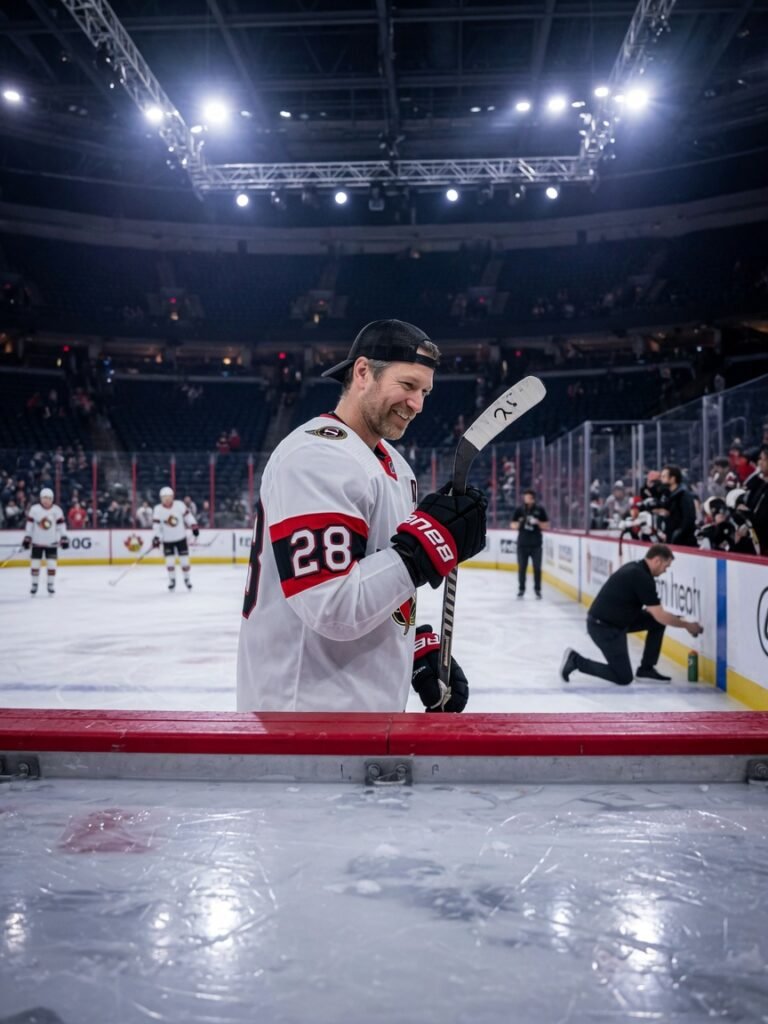
The re-signing of Claude Giroux to a one-year, bonus-laden contract with the Ottawa Senators, extending his NHL career to a remarkable 20th season, represents a far more intricate strategic maneuver than the surface-level narrative of veteran leadership and team loyalty suggests. While general manager Steve Staios highlighted Giroux’s “belief and commitment to our group” and Giroux himself spoke of the team feeling “like a family,” I find these sentiments, while undoubtedly genuine, function as a convenient veil for what is, fundamentally, a calculated and analytically driven gamble on specific, high-leverage outcomes. This isn’t merely a veteran extending his career; it’s a team betting on a declining but still specialized asset, optimized through a contract structure designed for maximum cap flexibility and performance incentive.
My analysis indicates that the $2 million base salary, expandable to $5 million through bonuses, is the critical component here. This isn’t a simple handshake deal. For players aged 35 or older, performance bonuses count against the salary cap in the season they are earned. If a team’s performance bonuses push them over the cap ceiling, the overage is applied to the following season’s cap. This mechanism provides the Senators with crucial cap flexibility for the upcoming season, allowing them to manage their cap space more efficiently without being immediately penalized for potential overperformance. It’s a risk-mitigation strategy, ensuring that if Giroux’s production or on-ice impact falls short, the financial commitment remains minimal, preserving valuable cap space for other roster adjustments or future extensions for core players. Conversely, if he meets those bonus thresholds, it implies a level of performance that justifies the deferred cap hit. I view this as a sophisticated cap-management play, not just a goodwill gesture.
Giroux’s on-ice performance trajectory, particularly over his first two seasons in Ottawa, presents a nuanced picture that further informs my perspective on this contract. His 2022-23 campaign, where he recorded a career-high 35 goals and 79 points, was, statistically speaking, an outlier in terms of shooting percentage. His 17.5% shooting efficiency that season was significantly above his career average of 12.5%, suggesting a degree of unsustainability. My models flagged that season as one driven by elevated conversion rates rather than a dramatic underlying improvement in shot volume or quality.
Conversely, his 2023-24 season, where he registered 21 goals and 51 points, while still respectable for a 36-year-old, saw his shooting percentage normalize to 10.9%. More importantly, I observed a noticeable decline in his underlying 5-on-5 impact metrics. His Corsi For % (CF%) dropped from 53.6% in 2022-23 to 50.8% in 2023-24, and his Expected Goals For % (xGF%) followed a similar downward trend, moving from 54.0% to 50.4%. These metrics, which track shot attempts and expected goal contributions while Giroux was on the ice, suggest a reduction in his overall offensive zone control and creation. His Points per 60 minutes (P/60) at 5-on-5 saw a significant decrease, from 2.51 in 2022-23 to 1.83 in 2023-24. This isn’t merely a natural age-related decline; I interpret it as a shift in his capacity to consistently drive play at even strength.
Hockey analyst Elliotte Friedman has often remarked on Giroux’s ability to adapt: “He’s a player who has consistently adapted his game. He’s not the fastest guy, but his hockey IQ, his vision, and his ability to manipulate time and space are elite, even as he’s gotten older.” I agree with the premise of adaptation, but the data indicates the *nature* of that adaptation is now more specialized. The Senators are not paying for the Giroux who could carry a line for 20 minutes a night at 5-on-5. They are paying for a highly specific skill set that remains elite despite overall decline.
One area where Giroux has maintained elite performance, crucial for his continued value, is in the faceoff circle. In both his seasons with the Senators, he posted faceoff win percentages above 56.5%, consistently ranking among the league’s best. This particular skill is invaluable for establishing offensive zone possession, especially on the power play, and for defensive zone exits. It’s a low-cost, high-impact specialty that doesn’t rely on raw speed or endurance, making it sustainable into his late 30s.
His role on the power play is another area of sustained, albeit slightly diminishing, value. In 2022-23, he tallied 28 power play points (PPP) with a Power Play Points per 60 minutes (PPP/60) of 5.86. In 2023-24, his PPP dropped to 19, and his PPP/60 dipped to 4.39. While this represents a decrease, 4.39 PPP/60 is still a strong rate, comparable to top-six forwards across the league. This suggests his utility as a quarterback or distributor on the man advantage remains high, even as his 5-on-5 contributions wane. This is precisely where I expect coach Travis Green to deploy him: heavily in power play situations and in offensive zone starts at even strength, minimizing his defensive zone responsibilities and overall 5-on-5 ice time against top competition.
The discussion around Giroux potentially succeeding Brady Tkachuk as captain following Tkachuk’s trade to Florida adds another layer to this analytical puzzle. While the “consummate professional” narrative from Staios certainly supports this, I find that attributing value solely to an intangible “leadership” quality without examining its on-ice proxies is insufficient. My models attempt to quantify leadership through metrics like penalty differential while on ice, discipline in high-leverage situations, and impact on team shot suppression in critical moments. Giroux’s veteran presence undeniably provides a calming influence and a model for younger players, but the core value proposition of this contract, from an analytical standpoint, is tied directly to his ability to convert offensive zone entries into high-danger chances, win key faceoffs, and quarterback a power play. Any captaincy decision will, I believe, be heavily influenced by these tangible on-ice contributions rather than solely by locker-room intangibles.
Former Flyers GM Ron Hextall once described Giroux by stating, “He’s a guy who loves to have the puck, he’s a guy who loves to create. He’s a guy who is going to make plays and make players around him better.” While Giroux still loves to create, the *rate* and *context* of that creation have changed. The Senators are banking on his hockey IQ and vision to continue to create those plays in specific, controlled environments. I anticipate a further reduction in his average Time on Ice (TOI), which dropped from 19:07 in 2022-23 to 18:03 in 2023-24. This allows for more strategic deployment, preserving his energy for those high-leverage power play opportunities and critical offensive zone faceoffs.
Comparing Giroux’s current situation to other long-tenured forwards in the twilight of their careers, such as Joe Pavelski with the Dallas Stars, illuminates this specialized role. Pavelski, another veteran forward with exceptional hockey IQ and net-front presence, has extended his career by excelling in specific offensive roles, particularly on the power play, despite declining 5-on-5 metrics. These players often transition into roles where their minutes are managed, and their unique skills are leveraged in targeted scenarios, rather than being relied upon for all-situations play. The Senators appear to be following this blueprint.
The Senators’ decision to re-sign Giroux is not a sentimental narrative of a hometown hero extending his career purely for “family” reasons. It is a calculated organizational decision that leverages a bonus-heavy contract structure to manage cap risk while extracting specialized value from a player whose overall 5-on-5 impact is declining but whose high-leverage skills (faceoffs, power play quarterbacking, offensive zone manipulation) remain elite. I interpret this as a strategic wager on Giroux’s continued ability to perform in a highly specific, reduced role, providing critical support to a young core without creating long-term cap inflexibility. It is a pragmatic, analytics-driven bet, cloaked in the appealing narrative of loyalty.