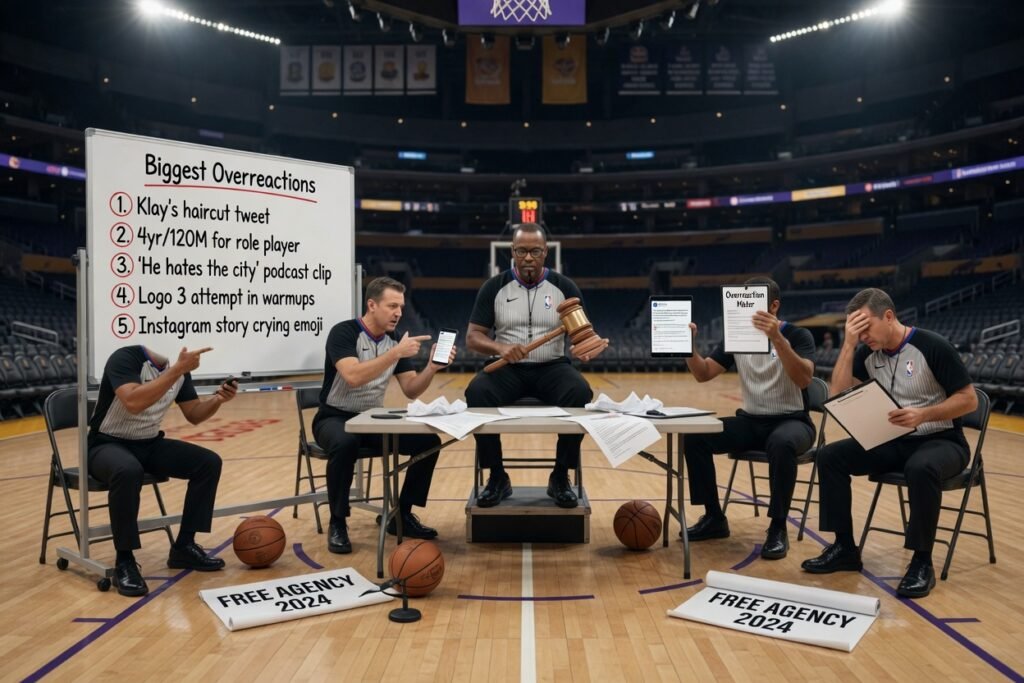
The NBA offseason isn’t just about trades anymore. It’s a full-contact sport played entirely on the timeline, a gladiatorial arena where takes are currency and nuance goes to die. Every single move, every whisper of a rumor, gets put under the microscope and then immediately blown up into a supernova of scorching hot takes. It’s glorious. It’s chaotic. And 99% of it is pure, unadulterated garbage.
I’m talking about the kind of L-energy takes that make me wanna smash my phone and go live in a cave. The instant “W/L” grades for trades that won’t show their true colors for three years. The “team is cooked” declarations before the ink is even dry on the contract. It’s a feeding frenzy for the chronically online, and frankly, I’m here to clean up the mess.
So I’ve been sifting through the digital debris, separating the actual analysis from the pure, uncut overreaction. And let me tell you, there’s a lot of the latter. We’re talking about moves involving Giannis, Kawhi, Brown, LaMelo, Ja – 37 All-Star appearances between them, and the internet somehow managed to turn every single one into a doomsday prophecy or a coronation.
Let’s get into it.
***
**OVERREACTION #1: “The Celtics traded Jaylen Brown because ownership is cheap.”**
I saw this one spammed everywhere the moment the news broke. “Billionaire owners don’t wanna pay the luxury tax!” “Boston is cooking their own title window to save a few bucks!”
Stop it. Just stop.
I know what you’re about to type in the comments. Your fingers are already twitching to call me a corporate shill, a Celtics glazer, whatever. Go ahead, @ me. But if you think a franchise that just won a title and has been in contention for a decade is suddenly gonna punt their future to avoid a few extra millions in tax, you’re missing the forest for the trees. This isn’t your grandfather’s NBA. This is the new CBA era, where the second apron isn’t just a suggestion, it’s a financial guillotine.
Brad Stevens, the guy actually making the moves, didn’t mince words about it last year: “It’s not as simple as ‘you have to keep everybody,’ because that’s not possible with this new CBA.” He wasn’t crying poor; he was stating a fact. The rules changed. Period. You can’t just stack All-Stars and pay through the nose forever. That 2024 championship model? It’s basically nerfed now.
Jaylen Brown is a fantastic player. Finals MVP. An absolute dawg on the court. But he’s also turning 30 in October, and his next contract extension would have been astronomical, pushing Boston so deep into the second apron that they’d lose all flexibility. No mid-level exception, no buying second-round picks, restricted trade options. They would have been LOCKED IN with Tatum and Brown on supermax deals, praying they both stayed healthy and played at an elite level into their mid-30s.
That’s not prudent planning; that’s financial suicide.
The Celtics didn’t get cheap; they got SMART. They pivoted. They got Paul George, a dude who still has juice, and draft picks to reload a younger, cost-controlled supporting cast. They’re still contenders, trust me. This was about sustainability, about being able to fill out a roster around Jayson Tatum for the next five years, not just the next two. Anyone screaming “cheap owners” needs to pick up a CBA rulebook, not just a pitchfork.
**VERDICT: PURE OVERREACTION. L-energy thinking.**
***
**OVERREACTION #2: “The Lakers got absolutely FLEECED in the Walker Kessler trade.”**
Oh, the outrage. “How could Pelinka give up a future DPOY for *that*?” “Kessler was the next Gobert!” “Lakers management is incompetent, they just gave away their future!”
Again, I hear the wailing and gnashing of teeth. I know the Lakers faithful are ready to riot at a moment’s notice. But let’s pump the brakes on the “fleeced” narrative like it’s a guaranteed lottery pick.
Walker Kessler is a good player. He’s a legitimate rim protector, an elite shot-blocker, and he understands his role. He’s got a high 2K rating for defense, no doubt. But I watched him. I watched him get played off the floor in certain matchups. I watched him struggle with offensive versatility. And while “rim protection” is a sexy stat, the modern NBA demands more. It demands switchability, it demands a threat on the perimeter, it demands offensive creation. Kessler provides one of those things at an elite level.
The Lakers’ trade was for a package that allowed them to retool *around* LeBron and AD for another run. They got assets that fit their immediate timeline and provided more offensive punch and defensive versatility. And let’s be real, the “next Gobert” comparisons are exactly the kind of hyperbolic nonsense I’m railing against. Rudy Gobert is a 3-time DPOY, a perennial All-NBA guy. Kessler showed flashes, but projecting that level of impact is insane.
This isn’t to say Kessler won’t be a great player. He absolutely could be. But the idea that the Lakers gave away some untouchable, generational talent is a complete overreaction. They made a move that they believed addressed their immediate needs and long-term flexibility, especially given the new CBA constraints we just talked about. Sometimes, a player is great, but not a perfect fit, and his value is higher to another team. That’s just the business.
When the Jazz acquired Kessler in the Donovan Mitchell trade, Danny Ainge said, “We felt really good about the draft capital and the players we were getting back.” He meant Kessler was a key piece, but also that the *overall package* was what they wanted. The Lakers didn’t get fleeced; they made a calculated risk to get different pieces.
**VERDICT: OVERREACTION. It was a calculated risk, not a robbery.**
***
**OVERREACTION #3: “The Hornets traded LaMelo Ball way too soon; they gave up on their franchise player!”**
The internet went absolutely nuclear when the Hornets moved LaMelo. “Another small market team selling off talent!” “They’re gonna regret this forever!” “LaMelo was the only reason to watch that team!”
Look, I’m a fan of LaMelo Ball. The dude has undeniable talent. He’s got that Luka-esque vision, that flair, that passing wizardry that makes you gasp. He sees plays before they happen. Steve Clifford, when he coached LaMelo, once remarked, “He sees the game three steps ahead.” I’ll give him that. He’s a highlight reel waiting to happen. But “franchise player”? That’s a strong word for a guy who’s missed more games than he’s played in recent seasons.
The cold, hard truth is that LaMelo has been perpetually injured. Ankle issues, wrist issues, you name it. Availability is the best ability, and LaMelo hasn’t had it. The Hornets have been mired in mediocrity, never sniffing the playoffs with him as the cornerstone. At some point, a franchise has to decide if they’re building around potential or proven durability and consistent winning.
Charlotte, bless their heart, needed a reset. They needed to stop chasing the ghost of a playoff spot and actually commit to a full rebuild. Moving LaMelo, while painful for the highlight reels, gave them serious draft capital and freed up a significant chunk of their cap sheet. It allows them to truly bottom out, acquire more top-tier talent, and build a cohesive roster from the ground up.
Was it a popular move? Hell no. Was it the right move for a franchise stuck in neutral? Absolutely. Sometimes, you gotta tear it all down to build something real. This wasn’t “giving up on a franchise player”; it was admitting that the current path wasn’t working and taking a brave, decisive swing for a *new* franchise player in the future.
**VERDICT: OVERREACTION. A necessary, albeit brutal, strategic move.**
***
**OVERREACTION #4: “Memphis should’ve gotten way more for Ja Morant, they let him go for pennies!”**
This one makes me laugh-cry. “He’s a superstar! You can’t trade a top-15 player for that package!” “The Grizzlies got cooked, they should’ve held out!”
I know Ja Morant is an electrifying talent. When he’s on the court, healthy and focused, he’s a blur. He’s got that “dawg in him” when it comes to attacking the rim, that fearless athleticism that few can match. But let’s be brutally honest: his off-court issues had become a cancerous distraction. Two major suspensions, repeated gun incidents, constant headlines for all the wrong reasons. It wasn’t just “mistakes”; it was a pattern.
Ja himself admitted it, repeatedly: “I’ve made mistakes. I’ve got to be better.” He even said to ESPN in May 2023, “I take full responsibility for my actions.” But responsibility without sustained change doesn’t move the needle for a franchise trying to build a winning culture.
You think teams were lining up to give up a king’s ransom for a guy who comes with that much baggage and a high probability of missing significant time? His trade value was absolutely nerfed by his own choices. Memphis wasn’t operating from a position of strength. They were trying to offload a supremely talented player who had become a liability, both on the court (due to availability) and off (due to reputation).
The package they got was probably the *best* they could get given the circumstances. It allowed them to move on, reset their locker room culture, and get assets that could contribute immediately or be flipped for future pieces. To say they should have “held out” is to ignore the reality of the situation. No sane GM was going to mortgage their future for a player who might be suspended again at any moment. This wasn’t a fire sale of a healthy, productive superstar; it was a necessary separation from a volatile situation.
**VERDICT: OVERREACTION. His value was self-inflicted, and Memphis did well to get what they did.**
***
**OVERREACTION #5: “The Celtics are no longer contenders after trading Jaylen Brown.”**
Oh, this is my favorite flavor of internet outrage. The instant declaration of doom. “Their window is closed!” “Tatum is gonna demand a trade next!” “Enjoy your one ring, Boston!”
This is the kind of take that gets 10,000 quote-tweets and makes Skip Bayless nod knowingly. And it’s absolutely, unequivocally, 100% WRONG.
Let’s recap: they traded Jaylen Brown, a fantastic player, for Paul George, *also* a fantastic player, plus draft capital. Paul George is an 8-time All-Star, 6-time All-NBA, and 4-time All-Defensive team selection. The dude is HIM. He’s still a two-way force. He can create his own shot, he can defend multiple positions, and he brings a veteran presence. His playoff resume is deep. He’s not some scrub they picked up off the street.
The Celtics still have Jayson Tatum, a top-5 player in the league. They still have Derrick White, an absolute ironman and a crucial two-way guard. They still have Jrue Holiday, one of the best point-of-attack defenders and clutch shot-makers in the game. They still have Kristaps Porzingis, when healthy, a legitimate stretch-five who can drop 20. And now they have Paul George, who fits seamlessly into their defensive schemes and gives them another elite scorer.
The idea that swapping Brown for George, while adding picks, somehow “closes” their window is pure, unadulterated madness. They didn’t lose talent; they reshuffled it. They improved their financial flexibility for the future. They brought in a different look, a different skill set, that might actually unlock *more* offensive versatility.
“But the chemistry!” I hear you whine. Newsflash: players are professionals. They adapt. They play basketball. This team is still loaded with top-tier talent, a championship coach, and a front office that just proved it’s willing to make tough, forward-thinking decisions. They are absolutely, unequivocally, still a top-tier contender in the Eastern Conference. And anyone who says otherwise needs to take a long, hard look at the roster sheet, not just their feelings.
**VERDICT: PURE, UNADULTERATED OVERREACTION. The Celtics are still cooking.**
***
So there you have it. Five of the biggest overreactions to the NBA offseason, debunked by yours truly. The internet is a cesspool of bad takes, and I’m just here trying to bring some sanity to the chaos. But I know what you’re thinking. You’re already drafting your angry replies.
Tell me I’m wrong. Tell me I’m a glazer. Tell me *your* favorite team got cooked, and I’m just too blind to see it. Go ahead. I dare you.