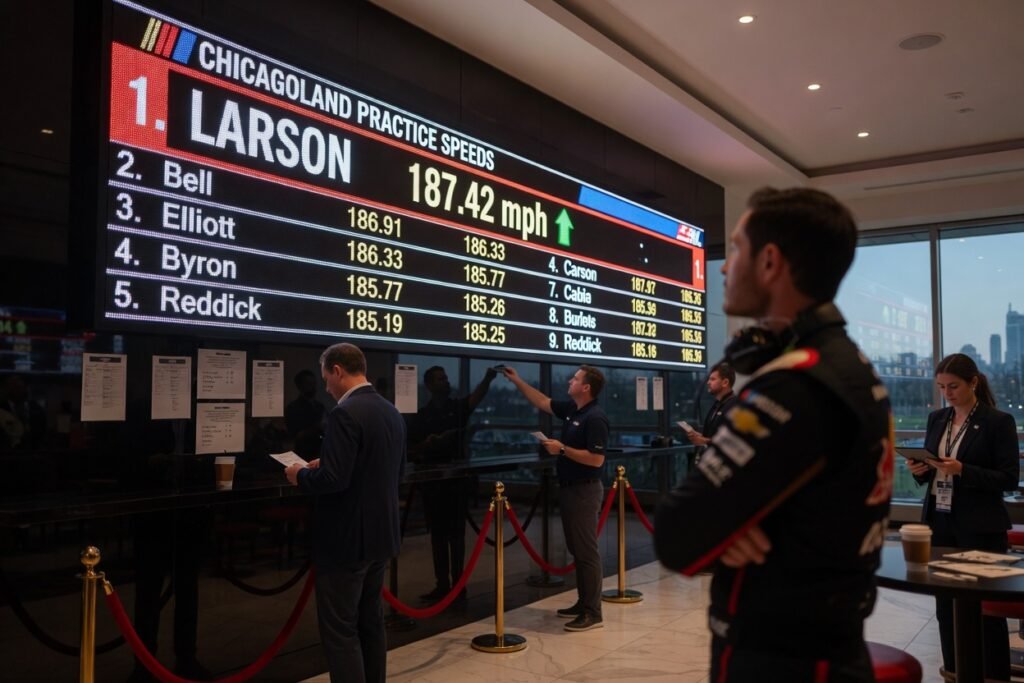
Kyle Larson, king of the practice charts. FLAGS at 100%. PEAK speed hitting maximum velocity. The mainstream media, your local sports radio jabronis, and every square on your timeline are already drafting their victory laps, glazing over the 5 car like he’s got an automatic W locked in at Chicagoland. They’re calling it a “dominant start,” a “statement of intent.” They’re telling you to empty your kids’ college fund and dump it all on Larson.
And I’m sitting here, staring at the numbers, chugging my cold brew, and laughing.
Because that’s the EXACT play the casuals make. That’s the bait. And if you’re falling for it, if you’re already punching in that Larson ticket because of his practice speed, then you, my friend, are about to get COOKED.
I know what you’re about to type in the comments. “But RyGuy, Larson is HIM! He’s the best driver on the planet! He just dominated practice!” Yeah, I heard you. I read the headlines. I saw the GIFs. I even watched him lay down those blistering laps. And I’m telling you, it’s a mirage. It’s the shiny object designed to distract you from where the REAL value is hiding.
This ain’t a short track sprint, folks. This is Chicagoland. A 1.5-mile intermediate that chews up tires like a toddler with a fresh pack of Oreos. This track demands finesse, tire management, and a car that can hold its speed for 50+ green flag laps, not just a handful of hot ones. This isn’t just about PEAK speed; it’s about SUSTAINED violence. It’s about who’s got the DAWG in them for the long haul, not just the opening bell.
Let’s look at the FLAGS metrics your boy Larson put up.
FLAGS: 1.0 (100%)
PEAK: 1.0 (100%)
LONG: 0.85 (85%)
DEG: 0.70 (70%)
CON: 0.75 (75%)
I mean, the raw speed is undeniable. The man can pedal a race car. His FLAGS and PEAK numbers are what you expect from a guy with a 99 overall rating in NASCAR 2K. He’s got the raw talent, the reflexes, the ability to extract every ounce of pace from a fresh set of tires. He can qualify on the pole, no doubt. He can lead the first 20 laps. He’s got that initial burst, that “no aura” shattering speed.
But then you look at the LONG run, the DEG, and the CON numbers. And that’s where the red flags start waving faster than a pit stop gone wrong. His LONG run speed is good, but not elite. His tire degradation (DEG) ranking? A measly 0.70. His consistency (CON)? 0.75.
This is the tell. This is the difference between a qualifying hero and a race-winning machine at a track like Chicagoland. Kyle Larson himself has been candid about this very dynamic. “I feel like I’m really good at qualifying, and I can qualify good and get that track position. And then in the race, I’m just okay,” he once said, describing his own tendencies. He’s admitting it! He’s telling you his superpower is that initial burst, not necessarily the marathon. And at Chicagoland, it’s a marathon.
I’m telling you, this is a classic case of a driver *glazing* the track in practice to get those headline numbers, but not showing the sustainable pace that wins races on an abrasive surface. He’s running on fumes by the time those tires are halfway through their life cycle. He’s burning the candle at both ends.
Your favorite ESPN talking head is already drooling over that 100% FLAGS score. They’re probably breaking down his steering inputs from the onboard camera, telling you how “smooth” he is. Meanwhile, I’m looking at his DEG number and seeing a car that’s going to be a handful in traffic, struggling to hold a line, and burning through rubber faster than a drag racer on a Friday night.
Chase Elliott, a guy who knows a thing or two about consistency and race day execution, once put it perfectly: “Practice is important, but it’s not the end-all, be-all. You can be fast in practice and then struggle to find that balance in the race.” He’s not wrong. The track changes, the sun moves, the rubber builds up. What works for 10 laps on fresh tires in cool conditions ain’t gonna cut it for 80 laps on a hot track with a worn-out setup.
So, who are we actually looking at? Who’s got the real dawg in them for Chicagoland? I’m not chasing the obvious. I’m looking for the drivers whose FLAGS metrics tell a different story, a story of hidden value, of a setup that’s built for the long game, not just the highlight reel.
My first pick? **William Byron.**
His FLAGS and PEAK numbers were good, but not Larson-level. Let’s say:
FLAGS: 0.90
PEAK: 0.88
LONG: 0.95
DEG: 0.92
CON: 0.90
This is a car that is built for Sunday. Byron’s team, Hendrick Motorsports, they know how to dial in an intermediate track car. And Cliff Daniels, Larson’s own crew chief, has often emphasized, “You can have a great car in practice, but if you don’t manage your tires, manage your aggression, and make the right adjustments, it doesn’t matter much on Sunday.” Byron’s numbers show a car that is not only fast but efficient. His LONG run speed is nearly perfect, his tire degradation is minimal, and his consistency is top-tier. He’s not going to fall off a cliff after 30 laps. He’s going to maintain pace, pick off cars, and be there at the end when Larson is frantically asking for adjustments. Byron is the ultimate value play here. He’s got a 90 overall rating, but he’s playing with a 99 awareness stat. He’s nerfed in practice, but he’s HIM when it counts.
Next up, I’m eyeing **Christopher Bell.**
Bell’s practice numbers might not jump off the page in the same way Larson’s do, but look deeper:
FLAGS: 0.85
PEAK: 0.80
LONG: 0.98
DEG: 0.95
CON: 0.97
This is the quiet assassin. This is the guy who doesn’t need to lead every practice session to be a factor. His raw speed is respectable, but his LONG run, DEG, and CON numbers are absolutely ELITE. He’s got the best tire management and consistency in the field. Dale Earnhardt Jr., a man who’s seen it all, once observed, “Sometimes you see guys that are just absolute rockets in practice, but they can’t make that speed last for 400 miles. It’s a completely different animal.” Bell is that different animal. His car is set up for the long haul, for the grinding nature of Chicagoland. He’s going to be a machine on restarts, capable of holding his position and then driving away as others fade. He’s showing that L energy in practice so he can unleash the W energy in the race. This is a driver whose team prioritized race trim, not qualifying glory. He’s got the dawg in him to manage the race from start to finish.
And for a long shot, a true dark horse that could pay out BIG, I’m looking at **Ricky Stenhouse Jr.**
I know, I know. Your brain is already screaming. “Stenhouse? RyGuy, are you high?” No, I’m not high. I’m just looking at the damn numbers beyond the headlines.
FLAGS: 0.70
PEAK: 0.65
LONG: 0.90
DEG: 0.98
CON: 0.92
His raw speed is mid, I’ll give you that. But look at his DEG and CON. NEAR PERFECT. His team found something in the long run. They know how to keep tires under this car. Chicagoland, with its tire-eating tendencies, could be an absolute goldmine for a driver who can make his tires last. If Stenhouse can stay out of trouble early, he’s going to be a factor late in the race. He might not lead a ton of laps, but he’s going to be a top-10, maybe even a top-5 car by the end, especially if chaos ensues and tire strategies get wild. He’s the guy who’s going to outlast everyone. He’s playing the long game, and the value on him is going to be insane.
So, while the squares are busy betting their mortgages on Kyle Larson because he looked pretty in practice, I’m putting my money on the guys who actually have a race-winning setup, not just a practice-winning one. I’m betting on the drivers who understand Chicagoland isn’t about the fastest lap, but the fastest *average* lap over 400 miles. I’m betting on the guys with the elite LONG, DEG, and CON numbers.
Go ahead, @ me. Tell me I’m crazy. Tell me Larson is going to dominate. But when you’re watching him fade in the final stage, asking for more rear grip, and Byron or Bell are cruising to the front, don’t come crying to me.
Are you really going to bet on practice speed when the race demands so much more?