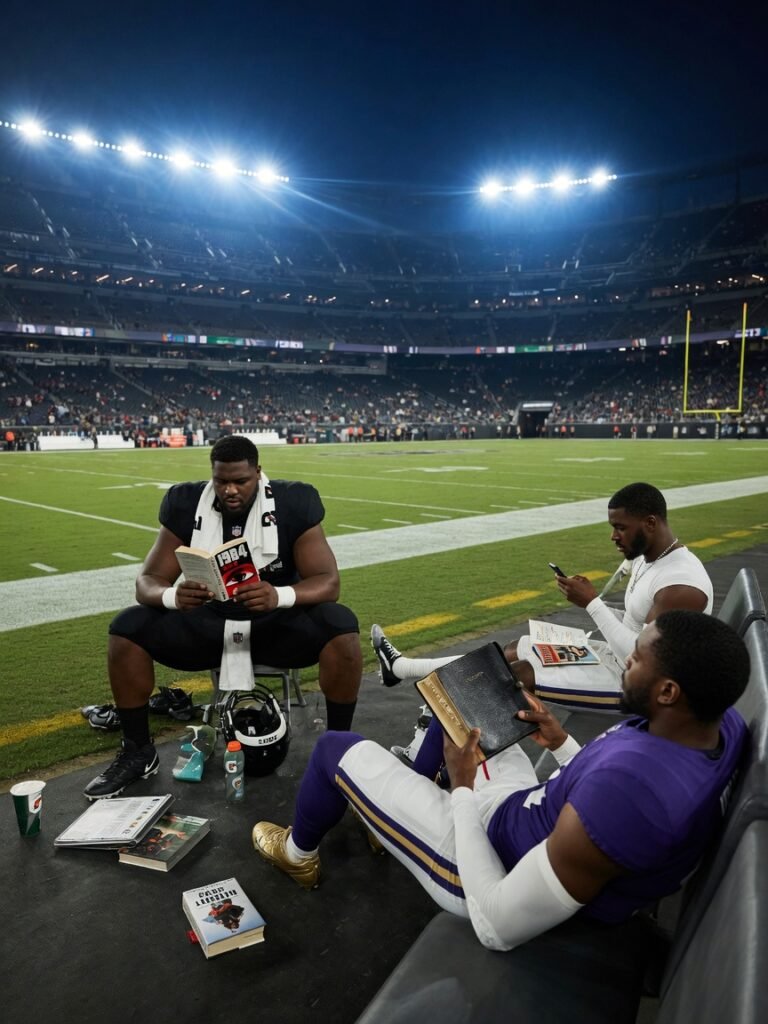
I’m looking at these NFL players, sprawled out on some beach somewhere, or maybe just chilling in their palatial offseason estates, and they’re not just scrolling TikTok or grinding Warzone, are they? No, some of them, the ones who truly get it, they’ve got their heads buried in books. And I gotta tell you, my chest actually tightened when I saw what some of these guys are devouring. Because it’s not just about passing the time; it’s a goddamn roadmap. It’s a peek into the soul of a locker room, a front office, and, frankly, the very fabric of what makes a championship contender.
Take Leonard Williams, for crying out loud. Last offseason, the dude was wrestling with *War and Peace*. Tolstoy. All 1,000-plus pages of Russian existential dread and historical epic. I mean, who *does* that? That’s a commitment, a true intellectual grind, the kind of deep dive that makes you think this guy sees the game in 4D. He’s looking at the long arcs, the grand strategies, the way individual choices ripple through history. That’s a *different* kind of player, a player who understands the game isn’t just about the next snap, but the next dynasty. It’s like watching Al Pacino in *Godfather II*, meticulously planning every move years in advance, understanding the weight of legacy before he even lifts a finger.
But this summer? This summer, Williams, along with his fellow Seahawks defensive line vets like Jarran Reed, DeMarcus Lawrence, and Uchenna Nwosu, they’re reading “Chop Wood Carry Water.” Given to them by their new defensive coordinator, Aden Durde. And when I read that, I swear, a shiver went down my spine. Because this isn’t just a book; it’s a message. It’s a parable about a samurai archer, about mastering the process, not fixating on end goals. It’s all about the “chop wood, carry water” daily grind.
Williams, bless his honest heart, even laid it out for us: “It’s kind of a representation that he wanted to talk to me and some of the older guys on the team, that even though we’ve had great careers, we’ve got respect around the league and stuff like that, how do we really want to keep finishing our legacy?”
See? See what I mean? This isn’t some light summer read. This is a *directive*. It’s a subtle, brilliant piece of psychological warfare from a new coach to a group of accomplished, aging veterans who just won a Super Bowl. They’re coming off the mountain, right? They’ve reached the summit. The natural human inclination is to maybe, just maybe, let off the gas a millimeter. Coast a little. Enjoy the view. But Durde, he’s not having it. He’s handing them a book that says, “No, no, no. The work never ends. The process is the reward.”
And that story in the book, the one about the master homebuilder who reluctantly agrees to one last build, cuts corners because his heart isn’t in it, only to find out it was his *own house*? Man, that’s a gut punch. That’s a “Goodfellas” moment where you realize you’ve been played, but in a good way. It’s a stark reminder: you are always, *always* building your own legacy. Every rep, every practice, every snap, even after a Super Bowl, is another brick in that house. If you slack off, if you cut corners, you’re just screwing yourself. It’s the ultimate “you reap what you sow” narrative, delivered under the guise of motivational fable. I’m telling you, Durde is playing chess, not checkers. This isn’t just coaching; this is a masterclass in team psychology. It’s like Stringer Bell in “The Wire” trying to get his crew to read “The Wealth of Nations”—it’s about changing their mindset from the street corner to the boardroom, but in this case, from Super Bowl hangover to Super Bowl repeat.
Then you got the other end of the spectrum, the fresh meat. Josh Conerly Jr., the Commanders’ rookie offensive tackle, got “Atomic Habits” from GM Adam Peters after being drafted. James Clear’s book. Now, that’s a different kind of message, isn’t it? It’s not about legacy for a rookie; it’s about *foundation*. It’s about those tiny, incremental changes that compound over time. It’s the “how do you eat an elephant?” answer: one bite at a time. For a rookie, especially a first-rounder, the pressure is immense. Every single thing they do is scrutinized. Peters isn’t telling him to reinvent the wheel; he’s telling him to build a flawless, repeatable process. To make the 1% improvements every day. This is the NFL machine at its most efficient, stamping out bad habits before they even form, molding raw talent into consistent performance. It’s less “Goodfellas” and more “Heat,” the meticulous planning of a heist, every detail accounted for, every step a micro-habit leading to the ultimate score.
But not everyone is a process guy, or a legacy guy, or a building-your-own-house guy. Some players are in a different fight altogether. New York Giants outside linebacker Kayvon Thibodeaux, he’s an interesting cat. He says he focuses his offseason on “business and philanthropy,” doesn’t “really have time to read” then. And I get it, the dude’s got a brand, a future. But then he drops this: “Then during the season all of that slows down, and I can read books to kind of help you mentally get through that long stretch.”
Hold on a damn minute. Most guys are trying to *escape* the season grind, to compartmentalize. Thibodeaux is leaning *into* reading *during* the season for mental fortitude. That’s a revelation. That’s an admission that the regular season is an absolute war, a mental and physical gauntlet so brutal that you need external input, a mental escape hatch, just to survive it. He’s not reading for self-improvement; he’s reading for *survival*. That’s a level of honesty that makes me respect the guy even more, because he’s admitting the beast is real, and he needs tools to fight it. It’s like Frank Serpico, alone against the system, finding solace in something outside the corruption, a way to keep his head screwed on straight when everything else is trying to twist it.
And then you have the spiritual warriors. Carson Wentz, the Vikings quarterback, who’s been going through the Bible, journaling, “still in the Old Testament, in the book of Psalms, moving slow with the journaling.” Dawson Knox, the Bills tight end, working his way through the New Testament, saying it’s the “most important 30, 45 minutes I can spend during my day.” Kaden Elliss, Saints linebacker, also reading the Bible daily, plus C.S. Lewis’s “Miracles.”
Now, this is a different dimension entirely. This isn’t about improving your technique or building habits for the field. This is about the *why*. It’s about finding a deeper purpose, a moral compass, an internal anchor in a league that can chew you up and spit you out faster than you can say “ACL tear.” When Wentz says he’s trying to figure out “what’s God saying? What’s the storyline in each chapter, but then also what’s the heartbeat of God and what am I learning? How do I apply this?”, that’s a profound search. That’s a guy trying to reconcile the brutal, gladiatorial nature of professional football with a higher calling. Does it make him a better QB? Maybe not directly, but it sure as hell makes him a more resilient human being. It’s the kind of inner peace that, when the pocket collapses and the season is on the line, might just give him that extra fraction of a second of calm, that unshakeable belief that the outcome, whatever it is, is part of a larger plan. It’s the ultimate long game. It’s like the quiet strength of Gandalf in “Lord of the Rings,” drawing on something ancient and powerful to face down the darkness.
Martin Emerson Jr., the Saints cornerback, is another fascinating case. A torn Achilles cost him the entire 2025 season. Bed rest, he says, got him back into reading, mostly nonfiction. “A lot of time to read and to learn.” That’s the Phoenix rising from the ashes, isn’t it? The injury, the setback, becoming an opportunity for intellectual growth. It’s the quiet moments of reflection, the forced pause, that sometimes yield the most profound insights. It’s not just rehab for the body; it’s rehab for the mind, fueling the spirit for the comeback. That’s the kind of narrative that makes you believe in redemption arcs, that makes you understand that sometimes the biggest losses are just setups for the biggest gains.
I’ve been watching this league for decades, and I’ve seen players come and go. I’ve seen guys with all the talent in the world flame out because their head wasn’t right, and I’ve seen guys with less physical gifts grind their way to greatness because their mental game was impeccable. What these summer reading lists tell me, what they *scream* at me, is that the mental game is evolving. It’s not just about film study and playbook memorization anymore. It’s about understanding your place in the narrative, whether you’re a grizzled veteran trying to cement a legacy, a wide-eyed rookie building a foundation, a warrior needing mental sustenance during the grind, or a spiritual seeker looking for meaning beyond the gridiron.
This isn’t just fluff. This isn’t just a quirky offseason story. This is a window into the souls of these athletes, a testament to the intellectual and spiritual battles they’re fighting off the field, battles that absolutely, positively dictate what happens *on* the field. And I, for one, am absolutely here for it. Give me a player who’s wrestling with Tolstoy, or finding solace in Psalms, or meticulously building atomic habits, over one who thinks the game starts and ends on Sundays. Because the ones who understand the deeper currents, the ones who are reading the playbook of life, those are the ones who are going to be holding the Lombardi Trophy. My gut tells me this isn’t just a trend; it’s the new standard for true greatness.