I’m looking at these NHL free agency grades for 2026, laid out by ESPN, and I swear to God, I feel like I’m watching a replay of *Goodfellas* where the guys are celebrating a score, completely oblivious to the fact that Jimmy Two Times is about to get clipped and the whole operation is going to come crashing down. A “B” for John Carlson to Tampa? An “A-” for Frederik Andersen to Edmonton? Are we watching the same league? Because what I see here isn’t savvy management; it’s desperation dressed up in a cheap suit, and I can practically hear the “boom” of the explosion waiting to happen.
Let’s start with John Carlson, because that’s where the real cinematic tragedy begins. Two years, $8.5 million for a 36-year-old defenseman in Tampa Bay. ESPN slaps a “B” on it. A “B”?! My chest actually tightened when I read that. It’s not a “B,” it’s a desperate plea, a Hail Mary pass from a team that knows its window is slamming shut like a vault door. They call it “cheeky” that Tampa matched Darren Raddysh’s AAV. I call it delusional. You lost a guy, Raddysh, who just had a career year with 70 points in 73 games – a guy who is *just entering his prime* at 30 years old – because you weren’t willing to give him the term. So you sign-and-trade him to Toronto for eight years, $8.5 million AAV, and then turn around and pay an *aging* 36-year-old the *exact same money* for two years? That’s not cheeky, that’s a direct quote from the playbook of “how to postpone the inevitable while making your future even bleaker.”
I mean, I get it. The Lightning are in “win-now” mode. That phrase, “win-now mode,” it’s like the siren song that lures GMs onto the rocks. It’s what Vinnie in *Casino* says when he’s trying to convince Ace to let him skim more from the joint: “We gotta make hay while the sun shines, Ace!” But the sun, my friends, is setting over Tampa Bay. Hard. They already have Victor Hedman at 35 and Ryan McDonagh at 37 on the blue line. Now you’re adding Carlson at 36? That’s not a defensive corps; it’s a retirement home power play unit. I love those guys, I do, but Father Time is undefeated, and he’s coming for them with a steel chair.
And let’s be real, the context here is everything. Tampa *tried* to land Zach Werenski, a legitimate stud, and he ghosted them to stay in Columbus. That’s like asking the hottest girl to prom, getting shot down, and then settling for the one who’s already been to five proms and has two kids. Carlson is the “next best offensive defenseman” on the market, sure, but that’s like saying the burnt toast is the “next best breakfast” after the omelet station closes. It’s a consolation prize, a stopgap, a white flag disguised as a bold move. Capitals GM Brian MacLellan, when talking about Carlson’s value, once said, “He’s a big part of what we do. He’s a veteran guy. He knows our system. He’s a big part of our leadership group.” And yes, Carlson *was* that for the Caps, and he won a Cup. But that was 2018. It’s 2026 now. The mileage adds up. The quick, decisive passes slow down. The ability to pivot quickly to stop an odd-man rush becomes a half-second too late. And a half-second in the NHL is a goal. It’s a series loss. It’s a Stanley Cup slipping through your fingers.
Now, let’s talk about the *real* headline from that exchange: Darren Raddysh to Toronto for eight years, $8.5 million AAV. This is the kind of deal that makes me want to pull my hair out, then immediately re-evaluate my life choices. An eight-year term for a guy who had *one* breakout season? One! It’s like watching *The Wire* and thinking Marlo Stanfield is going to clean up his act and go legit after one good quarter of business. He’s a 30-year-old defenseman with a career high of 70 points *this past season*. Before that, his career high was 20 points. Twenty! I’m not saying the guy isn’t good, but 8 years at $8.5 million? That’s elite-level money for elite-level production, sustained over years, not a flash in the pan.
This, my friends, is pure Toronto Maple Leafs panic. It’s the constant, suffocating pressure of a market that hasn’t seen a Cup since black and white TV. I can practically hear the whispers from the front office, “We need a right-shot defenseman! We need term!” Brad Treliving, bless his heart, is trying to make his mark, but this feels less like a calculated chess move and more like a desperate poker player pushing all his chips in on a pair of deuces. This contract has “future compliance buyout” written all over it. It’s an albatross waiting to happen. Toronto media, and by extension the entire fan base, lives and breathes this team. As one former Leaf, who probably wished to remain anonymous to avoid the current scrutiny, once quipped, “In Toronto, you’re always under the microscope. Every move is magnified.” Magnified, indeed. This move isn’t just magnified; it’s under an electron microscope, and I’m seeing all the potential flaws already. Give it three years, and that contract is going to look like a mob debt that’s impossible to pay back.
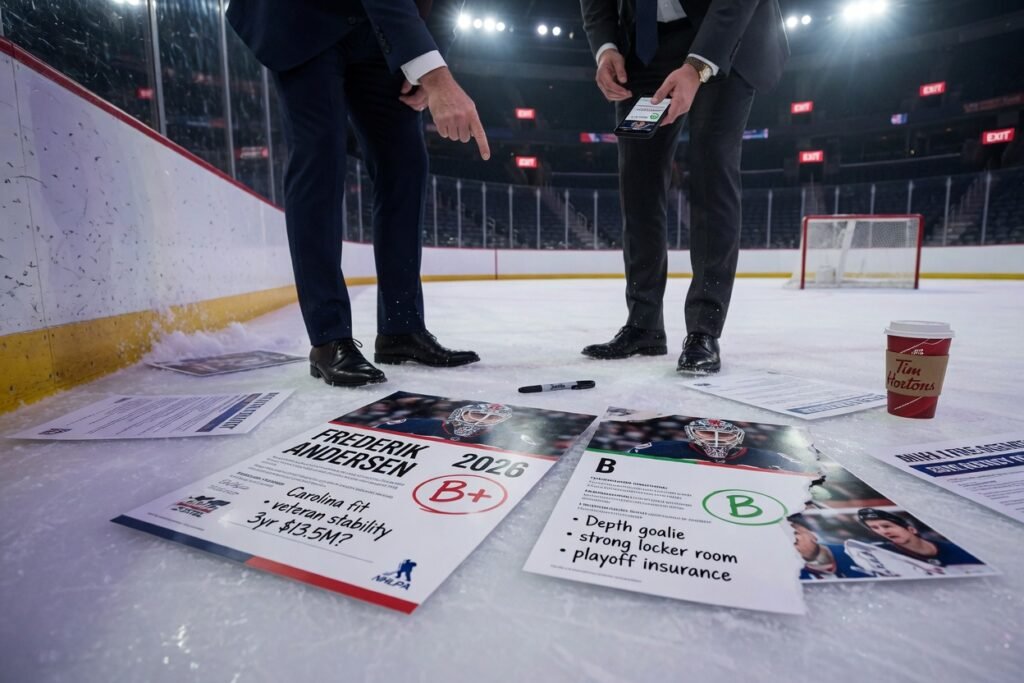
And then there’s Frederik Andersen to Edmonton. ESPN gives it an “A-.” An “A-!” I’m just going to say it: this grade is a total joke. A 36-year-old, injury-prone goalie, signing a one-year, $2.8 million deal with performance bonuses, to join a “logjam” that already includes Tristan Jarry (two more years at $5.375 million AAV) and Devon Levi (a young, promising trade acquisition)? My stomach actually lurched when I read this. This isn’t an “A-“; this is a classic Oilers move, the kind that makes you wonder if Ken Holland is just throwing darts at a board with pictures of veteran goalies.
The Oilers’ goaltending history is a horror show, a B-movie slasher flick where the masked killer is always an unexpected soft goal. They’ve tried everything – Mike Smith, Jack Campbell, Jarry, and now Andersen. It’s like Walter White constantly trying to perfect his meth recipe in *Breaking Bad*, only to realize he keeps getting tainted product. They’re desperate, and desperation makes you do stupid things. Yes, Andersen was “mostly excellent” in Carolina, guiding them to a Cup Final, until – and this is the key part – *an injury sidelined him and paved the way for Brandon Bussi to take over*. That’s the entire story of Frederik Andersen’s career: flashes of brilliance, followed by the inevitable trip to the IR.
The idea that Mike Babcock is going to “pit the netminders against one another in training camp” isn’t a strategy; it’s a recipe for a goalie controversy. Babcock, in his own inimitable style, has often said, “I believe competition brings out the best in people.” And sometimes it does. But sometimes, especially with three goalies all vying for the starter’s job, it creates a toxic locker room, undermines confidence, and leaves your team with no clear answer when the games actually matter. You think McDavid and Draisaitl, whose Cup window is closing faster than a bank vault at closing time, want to spend October wondering who their starting goalie is? They want stability. They want a proven, healthy, reliable presence. Andersen, for all his talent when healthy, is none of those things reliably. This is a low-cost, high-reward gamble, I’ll grant you that, but the Oilers have burned through so many of these gambles, I’m surprised they haven’t run out of chips. It’s like watching a degenerate gambler at the casino; they might hit big once, but eventually, the house always wins, and the Oilers are the house that always seems to lose when it comes to goalies.
So, where do I stand on all this? I stand here, bewildered, shaking my head at the collective delusion. Tampa Bay is trying to outrun time, building an aging defensive corps that will eventually crumble. Toronto is throwing generational money at a one-year wonder, guaranteeing themselves cap hell and buyer’s remorse. And Edmonton? Edmonton is doing what Edmonton always does: hoping against hope that *this* veteran goalie, *this* time, will be the answer. These aren’t “B” or “A-” grades. These are grades of desperation, of short-sightedness, of GMs who are either too scared to rebuild or too stubborn to admit their windows are closing. I’ve seen this movie before, and it rarely ends with a parade. More often, it ends with a quiet, lonely montage of what could have been, set to the tune of a soaring cap hit and a first-round exit.