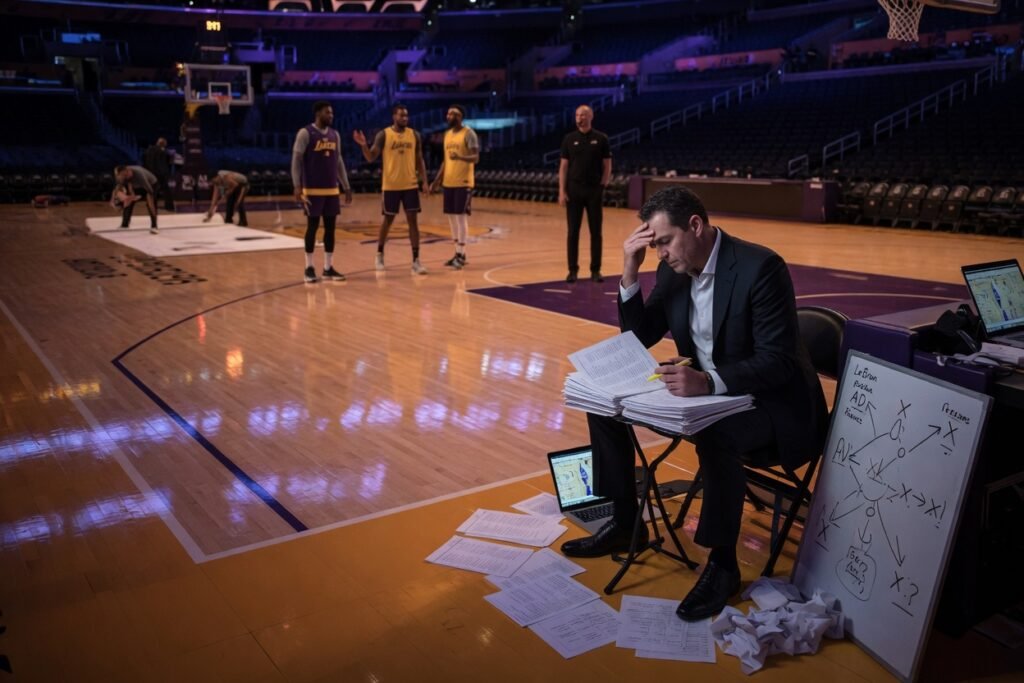
America, let me tell you something about the Los Angeles Lakers. What I witnessed this week was not a roster overhaul; it was an organizational admission of guilt. It was a desperate, chaotic scramble, a fire sale executed with all the grace of a runaway freight train, leaving behind a trail of smoke and a profound question mark hanging over one of the most storied franchises in all of professional sports. For years, I have stood here, I have screamed, I have pleaded with the basketball gods to open the eyes of those in power, to see the writing on the wall. And now? Now, the wall has crumbled, and the truth, in all its brutal honesty, is laid bare for the entire world to see.
LeBron James, one of the greatest players to ever grace a basketball court, is GONE. And for anyone who claims this was some kind of mutual, amicable parting, I say to you: you simply were not watching. You were not paying attention to the subtle tremors, the increasing frustrations, the slow, agonizing erosion of trust that defined the latter half of his tenure in purple and gold. A source familiar with his thinking told ESPN that James felt “it was time to move on,” desiring to extend his career playing “meaningful, competitive basketball.” Meaningful, competitive basketball, America! Do you hear what that implies? It implies that what he was playing in Los Angeles, particularly over the last few seasons, was anything but. And *that* is the core indictment of this Lakers organization.
I watched this man, LeBron James, drag teams to the NBA Finals for over a decade. I saw him arrive in Los Angeles with the weight of an entire city, an entire *brand*, on his shoulders. He delivered a championship, a bubble championship, yes, but a championship nonetheless, solidifying his place in Lakers lore. And what did the organization do in return? They squandered precious years. They made ill-advised moves. They traded for Russell Westbrook, an unmitigated disaster that I, Ryan Craig, declared an impending catastrophe the moment the ink dried on the deal. I said it then, I’m saying it now: that trade crippled this franchise, financially and strategically, and it created a disconnect between LeBron and the front office that, as ESPN reported, “never fully recovered.” How can you expect a generational talent, a man who has dedicated his life to winning, to stay when he feels his precious, finite championship window is being slammed shut by the very people who should be widening it?
And then came the immediate aftermath of his departure. Silence. Crickets. While the rest of the league went on a spending spree, the Lakers, with $52 million in cap space, sat on their hands, clinging to Luka Doncic and Austin Reaves as if they were the only two players on Earth. For hours, I sat here, watching the ticker, seeing legitimate difference-makers sign elsewhere, and I thought to myself: Is this negligence? Is this incompetence? Or is this a front office so utterly devoid of a coherent strategy that it simply freezes when faced with actual decisions?
But then, America, the dam broke. And what a break it was. In the span of 35 minutes, they agreed to a sign-and-trade for Walker Kessler, then signed Sandro Mamukelashvili, Quentin Grimes, and Collin Sexton. And suddenly, the Lakers had a *plan*. Or, at least, they had *a* roster. A decidedly younger roster, yes, but also, as the source pointed out, “totally unproven.”
Let’s talk about Walker Kessler. A legitimate, 7-foot-2 center, a rim protector, a lob threat. Exactly what LeBron James and Anthony Davis had been pleading for, publicly and privately, for YEARS. Anthony Davis, a man whose career has been punctuated by injuries, a man who desperately needed a true big man beside him to alleviate the physical toll, begged for this. And the Lakers, with all their resources, all their perceived wisdom, refused to deliver. Why? Because Utah’s asking price was “too steep.” That’s what ESPN reported. Too steep *then*, when he was on a cost-controlled rookie contract, making under $3 million. But now? Now, the Lakers swooped in when Kessler was a restricted free agent, seeking a massive raise, and Utah had more motivation to move him, having just drafted Darryn Peterson. They waited until he was expensive. They waited until it became a *necessity*, driven by the new face of the franchise.
Because make no mistake, this wasn’t some stroke of genius foresight by the Lakers’ front office. This was a direct, undeniable response to Luka Doncic. ESPN reported that Doncic gave the front office a “clear directive this offseason: to find him an ‘A-list’ center.” A *directive*. Not a suggestion. Not a preference. A directive. Luka Doncic, a man who arrived in Los Angeles with the weight of expectation, but now carries the explicit power to shape this franchise, *demanded* it. And only then, America, did the Lakers act. I have watched this league for decades. I have seen players come and go. But I have rarely, if ever, seen a front office so blatantly reactive, so utterly incapable of anticipating needs until their star player has to hand them a shopping list. What does that say about the leadership of Jeanie Buss? What does that say about Rob Pelinka? It says they are operating from a position of weakness, not strength. It says they are being led by their players, rather than leading them.
And what about the rest of this new-look roster? Sandro Mamukelashvili. Quentin Grimes. Collin Sexton. These are good, young players, I will give them that. They bring energy. They bring a certain level of untapped potential. But let me be unequivocally clear: these are not the pieces you acquire to contend for a championship *right now*. This is not a pivot to immediate contention around Luka Doncic, who is squarely in the prime of his career, a player who deserves to be surrounded by proven talent, not projects. This is a gamble. A massive, high-stakes gamble on unproven commodities, hoping that sheer youth and athleticism can somehow compensate for a lack of veteran experience and established chemistry.
Marcus Smart went to Houston. Luke Kennard went to Phoenix. These are the kinds of proven, two-way players, the veteran role players who understand what it takes to win, who were available, who would have provided stability and depth. And the Lakers let them walk, opting instead for a collection of players who, while individually talented, have yet to demonstrate they can contribute to a winning culture at the highest level.
So, what is the legacy impact of all this? For LeBron James, it’s a final, resounding statement that he will not waste his precious remaining years in a situation he deems untenable. He is prioritizing his own basketball happiness, his own quest for meaningful competition, above the allure of Hollywood. And who can blame him? For Luka Doncic, this is his moment. His team. His directive. The weight of this entire franchise, the expectations of a global fanbase, now rest solely on his shoulders. He *has* the center he wanted. He *has* a younger, more athletic supporting cast. But does he have a championship contender? I am not convinced, America. Not by a long shot.
The Lakers, this once-proud organization, find themselves in an identity crisis. They are no longer the undisputed destination for every superstar. They are no longer the gold standard of front-office savvy. They are a franchise scrambling, reacting, and hoping that a collection of young, unproven talent, guided by the immense gifts of Luka Doncic, can somehow, miraculously, stumble into sustained success. I have seen this movie before, America. I have seen franchises sacrifice their present for a nebulous future, only to find themselves stuck in mediocrity, wasting the prime years of their best players.
This is not a rebuild. This is a desperate attempt to reset, to find a new path after years of veering wildly off course. The price they paid? The departure of a legend. The erosion of trust. And the gamble of an entire generation on a roster that is, by all accounts, a giant, flashing, neon sign that screams: “WE DON’T KNOW WHAT WE’RE DOING!” And for that, America, I am telling you, the Lakers deserve every single ounce of scrutiny that is coming their way. Their moves this week were not just about basketball; they were about a profound failure of organizational vision. And the consequences? They will reverberate for years to come.