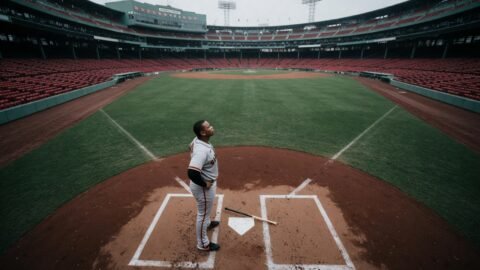
The Chicago White Sox are on the clock for 2026, and I’m already seeing the smoke signals from the war room. Roch Cholowsky, Vahn Lackey, Grady Emerson – names getting floated around like they’re artisanal craft beers at a Brooklyn brewery. But let’s be real, this isn’t about *who* the White Sox pick. This is about whether they have the *dawg in them* to actually pick the right kind of player, or if they’re gonna fold like a cheap lawn chair under the pressure of conventional wisdom.
Because I know what you’re about to type in the comments. I know your brain is already pre-loaded with the “pitchers are risky” and “high schoolers take too long” talking points. I can hear the ESPN talking heads already drafting their bland, statistically-speaking analyses. But I’m here to tell you, that entire framework is cooked. It’s L energy. It’s why so many GMs end up with rosters full of guys who are just… *fine*.
This isn’t just about the 2026 draft; it’s about every draft. It’s about the systemic failure to truly swing for the fences. The primary source gives us a little taste, right? Skenes vs. Crews, Holliday vs. Jones, Lewis vs. Greene. These aren’t just debates; these are battlegrounds where GM careers are forged or turned into ash. And too often, they choose the path of least resistance, the “safe” pick, the guy who won’t get them fired *immediately*.
But let me drop a truth bomb on you: The “safe” pick is often the *most dangerous* pick of all.
Think about it. We’re talking about the MLB draft, the single most critical pipeline for sustainable success. As the legendary Billy Beane himself said, “The amateur draft is the most important element of the game for any franchise. There’s no way to build a sustainable winner without excelling in the draft.” He’s not wrong. This isn’t just about adding a piece; it’s about defining the next decade of your franchise. So why, THEN, are GMs so allergic to taking the *real* swing?
Let’s rewind to 2023: Paul Skenes vs. Dylan Crews. LSU teammates, both absolute monsters. Crews was the “sure thing” bat, a college hitter with a 2K rating that was off the charts. Skenes was the flamethrower, undeniable stuff, but, you know, a *pitcher*. And a college pitcher, at that, which somehow gets viewed as less risky than a high schooler, but still, *a pitcher*. Baseball America had Crews first. FanGraphs had him first. ESPN had him second, but still above Skenes. The Pirates took Skenes.
And what happened? Skenes is already a Cy Young winner in 2025 (in the timeline provided by the source, which I’m embracing fully because it proves my point). Crews is struggling to hit in the majors. I know, I know, “small sample size,” “he’s still young,” blah, blah, blah. But the point stands: the “sure thing” college bat, the guy with the high floor, *still* has a floor that can fall through the damn earth. There’s no such thing as a “sure thing” in this game. Ted Williams, the greatest hitter who ever lived, once said, “Hitting a baseball is the hardest thing to do in sports.” And if it was hard for him, imagine what it’s like for a 22-year-old trying to figure out MLB pitching. Crews, the dude who looked like a cheat code in college, is learning that lesson the hard way.
My take? The Pirates had the *cojones* to take the guy with the highest ceiling, the most dominant stuff, even with the “pitcher risk” narrative hanging over him. They chose violence. They chose a generational arm. And it paid off.
Then you look at 2022: Jackson Holliday vs. Druw Jones. Two high schoolers, sons of legends. Jones, the five-tool center fielder, looked like his dad, Andruw Jones, was just built different. Holliday, the infielder, broke high school hitting records. Most boards had Jones first. Baltimore took Holliday.
And now? Holliday is still figuring it out, strikeout rates higher than expected, defense a bit shaky. Jones is in Double-A, power not developing. Again, no “sure thing.” The Orioles, through GM Mike Elias, said on draft day, “We think he has a chance to be a star shortstop in the big leagues.” That’s the dream, right? But the reality is a grind. You take the highest upside and pray. The “safe” high school pick, the one who was supposed to be the *bat*, is still just a prospect. And the “safer” high school pick, the one who was universally ranked higher, is even further behind.
This is where the GMs get cooked. They get paralyzed by the perceived safety of a known quantity, or they get bamboozled by the hype of a high-floor prospect. They don’t want to be the guy who passes on a Bryce Harper or a Stephen Strasburg. But they also don’t want to be the guy who takes a huge swing on a high school kid and watches him flame out. It’s a no-win scenario for the weak-minded.
Let’s talk about the *real* debate that the White Sox are facing, the one implied in the primary source: a high school catcher like Vahn Lackey over, let’s say, a college shortstop like Roch Cholowsky, or even a more polished college arm. That’s the kind of decision that separates the legends from the “just a guy” GMs.
I know what the scouts say. I know what the analysts whisper. “High school catchers never work out.” “The position is too demanding.” “Takes too long to develop.” They’ll tell you about the physical toll, the mental grind, the rarity of a truly elite offensive catcher. And they’ll trot out the usual suspects: “What about Joe Mauer?” or “Adley Rutschman was a college guy!”
But that’s exactly the kind of L energy that keeps teams mired in mediocrity. When everyone is saying “don’t do that,” that’s precisely when you should be doing it.
Look at the 2017 draft: Royce Lewis vs. Hunter Greene. Greene, a high school righty hitting 102 mph. Unheard of. A unicorn. Every board had him #1. But the Twins, oh the Twins. They went for Lewis, a high school shortstop. Why? “High school right-handers are risky.” “Position player is safer.” Blah, blah, blah. Lewis has been plagued by injuries, never truly reaching that ceiling. Greene, for all his struggles with command and health, is still touching triple digits, still has that *aura* of a top-tier arm.
The Twins played it “safe” by taking the position player over the high-octane arm, and it hasn’t really paid off in the way they hoped. They signed Lewis for less money, too, which always feels like a tell. It feels like they were trying to outsmart the room, trying to be too clever by half, instead of just taking the dude who could throw a baseball through a brick wall.
And what about the vaunted 2015 debate, Swanson vs. Bregman? Both college shortstops, both “safe” picks. Dansby Swanson went #1 to Arizona (traded to Atlanta later), Alex Bregman #2 to Houston. Both have had solid, respectable careers. But neither became the generational, face-of-the-franchise superstar that a #1 pick *should* be. They were high-floor, high-probability picks. And they delivered on that probability. But where’s the *boom*? Where’s the guy who completely changes the trajectory of a franchise?
This is my point. The difference between a high-floor college bat and a high-floor high school bat is often negligible in terms of *upside*. They both can bust, or they both can be solid. But the difference between a high-floor guy and a *true high-ceiling* guy – the kind of guy who makes you gasp when you see him play – that’s galactic.
GMs and their scouting departments spend countless hours looking for “the whole package.” J.J. Picollo, the Royals GM, put it perfectly when discussing their draft philosophy: “What you look for is the whole package. It’s not just the tools, but it’s the makeup, it’s the character, it’s the work ethic.” And I agree, those things matter. But what they *really* mean is they’re looking for a reason *not* to take the truly risky, truly high-upside guy. They’re looking for a flaw, a crack in the armor, so they can justify taking the safer, less-criticized path.
They don’t want to be the guy who drafted a high school catcher who never makes it past Double-A. They’d rather draft a college shortstop who has a respectable, 10-year career as an average regular. Why? Because the latter doesn’t get you fired. The former does. It’s about self-preservation, not about maximizing the franchise’s potential. It’s an absolute clown show of risk aversion.
But I’m telling you, if Vahn Lackey, that Georgia Tech catcher, or any high school catcher in this class, has that *it factor*, that raw power, that cannon arm, that *aura* that just screams future Hall of Famer, the White Sox need to take him. And if it’s not a catcher, if it’s a high school phenom who throws 105 mph and hits nukes, you take that guy too. You don’t overthink it. You don’t try to outsmart the room with some “value pick” that everyone else already saw.
You take the guy with the highest ceiling, the most dominant raw tools, the one who makes scouts whisper about “generational talent,” even if it’s a high school righty or a high school catcher. You take the guy who makes you choose violence. You take the guy with the most *dawg in him*. Every pick is a gamble. So why not bet big on the biggest payoff?
Are GMs truly afraid of picking a bust, or are they just afraid of being *wrong* in a way that’s easily traceable back to them?