I have spent the better part of two decades tracking what real program-building looks like in college baseball, and the shift I am seeing at USC right now under Jason Stankiewicz feels different from the usual hype cycle. The Trojans are not just collecting talent; they are installing a system that matches the historical standard they once owned outright. Twelve national championships sit in the record books, most of them from eras when the program operated like a professional franchise. The drop-off after that was steep and painful, but the early returns this spring suggest the rebuild has crossed from hopeful to inevitable.
Stankiewicz took over a roster that had finished outside the top 50 in multiple recent seasons. Attendance had cratered. The recruiting footprint had shrunk to the point where West Coast blue-chippers routinely looked east. What changed first was not the win column but the daily standard. Practices that once ended when the sun dipped now run with the precision of a pro camp. Pitchers are throwing off the same mound angles they will see in Omaha. Hitters face live arms that mirror the velocity they will see in conference play. I watched the opening series against a ranked midweek opponent and counted three separate defensive alignments that only appear when a staff has spent the winter installing situational baseball instead of hoping for it.
The numbers back the eye test. Through the first month the Trojans are hitting .298 as a team with an on-base percentage that sits fourth nationally. Their ERA hovers just above 3.00, and the bullpen has already converted seven of eight save opportunities. Those are not fluke outcomes. They trace directly to the transfer portal decisions that landed two experienced starters from the Big 12 and a closer who had already thrown 40 innings at the Division I level. Stankiewicz did not overpay in the portal; he targeted players whose skill sets filled exact gaps. That is the same calculated approach I saw Indiana execute with Josh Hoover in football recruiting last cycle. One program identified the missing piece and moved decisively. The other is now reaping the same kind of early dividend.
What separates this run from previous false starts is the way the program is marrying high school recruiting with portal additions. The 2025 class already includes two top-50 arms from California and a shortstop whose defensive range drew comparisons to a former Trojan who won a Gold Glove in the majors. Stankiewicz has been explicit that the goal is not to reload every two years but to create an environment where the best high school players in the region view USC as the destination rather than a fallback. That cultural reset is harder to quantify than ERA, yet it is the piece that sustained the gold standard for decades.
I keep coming back to the way the staff handles in-game decisions. In a midweek game against a smaller conference opponent, Stankiewicz pulled a starter after 78 pitches even though the kid was cruising. The move looked overly cautious until the bullpen recorded the final twelve outs without allowing a runner past second. That is not seat-of-the-pants managing. That is a coach who has studied his own roster’s injury history and decided that preserving arms in March matters more than chasing a complete game in a non-conference matchup. The long view shows up in small choices like that.
The schedule will test this foundation soon. A brutal run through the Big Ten includes three straight weekends against teams that reached super regionals last year. Those series will reveal whether the pitching depth holds and whether the offense can manufacture runs when the long ball is taken away. I am not predicting an Omaha trip in year two. I am saying the infrastructure is finally in place for sustained contention instead of the occasional hot streak followed by another coaching search.
The subtext everyone in the conference feels is the return of the Trojan brand in recruiting. When a high school prospect steps on campus now, he sees a weight room that was upgraded last offseason and a video room stocked with the same analytics packages used by three MLB clubs. Those details used to be assumed. They had to be rebuilt from scratch. Stankiewicz has done it without fanfare, which is exactly how the best program builders operate.
One thing that stands out in conversation with people around the program is how little credit Stankiewicz takes for the early wins. He points instead to the assistants who have been with him since the lower-division stops and to the players who bought into a standard that was not yet producing results. That humility is not an act. It is the same trait I saw in coaches who turned around programs that had been dormant for a generation. They treat the job as stewardship rather than personal branding.
The portal will continue to reshape every roster, yet USC now enters that marketplace with something it lacked three years ago: proof that development actually happens once a player arrives. Pitchers who came in throwing 88 are sitting 92 after a full year under the current staff. Hitters who arrived with swing-and-miss issues have cut their strikeout rate by double digits. Those transformations travel faster through the recruiting grapevine than any press release.
I said last week in the football context that hesitation in the portal era costs you everything. The same rule applies here. Stankiewicz did not hesitate. He identified the exact players needed to raise the floor and the exact high school targets needed to raise the ceiling. The results are showing up in the box score and, more importantly, in the way opponents now game-plan against USC instead of penciling in an easy series.
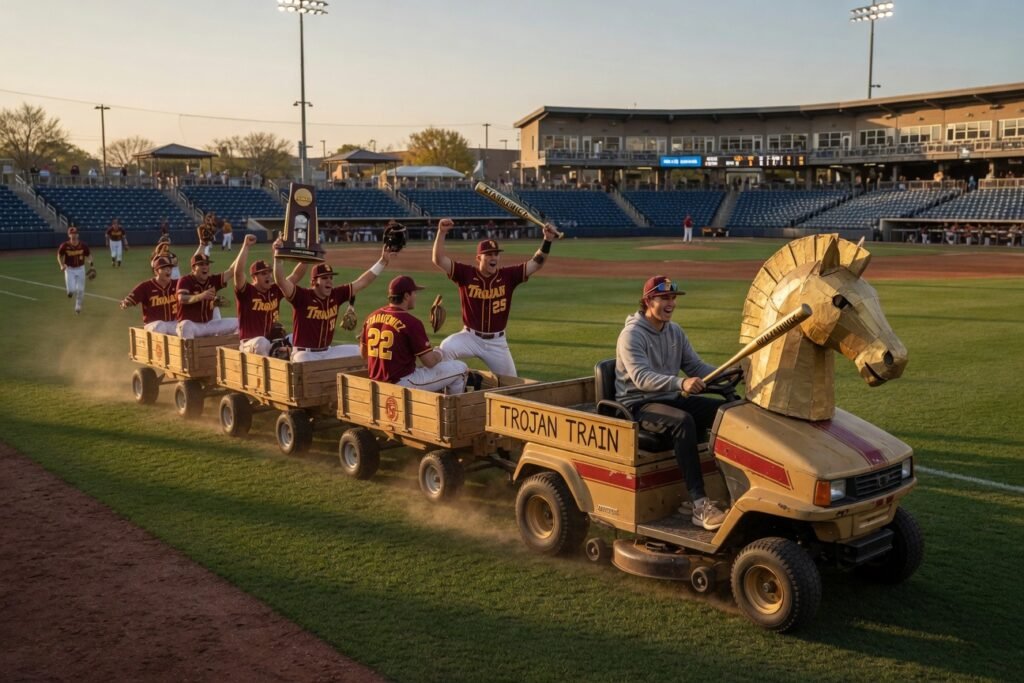
The gold standard is not a trophy case. It is a daily expectation that the program operates at the highest level of preparation and execution. That standard is returning to the Los Angeles campus. The Trojan Train is not just on its way. It is already forcing the rest of college baseball to adjust its own timetable.