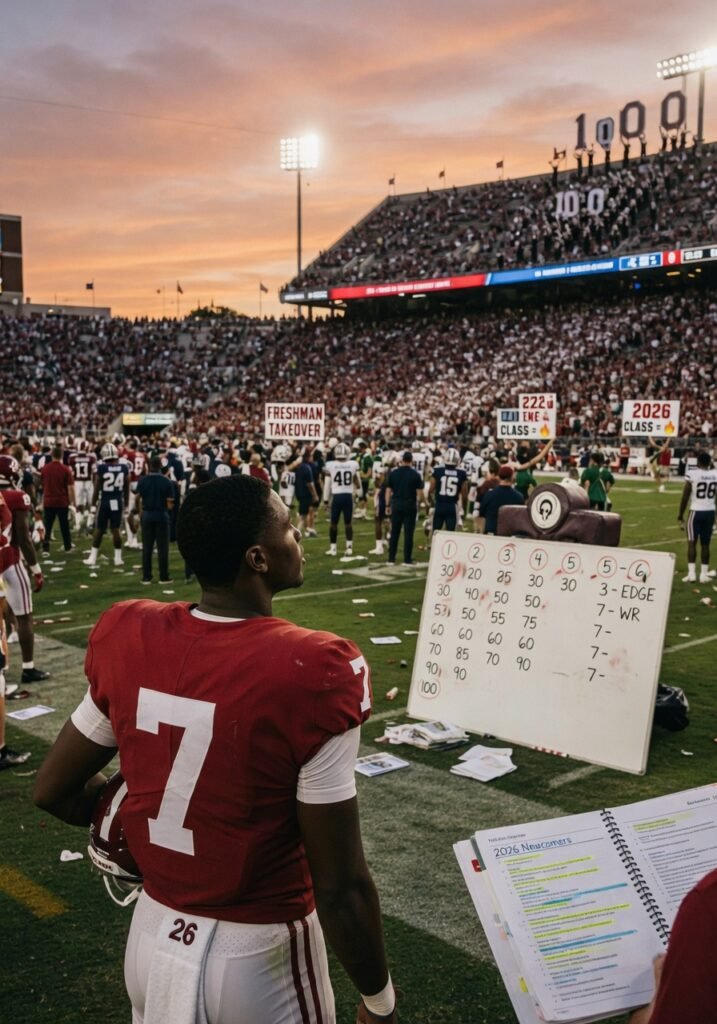
I have been staring at this ranking of the top newcomers for the 2026 college football season, and the more I turn it over in my head the clearer it becomes that the portal has turned roster construction into a zero-sum war where hesitation costs you everything. Indiana landing Josh Hoover at the top of the list is not just smart business. It is the kind of calculated swing that separates teams who talk about sustained excellence from the ones who actually deliver it. Curt Cignetti already proved he could elevate a program overnight. Now he has added a senior gunslinger who threw for 9,629 yards and 71 touchdowns at TCU, and the math on what that does to Bloomington’s ceiling is impossible to ignore.
I kept coming back to Hoover’s profile because the need was so glaring. Fernando Mendoza is gone to the NFL and the backup option bolted for Georgia Tech. That left a vacuum where experience meets production. Hoover brings both, plus the vertical aggression that fits right into the RPO-heavy system Cignetti runs. The man has swagger. He pushes the ball downfield and trusts his arm in ways that create explosive plays. Yet the volatility is real. Forty-two career turnovers and multiple seasons with double-digit interceptions mean he can just as easily hand games away. That tension is what makes this addition fascinating. Indiana is not simply plugging a hole. They are betting that the upside outweighs the risk in a year when playoff expectations are already sky-high.
Cam Coleman landing at Texas sits right behind him on this list, and I am telling you right now that this one changes the entire perimeter dynamic for Arch Manning. Texas lost Parker Livingstone, DeAndre Moore Jr., and Jaime Ffrench Jr. They needed an alpha opposite Ryan Wingo, and Coleman is exactly that. He posted 93 catches for 1,306 yards and 13 touchdowns at Auburn even with inconsistent quarterback play, and he brings 6-foot-3 size with elite body control and a nose for the back-shoulder throw. In the red zone he creates mismatches with his frame. After the catch he turns ordinary gains into chunk plays. Pairing him with Manning gives Steve Sarkisian one of the most dangerous receiving duos in the country, and the development curve for that young quarterback just got steeper in the best possible way.
What stands out to me about Coleman’s move is how cleanly it addresses Texas’s specific weakness. They have the offensive infrastructure and the quarterback talent. What they lacked was a proven SEC-caliber weapon who can win contested catches at a high rate. Coleman checks every box on that front. He averaged 14 yards per reception and showed he can track the deep ball at full speed. That is the kind of addition that turns a good offense into a national title contender, and it happened because Texas identified the exact profile they needed and went and got it.
Sam Leavitt at LSU is the third name on this list, and this one feels like pure Lane Kiffin chaos in the best sense. Leavitt just led Arizona State to a Big 12 title and a College Football Playoff run, accounting for 29 total touchdowns while throwing for 2,885 yards and adding 443 rushing yards on the ground. Now he is the centerpiece of what is being called the nation’s top transfer class, and the Tigers are counting on him to stabilize everything in Kiffin’s first season. The dual-threat ability and toughness are obvious. He played through injury against Texas Tech for 319 yards before foot surgery. That resilience, combined with the off-platform arm talent and eyes-downfield instincts under pressure, should translate directly into Kiffin’s system.
I keep thinking about what this means for Jordan Seaton anchoring the offensive line and the talent already on campus. LSU has championship expectations. Leavitt gives them the quarterback who can elevate the entire group. His 61 percent career completion rate leaves room for growth, but the arm talent and playmaking instincts point to first-round NFL upside if he stays healthy. This is not a safe pick. It is a swing that could define Kiffin’s tenure in Baton Rouge.
Darian Mensah heading to Miami rounds out the top of the list in the same quarterback-heavy pattern, and the Hurricanes clearly saw the same need for experienced leadership that Indiana and LSU addressed. The portal has become the fastest way to fix the most important position on the field, and these three teams executed at the highest level.
What ties all of this together is how ruthlessly these programs assessed their own gaps. Indiana needed a veteran passer who could sustain momentum. Texas needed a dynamic perimeter threat to maximize Manning. LSU needed a proven winner who could run a championship offense immediately. The physical skill sets these players bring line up almost perfectly with those roster holes. That is not luck. That is deliberate evaluation happening less than 100 days before kickoff.
I have watched enough cycles of this sport to know that these kinds of moves compound fast. Hoover’s vertical aggression could unlock an Indiana offense that already believes it belongs in the playoff conversation. Coleman’s contested-catch reliability gives Texas another weapon in an already loaded attack. Leavitt’s toughness and mobility should let LSU play fast and physical on both sides of the ball. When the season starts, these four names will be the ones everyone is tracking because the teams that fixed their quarterback and skill-position needs earliest are the ones most likely to still be standing in December.
The rest of the top 100 will fill in around these pillars, but the top of the list already tells the story. The programs willing to move aggressively in the portal are the ones setting the terms for 2026. Everyone else is reacting.