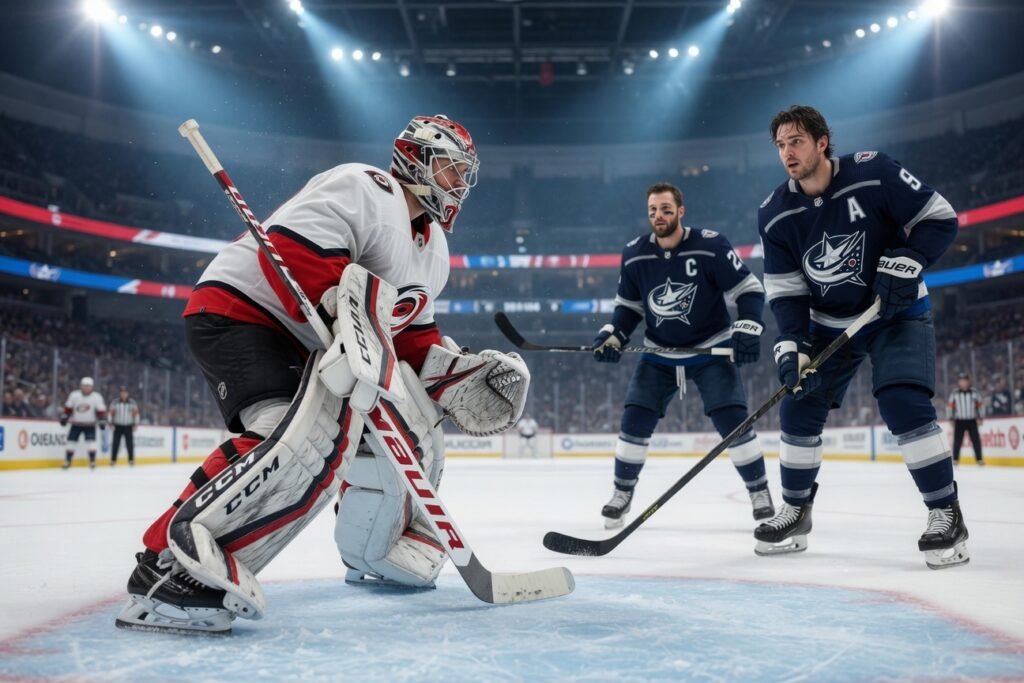
The Carolina Hurricanes have looked like the most complete team left in these playoffs, and the numbers from their run make Vegas the clear underdog despite the Golden Knights’ deeper path. I pulled the shot attempt data and goaltender splits after the conference finals wrapped, and Carolina’s structure has created the kind of consistent suppression that rarely cracks in a seven-game series.
Andersen’s 12-1 record with a 1.44 GAA and .928 save percentage stands out because it came against three different styles. The Senators series was about transition control. The Flyers series tested their ability to handle physical forechecking. Against Montreal, they faced a team that generated odd-man rushes early before Carolina’s defensive shell took over. After that nightmare first period in Game 1 where they surrendered four goals on turnovers, the Hurricanes posted a 153-77 shot advantage the rest of the way. That kind of adjustment shows a team that learns in real time.
Vegas reached the final by grinding through six-game series against the Mammoth and Ducks before sweeping Colorado. Mitch Marner led them with 7 goals and 14 assists in 16 games, but the underlying metrics tell a different story about sustainability. Carter Hart posted a 2.22 GAA and .924 save percentage, which looks solid until you stack it against Andersen’s efficiency in fewer high-danger situations. Hart has faced more rubber because Vegas allows more zone entries, and that volume tends to catch up when the opponent has Carolina’s level of structured retrievals.
I watched the way Carolina’s defense limited Montreal’s top line after Game 1. Nick Suzuki, Cole Caufield, and Juraj Slafkovsky combined for almost nothing once the Hurricanes tightened their gaps and forced plays to the perimeter. Taylor Hall’s 5 goals and 11 assists in 13 games came from secondary chances created by that same structure, not from carrying the offense himself. That distribution matters in a final where one line can be shadowed.
The schedule gives Carolina home-ice advantage for Games 1 and 2, which lines up with how Rod Brind’Amour’s teams have performed in front of their crowd during these playoffs. Vegas will need to steal at least one early to shift momentum, but their four-game sweep of Colorado came against a team that looked gassed after a longer regular season. The Avalanche series featured heavy special-teams swings that may not repeat against a Hurricanes penalty kill that has operated at elite levels since the second round.
Marner will draw the toughest matchups, and history shows that production often dips when opponents can dedicate a full pairing plus a checking center to one player. Hall, by contrast, benefits from Carolina’s depth and the fact that opponents cannot load up without leaving secondary threats open. The 1.41 GAA Andersen posted across his starts reflects fewer high-danger chances allowed per 60 minutes than Hart has faced, a gap that usually widens in best-of-seven play.
If the series reaches Game 5 or beyond, fatigue from Vegas’s longer path becomes a factor. Carolina needed only 13 games to reach the final. That extra rest has shown up in their third-period shot shares, which climbed steadily through the Montreal series. Vegas will have to win with speed and transition before Carolina settles into its half-ice game, where the data favors the Hurricanes by wide margins in expected goals.
Andersen’s unflappability after tough outings has been the difference-maker. He does not need to post a .950 save percentage every night; he just needs to keep the door closed in the moments that decide series. Hart has shown he can do the same, but the shot quality he is stopping has been higher on average. That difference compounds over six or seven games.
The Conn Smythe watch will likely come down to which goaltender holds up longer and which supporting cast generates more secondary scoring. Carolina has the edge in both categories based on what we have seen since the second round. Vegas can win if Marner stays hot and their blue line limits odd-man rushes, but the structural advantages sit with the Hurricanes.
I said last week in the conference finals preview that Carolina’s defensive metrics pointed to a team built for deep runs, and nothing from the Montreal series changed that view. The same principles apply here against a Vegas squad that relies more on individual skill to create offense. In a final, the team that forces the opponent into low-percentage areas usually prevails, and Carolina has executed that better than anyone left.
The series opens Tuesday with the Knights as slight underdogs on the road. Expect tight checking early, special-teams swings in the middle, and goaltending to decide the outcome. Andersen’s track record gives Carolina the slight but meaningful edge.