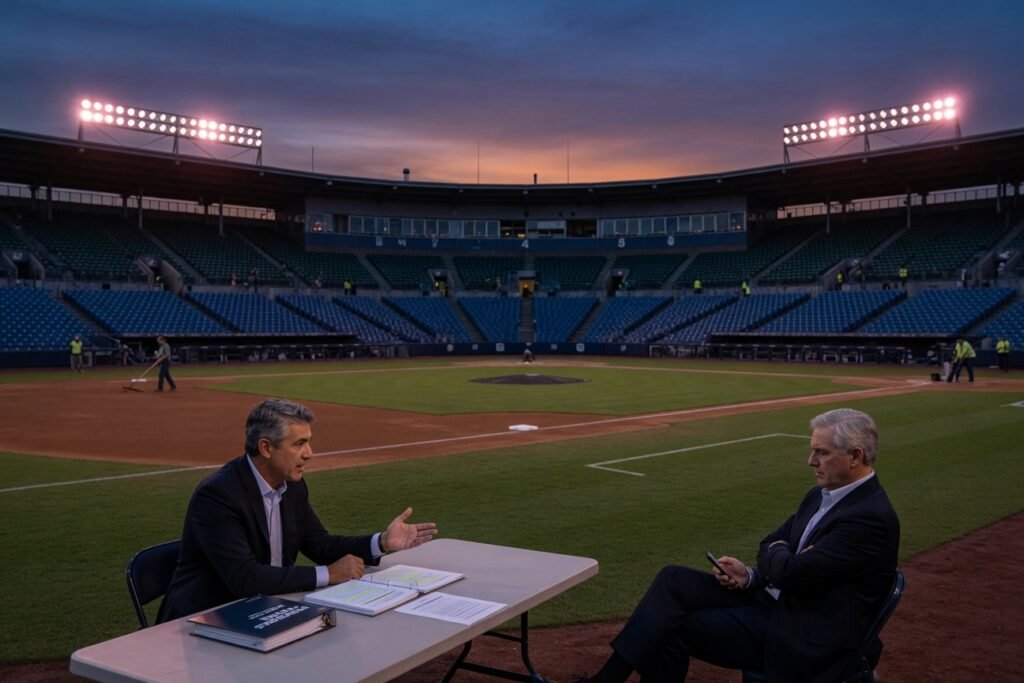
The gap between MLB owners and the players union just widened into something structural, not tactical. Bruce Meyer laid it out plainly on that Monday call: the league’s salary cap proposal was not a starting point for negotiation but an attempt to import the worst elements of other leagues’ systems without any of the player protections that make those systems functional.
I pulled the proposal details against historical revenue splits and the numbers do not lie. MLB wants a hard cap starting at $171.2 million and a floor at $245.3 million by 2027, paired with an explicit 50-50 revenue split enforced through escrow. That mechanism would claw back player pay if actual revenues fall short of projections. Meyer noted that applying the same math to 2026 projections would cost players roughly half a billion dollars. The union’s own modeling shows player share dropping below current levels once amateur bonuses and other accounting items are folded in.
Meyer did not mince words. “I thought they would try harder to make it look good,” he said, “and they didn’t even do that.” He called the entire structure “a form of institutionalized collusion” because it caps what any single club can spend regardless of local market strength or ownership willingness. That language echoes the 1994 strike rhetoric, but the context has shifted. Revenues have grown faster than salaries in recent years, yet ownership still frames the ask as competitive balance for small-market fans.
The league’s counter-statement emphasized that major-league payrolls would rise in year one under the new rules, with twelve teams needing to add a combined $617 million and eight teams cutting a combined $578 million. That framing ignores the union’s core objection: the cap plus escrow plus amateur-bonus inclusion would compress total compensation over the life of the deal. The union’s counter-proposal instead raised the minimum salary, expanded the pre-arbitration bonus pool, lifted the luxury-tax threshold, and introduced a competitive-integrity tax on teams that chronically underspend. It also called for teams to pool close to 90 percent of local media revenue, a steeper ask than the league’s full local-media sharing plan but one that still leaves some market differentiation intact.
I keep returning to how this mirrors the 1994-95 impasse. Then, owners pushed a salary cap after claiming the prior system was unsustainable. The strike canceled the World Series, cost both sides hundreds of millions, and ended with a luxury-tax system that has since ballooned into the current CBT framework. The difference now is scale. Franchise values have multiplied, national media deals have reset upward, and local RSN erosion has made revenue volatility a real variable for mid-market clubs. Yet the owners’ opening offer treats the cap as non-negotiable rather than a leverage point.
The union’s economic plan tries to address value at every service tier. Raising the minimum and widening the bonus pool targets pre-arbitration players who have produced the largest surplus-value gap in recent WAR models. Lifting the tax threshold would allow more clubs to chase mid-tier free agents without immediate penalties. The competitive-integrity tax aims at the opposite problem: clubs that treat the floor as optional and suppress payroll to protect margins. Those mechanisms reward competition instead of flattening it.
Ownership’s insistence on a strict cap-and-floor with escrow reveals the priority list. The 50-50 split is the headline, but the escrow clause protects owners against downside revenue scenarios while the cap prevents upside spending by high-revenue clubs. MLB’s spokesperson noted that the system would still deliver more money to major-league players year over year than the 2026 baseline. That may be arithmetically true inside the proposal’s own definitions, yet it sidesteps the union’s calculation that overall player share contracts when the full revenue pie and the amateur component are counted.
I said last week when breaking down Tatis’s 451-foot homer that the game’s economic engine still runs through stars who clear the fences at elite exit velocities. The cap proposal effectively tells those players their marginal value will be rationed by a hard ceiling rather than market demand. Clubs that want to build around a Tatis-type talent would lose the ability to outbid everyone else once they hit the cap. That is the collusion Meyer identified, and it is why the union has treated any cap as a red line since 1994.
Local media sharing adds another layer. The league wants full pooling; the union wants 90 percent. Both moves would shrink the revenue gap between large and small markets, but the union’s version preserves some incentive for clubs to invest in their own broadcasts. Full pooling removes that incentive and hands the league office more control over distribution. The owners’ framing that this levels the field for fans assumes the extra payroll dollars will actually be spent on talent rather than returned to ownership or used for debt service. History shows that assumption is not automatic.
The timing matters. Six months remain before the current agreement expires. The union has already signaled it will not accept a cap without major concessions elsewhere. Ownership appears willing to absorb a work stoppage to reset the cost structure. That posture produced the 1994-95 lockout and the 2021-22 lockout in the NHL. In both cases the eventual deal preserved some form of cost certainty for owners while delivering modest gains for players. The MLBPA’s leverage this time rests on the sport’s current popularity surge and the absence of replacement players who could sustain a season.
If the cap framework survives into the next agreement, the effects would cascade through free agency, arbitration, and international spending. Teams currently clustered near the CBT threshold would face binary choices: drop below the floor and pay the integrity tax or push to the cap and lose flexibility. Mid-tier free agents would see their market compressed because only a handful of clubs could absorb their salaries without exceeding the ceiling. The pre-arbitration bonus pool expansion in the union plan was designed precisely to offset that compression at the entry level.
The distance Meyer described is not rhetorical. It is baked into the proposals themselves. One side wants to import a hard cap with escrow enforcement; the other wants to expand existing mechanisms that already tie pay to performance and service time. Those positions do not overlap without one side conceding its core demand. The next six months will test whether either side calculates that the cost of a stoppage exceeds the cost of compromise. The numbers on the table suggest both sides are still calculating the other way.