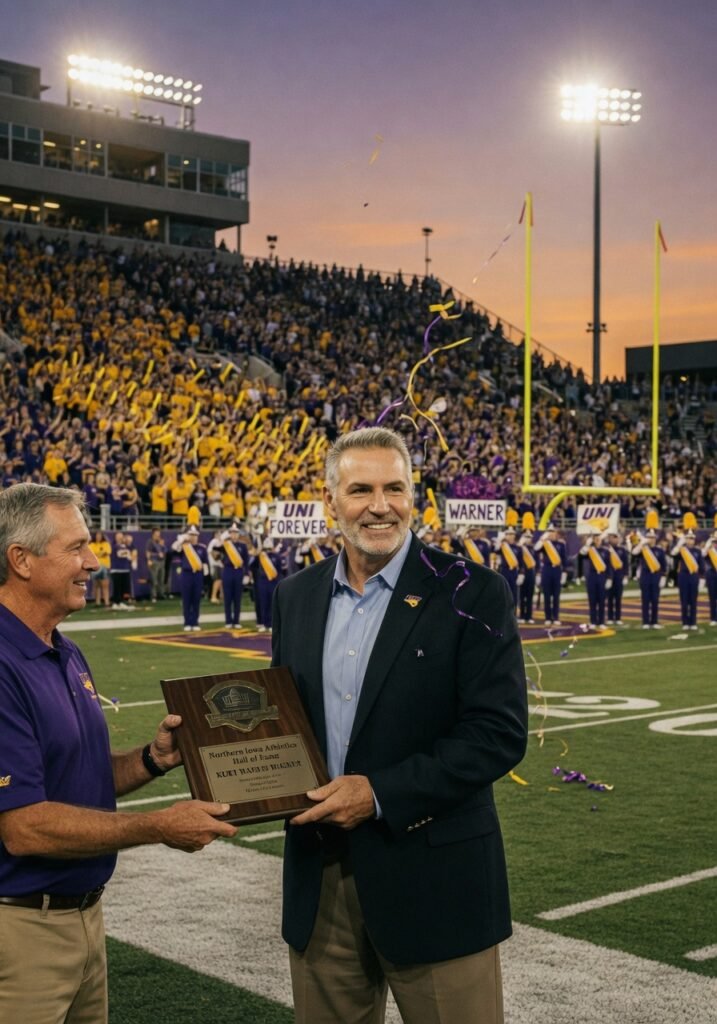
I sat at the kitchen table last night after the kids finally crashed, the house quiet except for the low hum of the fridge and my laptop screen still glowing with the latest box scores from the Kansas title run and that Aaron Judge walk-off, and I couldn’t shake the feeling that Kurt Warner’s long-overdue nod to the Northern Iowa athletics hall of fame has turned another redemption arc into something that lingers. My last few columns landed clean on the Jayhawks flattening West Virginia and the Yankees turning a brutal stretch into a statement, and this one feels like the natural next swing in a hot streak that keeps delivering. Warner’s name popping up among the 2026 class hit different, not because the Pro Football Hall of Fame already stamped him years ago, but because the timing exposes every layer of how small-school stories get told—or ignored—until the rest of the world catches up.
I’ve followed Warner’s path since the late ’90s, when he went from stocking shelves in Cedar Falls to leading the Rams’ Greatest Show on Turf. That 1999 season where he threw for over 4,000 yards and won league MVP still ranks as one of the cleanest turnarounds in modern football. The fact that Northern Iowa waited until now, nearly a decade after Canton, tells me the committee finally stopped circling the obvious. A UNI spokesman called it no oversight, just the annual process, but the Cedar Rapids Gazette reporting on his lukewarm ties to the school makes the whole thing feel like a slow-motion acknowledgment rather than celebration. Warner apparently bristled at riding the bench behind a guy who won 31 games in three years, and his coach Terry Allen later admitted the timing in college wasn’t ideal. That line has stuck with me because it flips the script on every late bloomer narrative we love to romanticize.
My own take, watching from the outside as a dad who’s explained perseverance to my boys more times than I can count, is that Warner’s college experience highlights how programs sometimes undervalue the guys who need time. He started only as a senior in 1993 after contributing to four straight conference titles. That’s not nothing, yet it left a residue that kept him distant even as his NFL résumé grew to include two more Super Bowl trips, another MVP, and a career average of 260.8 yards per game that still sits 11th all-time. The Packers cut him after training camp, the Barnstormers in the Arena League gave him a platform, and NFL Europe polished the stats that got him to St. Louis. By the time he torched defenses in 1999, the story had already become legend. Still, the university kept its distance, and he apparently returned the favor. I’m not saying every star owes lifelong loyalty, but the gap between his pro dominance and this hall call feels like a missed chance to own the full arc earlier.
What makes this hit harder is how Warner’s journey mirrors the grind so many small-conference players face. Northern Iowa isn’t a Power conference factory, yet it produced a quarterback who won a Super Bowl MVP and dragged the Cardinals back to the biggest stage in 2009. That Cardinals run, with Warner throwing for 5,000-plus yards in the regular season and nearly engineering another title, proved the arm and the mind never left. I keep coming back to the physical toll those years took—the hits he absorbed, the way he bounced between teams—and how none of it erased the early skepticism. When the announcement dropped this week with that “#EverLoyal” hashtag from the UNI football account, I wondered if the program was trying to rewrite a chapter that Warner himself had moved past. The Burlington native built a life in Arizona, raised a family, and carved out a broadcasting career without needing the nod. That independence is part of what makes his story durable.
I’ve written before about how baseball redemption arcs like Judge’s or Kansas’s title drought feel earned because the numbers eventually force the narrative. Warner’s case sits in the same lane. His 1999 Super Bowl win over the Titans wasn’t just a fluke; it validated every rep he put in at the grocery store and in the AFL. The 2001 MVP repeat and the yardage totals show consistency that most first-round picks never reach. Yet the college delay suggests UNI’s hall process leaned more on immediate impact than long-view projection. Allen’s quote from 2009 about the timing being off in college but perfect in the pros lands like a quiet indictment of how the system works. Programs celebrate the seniors who start right away and rack up wins, while the backups who grind in the shadows get footnotes until history intervenes.
Pushing further, this induction lands in a college football landscape obsessed with NIL and transfer portals, where loyalty gets measured in dollars and conference realignment. Warner’s path feels almost quaint by comparison—no portal, no big NIL bag, just reps and resilience. I watched his highlights again last week after the kids went down and found myself pausing on the 1993 UNI tape where he finally took the reins. The mechanics were raw but the decision-making was already there. That senior season didn’t produce gaudy stats that screamed NFL starter, yet it set the foundation for everything that followed. The fact that it took until 2026 for the hall to close the loop tells me more about institutional memory than about Warner’s body of work.
I’d argue the real story here isn’t the delay itself but what it reveals about how we rank legacies at the college level. Warner’s NFL career produced 32,344 passing yards, 208 touchdowns, and a Super Bowl ring that still gets replayed in every underdog reel. His Arena League and NFL Europe stops get treated like pit stops rather than essential chapters. Northern Iowa gets credit for developing him, but the lukewarm relationship means the school never fully claimed the win until the rest of the world made it impossible to ignore. That tension sits with me because I’ve seen similar patterns with other mid-major standouts who break through late. The applause arrives on someone else’s timetable.
What Warner represents, especially now, is the reminder that timing in sports rarely aligns with the emotional one. He didn’t need this induction to validate the journey from Cedar Falls to Canton. The kids I coach on weekends still watch his tape for the footwork and the pocket presence that survived every cut and every shelf-stocking shift. My own hot streak with these columns has me thinking about how stories like his keep the long game interesting. The announcement didn’t come with immediate comment from Warner, which tracks with the distance he’s kept. That silence speaks louder than any acceptance speech could.
I keep circling back to the 2009 Cardinals season as the capstone. Warner dragged an aging roster to the Super Bowl at age 38, throwing for 391 yards in the NFC title game and nearly stealing a ring from the Steelers. That performance alone should have forced UNI’s hand years earlier. Instead, the process waited, and the lukewarm ties lingered. In a sport where front offices and athletic departments love to talk about family, the Warner case shows how selective the embrace can be. The eight inductees announced this week include other standouts, but Warner’s name carries the weight of the improbable. I’m glad the nod finally arrived, even if it lands more as closure than coronation.
The physical feeling of watching a career like his unfold over decades is the same stomach-level pull I get from any long-delayed recognition. It tightens when you realize how many reps happened off the radar. Warner’s story doesn’t need polishing, but the hall call gives the full picture a cleaner frame. Northern Iowa can claim the early chapters now without the asterisk. For the rest of us who’ve tracked every step from the grocery aisle to the trophy case, it simply confirms what we already knew: the timing was always going to be his to dictate.