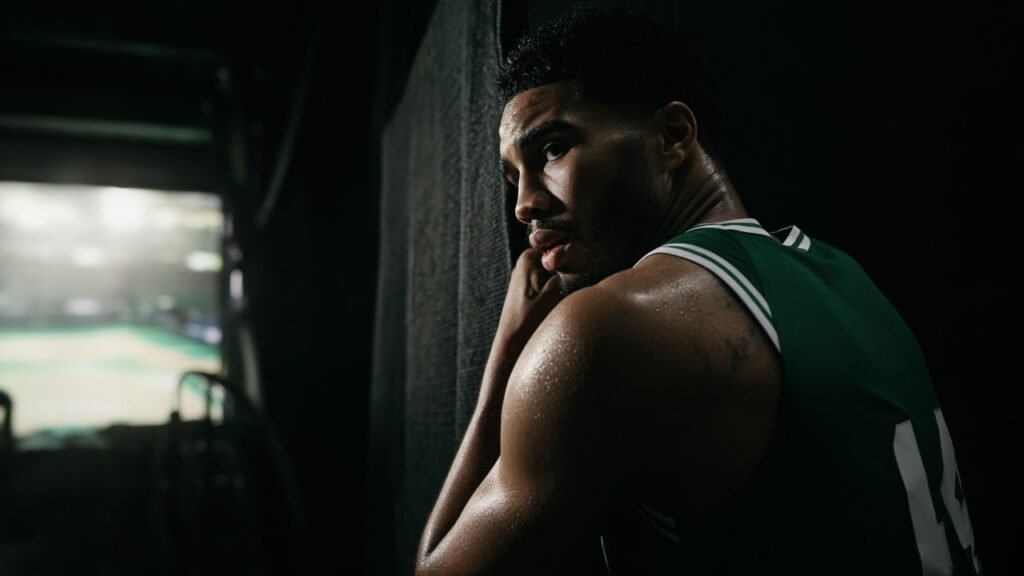
Missing six consecutive shots in crunch time to drop an 88-87 decision against a Golden State roster missing Stephen Curry is how you end up as the punchline on Jimmy Butler’s Instagram post. When Jayson Tatum clanked a contested 16-foot fadeaway over Draymond Green at the Chase Center buzzer on Sunday night, Boston sealed its first four-game losing streak in 429 games. Butler posted an AI spoof casting Tatum as Red from *Friday* running to his car to cry while Green and Brandin Podziemski watched from the porch. The social media ribbing is loud, yet my focus is on the alarming second-half offensive collapse that turned an 11-point Celtics cushion into the first four-game skid of Joe Mazzulla’s coaching tenure.
Tatum poured in 23 points before halftime, including a logo three-pointer that pushed him past Bill Russell into eighth place on the franchise’s all-time scoring list with 14,523 career points. Then the schematic vice tightened after intermission, and Tatum went 0-for-7 from the floor for a total of four second-half points. A team that prides itself on mathematical shot-profile supremacy scored 12 points in the fourth quarter and coughed up a double-digit lead for the third consecutive game.
Volume Three-Point Variance Is Cannibalizing Boston’s Half-Court Floor
In the locker room afterward, Tatum defended Boston’s late-game shot selection to the *Boston Globe*. “A lot of those, we got some good looks, looks that we want, looks that we work on. They just didn’t fall down today like they normally do, but the process I think was there.”
I look at the four-game sample and see a process that has detached from personnel reality. During this four-game slide against Orlando, Denver, Sacramento, and Golden State, the Celtics have jacked up 51.3 three-point attempts per game, full seven attempts above their season average, while converting a brutal 28.3 percent from beyond the arc. On Sunday, they shot 14-of-47 from deep (29.8 percent) and 1-of-8 in the fourth quarter.
That stubborn attachment to perimeter volume has me thinking of the teams that lived and died by the three-point shot. Without Paul George (rest) and Mitchell Robinson (illness) on the floor Sunday, Boston lacked both a secondary wing creator to punish closeouts and a vertical lob threat to collapse the paint. Late in the game, Boston kept firing from deep instead of generating paint touches.
- Four-Game Skid Scoring Output: 389 total points (105 vs. Orlando, 101 at Denver, 96 at Sacramento, 87 at Golden State), marking Boston’s first sub-400 four-game stretch since April 2012.
- Backcourt Perimeter Slump: Derrick White shot 6-of-21 overall and 2-of-12 from three-point range, underscoring how badly the spacing shrinks when secondary guards misfire.
- Second-Chance Bleed: Golden State grabbed 19 offensive rebounds for 22 second-chance points, erasing the 24 points Boston generated off 20 Warriors turnovers.
The Late-Game Hesitation Exposes a Broken Possession Cycle
The structural flaw in Mazzulla’s offense right now is how missed perimeter jumpers feed directly into defensive rebounding breakdowns. Long rebounds off 47 three-point attempts pull Boston’s perimeter defenders out of transition alignment, and without Robinson anchoring the glass, Golden State feasted on extra possessions. Mazzulla acknowledged that exact linkage after the horn, noting that Boston’s stretches of inefficient offense and inability to finish defensive possessions with a clean rebound are the two connected trends driving the skid.
Even more concerning is how the cold shooting has bled into decision-making latency on the floor. Derrick White admitted to the *Boston Globe* that he passed up an open late-game look because his internal clock stalled: “I didn’t want to turn it over, and so by the time I realized that I was open, then it was too late, and so it was kind of weird. Just a lot was going on; I didn’t want to rush into it.”
When a championship-tested guard hesitates on a catch-and-shoot trigger out of fear of a turnover, the offense loses its rhythm… and the ball inevitably defaults back to Tatum for a stagnant isolation bailout. After Brandin Podziemski buried a three-pointer with 2:38 remaining to put Golden State ahead 88-86, Boston’s final possessions devolved into a split pair of Tatum free throws at the 55.6-second mark, a missed three with 30 seconds left, a missed Neemias Queta putback, and finally Tatum’s contested 16-footer over Green after Hugo González stripped Green.
“We gotta make some shots,” Tatum told *MassLive*. “Whether it’s our pace, whether it’s getting stops, there’s a lot of things that go into that right now. But it’s on all of us, and we gotta figure it out.”
At 11-6, Boston still holds an upper-tier Eastern Conference cushion, which is why Tuesday night’s NBA Cup road matchup against the Washington Wizards carries far more tactical weight than a typical November tilt. If Mazzulla keeps green-lighting 50-plus three-point attempts a night while Robinson is sidelined and teams dare Tatum to settle for contested fadeaways over top-tier switch defenders like Green, this sub-400 scoring drought will follow them right back into the teeth of the East schedule.