The San Francisco 49ers finally cut ties with Brandon Aiyuk on Monday, and the front office wants everyone in the Bay Area to view this waiver wire release as closure. I see it as a $31.64 million monument to executive ego.
To my eyes, the divorce was inevitable the second Aiyuk stopped communicating with the team in 2025, but the way John Lynch dragged this saga out was pure organizational paralysis. San Francisco handed Aiyuk a four-year, $120 million extension in August 2024. Two months later, on October 20 against Kansas City, he tore his ACL, MCL, and meniscus. He has not played a snap of football since.
By July 2025, the 49ers voided roughly $27 million in contract guarantees when Aiyuk stopped attending mandatory rehab check-ins and team meetings. In December, they placed him on the reserve/left squad list. The relationship was completely dead in the water… yet Lynch spent the entire offseason holding onto his contractual rights like a poker player refusing to fold a busted draw.
John Lynch Froze His Own Leverage Out of Spite
Lynch tried to frame this breakup in January as an unavoidable act of nature. “It’s unfortunate. A situation that just went awry,” Lynch told reporters at his end-of-season press conference, adding, “sometimes it just doesn’t work out.” He made his ultimate verdict clear: “I think it’s safe to say that he’s played his last snap with the Niners.”
If the front office knew in January that Aiyuk would never wear the uniform again, sitting on his rights through free agency, the NFL draft, and training camp was an act of pure spite. I refuse to pretend Lynch had a master plan here. In my view, he operated under the fantasy that another franchise would trade real draft capital for an alienated 28-year-old receiver with a reconstructed knee.
The rest of the league saw the trap. Nobody was trading assets for a player posting social media clips calling the front office dumb, especially after the Santa Clara County District Attorney’s Office issued an arrest warrant on June 3 for misdemeanor exhibition of speed, which prosecutors alleged stemmed from a video of Aiyuk speeding past Levi’s Stadium. When reporters asked head coach Kyle Shanahan in September if he would consider bringing Aiyuk back to help an injury-riddled receiving corps, Shanahan gave an answer that required zero translation: “No.”
The Dead Money Math Destroys the Victory Lap
By running this feud past the November trade deadline, San Francisco eliminated every viable exit. Aiyuk hired agent Drew Rosenhaus, passed his league physical, and gained reinstatement from the NFL on November 9. The league granted a two-week unpaid roster exemption. When that clock ran out Monday, the 49ers had no choices remaining: activate a wide receiver their head coach publicly rejected, or release him.
Now Aiyuk hits waivers because the transaction occurred after the trade deadline. No rival front office will claim him because claiming him means inheriting the remaining non-guaranteed money on that four-year contract. He will clear waivers in 24 hours and walk straight into unrestricted free agency.
When I look at the cap sheet, the financial toll is staggering. Because this release carries post-June 1 accounting, the dead money bill splits into $12.35 million in 2026 and $19.29 million in 2027. San Francisco gets a cap credit of nearly $5 million in March and will attempt to recoup $13 million in previously paid bonus money. But banking on legal claims does not change the reality that over $31 million in dead space is now locked up in a player walking out the door for zero compensation.
When Aiyuk met with team officials on November 6, he made his physical status clear. “It was a long recovery process, a long rehab process,” Aiyuk said. “But I’m back to 100% and looking to get reinstated to the National Football League.”
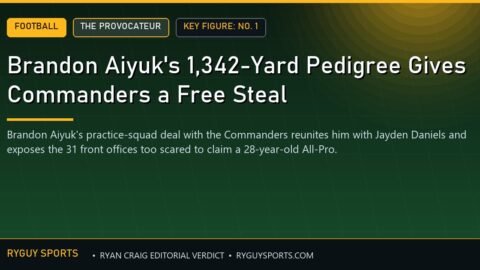
I see a front office that watched Aiyuk produce 294 receptions, 4,305 yards, and 25 touchdowns over his Bay Area tenure, including a 2023 campaign where he put up 1,342 receiving yards as one of the most efficient route-runners in football. Instead of flipping him when his trade value had a pulse, the 49ers froze, absorbed a massive cap penalty, and paved the way for him to sign anywhere he wants, possibly with Jayden Daniels and the Washington Commanders, for pocket change.
Did John Lynch protect team culture by dragging this saga out for ten bitter months, or did he just pull off the most expensive tantrum in modern NFL history?