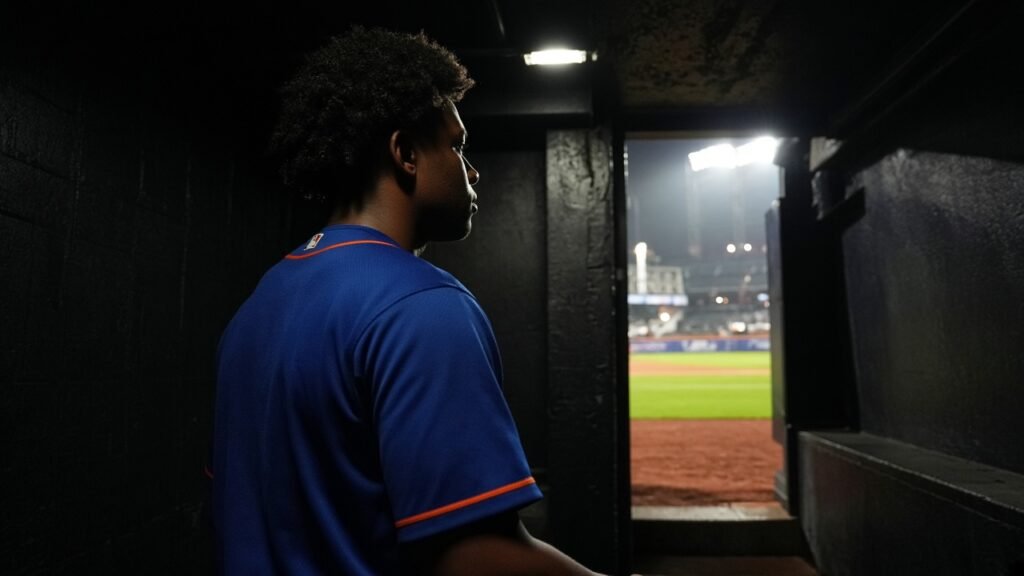
Ninety-five million guaranteed dollars just landed on the desk of a 22-year-old center fielder with a .700 OPS and 120 games on his major league resume, and the New York Mets just pulled off the sharpest heist of the winter. On Saturday, Queens locked up rookie A.J. Ewing on an eight-year, $95 million contract extension that carries a $25 million club option for 2035. In doing so, the front office shattered the franchise’s pre-arbitration extension record, previously held by David Wright’s six-year, $55 million deal signed back in August 2006.
Looking at a 74-88 last-place disaster in the National League East makes it easy to wonder why anybody is handing out historic guarantees. Yet this move represents the exact kind of cold, calculated roster engineering that builds a perennial heavyweight. I look at the contract math and see an absolute masterclass in pre-arbitration leverage.
SNY broadcaster Gary Cohen told viewers that “this is a move that every Met fan should applaud,” and for once, the booth is understating the triumph.
The Luxury Tax Masterclass Behind the 97 wRC+
Of course, the traditional box-score purists across New York talk radio and skeptical rival executives see a fourth-round high school pick from 2023 who finished his rookie year with a below-average 97 wRC+ and a 25.4 percent strikeout rate over 492 plate appearances, arguing that guaranteeing $95 million after 120 games is a reckless overpay for a light-hitting speedster. That surface-level critique completely ignores what happened once the kid adjusted to big-league sequencing. After recovering from a brutal midseason slump, Ewing tore through his final 25 games with a .318/.390/.489 slash line and an .879 OPS.
Manager Andy Green saw the foundation early in July, in comments the New York Post published, when he said, “We expected him to get more than 12 games at Triple-A; I think that’s very fair to say,” before adding, “Did we believe that the shortness of the swing and the athlete would play quickly in the big leagues? How quickly, no one ever really knows. I certainly believe he had attributes that you can point to and believe pretty strongly that was going to have respectable early returns. He’s done better than that.”
My evaluation starts with the structural mechanism of this deal on the luxury-tax ledger. By buying out Ewing’s two remaining pre-arbitration seasons, all three arbitration years, and up to four seasons of unrestricted free agency, the Mets locked in a flat $11.875 million average annual value for the luxury tax through 2034. Even during his offensive rut, Ewing produced 2.0 fWAR and 3.1 bWAR by setting a franchise rookie record with 25 stolen bases in 33 attempts while posting elite center-field range (+6 Fielding Run Value). Paying $11.875 million a year for a 22-year-old up-the-middle defender with a short left-handed stroke is highway robbery in a market where mediocre veteran free-agent center fielders command far more money to decline into their thirties.
A Generational Outfield That Leaves No Excuses
An unnamed Mets official told MLB.com that with Ewing, “all the arrows pointed in the right direction,” calling him “the type of person you want to invest in.” Investing in character and range is step one… turning that discount into a championship roster is where legacies are actually judged.
Look at the outfield alignment now etched in stone in Queens. You have franchise cornerstone Juan Soto manning left field. In right field, you have fellow rookie Carson Benge, who just finished second in National League Rookie of the Year voting after blasting 20 home runs with 22 steals and a .776 OPS across 156 games. In the middle sits Ewing, anchoring the grass until he turns 30. Having two cost-controlled, elite defensive rookies flanking Soto gives this organization a financial runway that every general manager in baseball envies.
That runway strips away the last remaining shield for a 74-88 ballclub. Locking up Ewing for an $11.875 million luxury-tax charge means the Mets have zero excuse to sit on their hands when front-line pitching hits the open market this winter. If the front office uses Ewing’s team-friendly pact merely to admire their own payroll efficiency rather than weaponizing those saved millions to buy an ace at the top of the rotation, then Saturday’s brilliant extension becomes nothing more than a discount coupon framed on the wall of a last-place cellar.