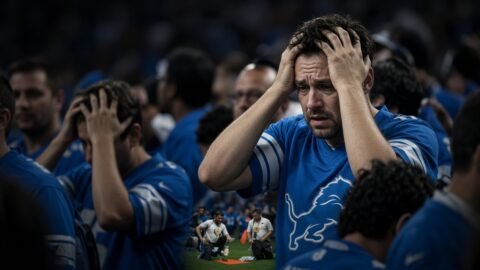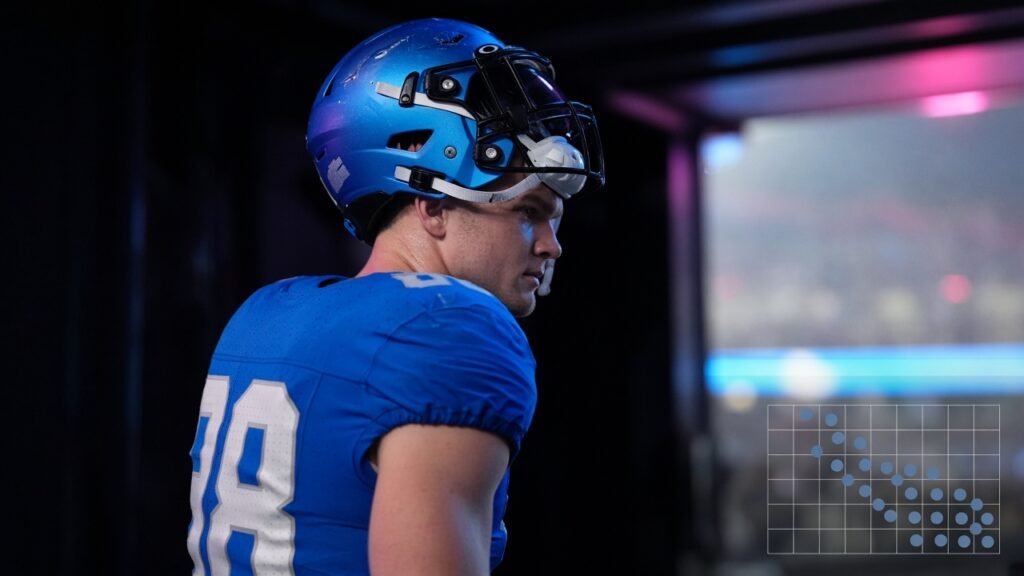
Nine snaps into a Week 10 blowout at Allianz Arena in Munich, a fist-pump celebration altered the structural math of the NFC playoff picture. Aidan Hutchinson sacked Patriots quarterback Drake Maye on third down to cap New England’s opening drive, forcing a 33-yard Andy Borregales field goal in what became a 35-10 Detroit Lions victory. Hutchinson leaped into the air to celebrate his sixth sack of the season, extending a franchise-record streak of six straight games with a takedown. When he landed, his right knee buckled without contact, sending him to the turf, into the blue medical tent, and eventually to the locker room, where he stayed for the rest of the game.
The Ringer’s Tom Pelissero and an Associated Press source reported Sunday that imaging in Munich confirmed a season-ending right knee injury, while NFL Network’s Ian Rapoport noted Hutchinson will seek a second opinion upon returning to the United States with no apparent hope of a 2026 return. For a 7-2 Lions roster with Super Bowl expectations, losing the NFL’s volume pass-rush engine forces an immediate schematic pivot before a Week 11 clash against the Tampa Bay Buccaneers.
Why 320 Pass-Rush Snaps Cannot Be Replaced By Committee
I look at pass-rush value through snap volume and protection gravity before raw sack totals, and Hutchinson’s 2026 profile is an outlier on both fronts. According to TruMedia, the 26-year-old led the entire NFL entering Sunday with 320 pass-rush snaps and 52 total pressures, posting a 16.3% pressure rate that ranked 10th among 121 qualifying defenders alongside 18 quarterback hits. That workload is the entire foundation of Detroit’s four-man rush. When a single defensive end absorbs 320 pass-rush reps over nine weeks while generating pressure on nearly one of every six dropbacks, offensive coordinators are forced to slide protection, leave tight ends in to chip, or keep running backs in pass protection.
That structural gravity is why Alim McNeill already sits at 6.5 sacks from the interior this season. Every chip block and half-slide directed toward Hutchinson’s edge leaves interior linemen isolated in one-on-one pass sets against McNeill in the B-gap. Without Hutchinson on the field after his ninth snap on Sunday, the Lions still suffocated a Patriots offense that lost Maye to an ankle injury on that same first-quarter sack. Against top NFC offenses over the final eight weeks, however, Detroit’s defensive staff will have to manufacture pressure via simulated pressures, five-man blitz paths, and heavier front-seven rotations, sacrificing coverage shells to replace the disruption one defender created on his own.
“Nothing new. We’ll know more when we get back in the States. But anytime you lose a player of his caliber, the type of teammate that he is, he’s a captain of ours, that doesn’t make things easy. But I thought guys stepped up in his wake and showed up for us today and helped us out,” Lions head coach Dan Campbell said postgame, via Pride of Detroit.
Campbell and the locker room optimists will point to Sunday’s dominant final three quarters and argue that Detroit’s culture and defensive depth can weather this absence the same way the roster survived Hutchinson’s fractured left tibia and fibula after Week 6 of the 2024 season. That argument overlooks the 14.5-sack, second-team All-Pro bounce-back Hutchinson delivered across all 17 games in 2025 to restore Detroit’s defensive ceiling.
“This is the second time this has happened, our guys have responded in a tough situation and didn’t bat an eye. Just went back to work, and that’s not easy to do. But, no, certainly you don’t want to know that a player like that is down,” Campbell added postgame, via Pride of Detroit.
The $180 Million Cap Reality Facing Detroit’s Front Office
My concern extends past Week 11 and straight into Detroit’s multi-year salary cap sheet. In October 2025, the Lions signed the No. 2 overall pick of the 2022 draft to a four-year, $180 million extension carrying a $45 million average annual value, making him the third-highest-paid edge rusher in the league. Committing $45 million per year to a cornerstone defensive end is sound roster construction when he plays all 17 games and logs 320 pass-rush snaps by mid-November… yet Hutchinson has now suffered two major lower-body injuries in three seasons, first fracturing his left tibia and fibula in 2024 and now injuring his right knee in November 2026.
When a franchise allocates top-three edge money to one star, the salary cap math requires the surrounding edge rotation to be built on rookie-scale contracts and low-cost veterans. You cannot pay $45 million a year at the top of the depth chart and carry an expensive backup insurance policy at the same position.
That leaves Detroit’s front office and defensive staff with a brutal dual mandate starting this week when those second-opinion results land back in the United States. On the field, the coaching staff must decide against Tampa Bay in Week 11 whether to ramp up their blitz rate to protect their secondary or play conservative coverage shells and trust McNeill to carry the pass rush from the interior. Long-term, a mid-November knee injury threatens to bleed into the 2027 regular-season calendar while that $180 million extension sits on Detroit’s books.