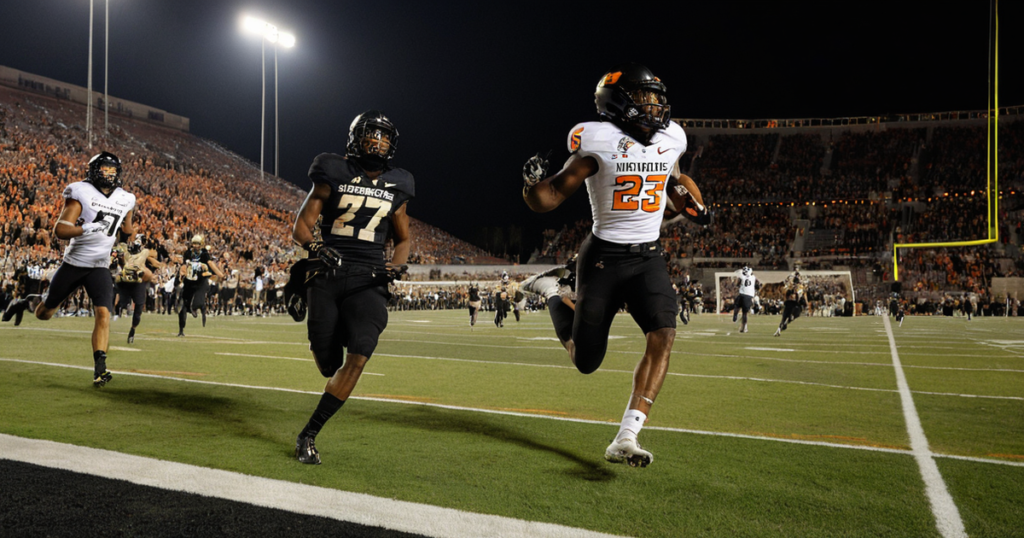
Giving up 57 points to Oklahoma State in late October strips a coaching staff of every defensive excuse left in the binder. Deion Sanders inked a $54 million contract extension at Colorado, and since the ink dried on that deal, his program has gone 5-14 overall. After the 57-24 blowout loss pushed the Buffaloes to 2-5 on the season, 0-4 in the Big 12, and five consecutive defeats, the mathematical reality in Boulder has completely eclipsed the marketing department.
Former Colorado tight end Sav’ell Smalls put that exact failure into sharp focus on X this week. A former five-star recruit who transferred in from Washington before congenital spinal stenosis forced his medical retirement last season, Smalls grew tired of Sanders loyalists attacking his old production to shield the head coach. “All y’all in the comments funny lol. I agree I was weak and my stats were weak. So what’s y’all argument for getting on your knees for Deion now?” Smalls wrote on X.
I respect the tactical move from Smalls here. By conceding his own stat sheet up front, he took away the only counterpunch the online Sanders defense force had left and forced the conversation back onto the scoreboard. When a former player who suffered episodes of temporary paralysis in his arms and legs during practices and games before an MRI revealed severe spinal pressure calls out the blind loyalty around the building, the critique lands with real weight.
The Portal Roster Model Breaks Down in the Trenches
The easy defense is that a roster overhaul of this magnitude requires patience now that generational NFL pieces like Shedeur Sanders and Travis Hunter have moved on to Sundays. That defense collapses the second you examine the game script and defensive efficiency metrics of a 5-14 run. Losing five straight games and sitting winless through four Big 12 outings happens when a coaching staff tries to shortcut developmental trench play with annual transfer portal churn.
Allowing 57 points in a conference game exposes a systemic failure in defensive gap integrity, tackling efficiency, and red-zone stop rate. You cannot survive four quarters of Big 12 football when your front seven loses first-down contact and forces the safeties to play run-support cleanup ten yards downfield. Once an opposing coordinator realizes he can dictate personnel groupings and stay ahead of the chains on early downs, the defensive play-caller is trapped between committing an extra hat to the box or leaving corners on islands without safety help.
I look at Colorado’s 33-point margin of defeat against Oklahoma State and see the exact same structural rot that shows up whenever a program leans on an expensive, transfer-built roster. Buying portal talent and winning the summer headline cycle does nothing to fix broken run fits or second-half situational football. My biggest gripe with modern college front offices is how quickly athletic directors hand out massive extensions based on television ratings rather than per-play efficiency.
Five Games to Find Four Wins
The financial and competitive stakes for Colorado over the next five weeks are brutal. At 2-5, the Buffaloes must win four of their final five games just to qualify for a six-win bowl berth. In any normal regression model, a team sitting at 0-4 in conference play with a defense surrendering 57 points has a near-zero probability of ripping off an 80 percent win rate down the stretch.
And the noise around the building is only getting louder. Earlier this month, after a blowout loss to Texas Tech, a Colorado legend publicly told Sanders, “You Should Take Accountability.” Between addressing quarterback Julian Lewis’s future and apologizing after a YouTube content creator friend caused a stir with a $50,000 comment, Sanders is spending more energy managing brushfires than fixing his third-down defense.
My evaluation of this $54 million investment comes down to how the defensive staff adjusts its front-seven alignments over the final five games of the schedule. Watch whether the Buffaloes can hold their next Big 12 opponent under five yards per carry on first down without blitzing… because another 50-point track meet will officially turn the final month of the 2026 season into an expensive coaching-carousel audition.