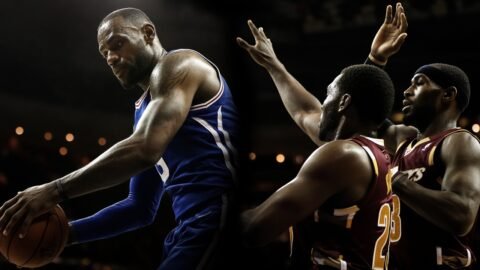
Dropping a 10-point fourth-quarter lead at Madison Square Garden to an Orlando Magic squad missing Paolo Banchero is how a championship hangover turns into a structural crisis. After Sunday night’s 111-102 collapse pushed the defending NBA champions to 0-3, the first titleholders to dig that hole since the 2011-12 Dallas Mavericks, I look at New York’s box score and see a roster getting solved in real time on both ends of the floor.
The optimists inside the Knicks’ locker room and across the New York market are already reaching for the calendar, pointing to a three-game sample size and cold perimeter shooting as a temporary October blip. “Everyone can say it’s early in the season,” Jalen Brunson told reporters afterward, per the New York Post. “We can use that as an excuse, but I think the one thing I see is when we get those runs and start to look like the team that we did in the past, we get comfortable.”
Brunson is right to reject the calendar excuse, because the numbers from Sunday night show a schematic failure that goes far deeper than rust. New York led 86-76 with 9:20 remaining after an OG Anunoby floater, only to get outscored 35-16 over the final nine-plus minutes. When a team surrenders 40 fourth-quarter points at home to an opponent playing without its primary offensive engine, effort is only half the equation. The geometry is broken.
Franz Wagner Exposed the Flaw in New York’s Drop Coverage
Look closely at how Orlando dismantled New York’s half-court shell in the final period. Franz Wagner entered the fourth quarter having missed nine of his first 10 shots, then erupted for 21 of his 23 points in the final frame while finishing with 13 rebounds and nine assists. He did not suddenly catch fire from deep, going 0-for-3 from beyond the arc for the night. Instead, Sean Sweeney’s offense repeatedly dragged Karl-Anthony Towns into high pick-and-roll actions and forced New York’s perimeter defenders to navigate screens at the point of attack without reliable backside rim protection.
Ideally, Mikal Bridges and OG Anunoby erase those driving lanes before the ballhandler reaches the paint. On Sunday, Anunoby delivered a strong two-way floor game with 22 points on 6-of-11 shooting, including 10 in the fourth, after picking up an early flagrant foul against Wendell Carter Jr. Bridges, however, gave New York almost nothing. He scored six points on 3-of-7 shooting, missed all three of his three-point attempts, and posted a minus-23 over his 35 minutes on the floor. When your primary point-of-attack wing gets wiped out on screens and provides zero gravity on the other end, Towns is left stranded in drop coverage against a 6-foot-10 downhill playmaker.
“Giving up 40 points in the fourth quarter is way too much,” Knicks head coach Mike Brown said postgame, per the New York Post. “There’s no light switch that we can just turn on and think we’re going to go win ballgames. Nobody is going to give us any of that. We have to be better with the little things until we start shooting the ball well.”
Brown tried to patch the interior leak by benching Andre Drummond in the second half after a defensive lapse, and James Wiseman struggled in his brief stint. That leaves my biggest concern with New York’s frontcourt depth chart completely exposed: when the backup five rotation cannot stay on the floor and the starters bleed 40 points in a quarter, the margin for offensive error drops to zero.
Eight Fourth-Quarter Turnovers Fueled Orlando’s Run
New York’s offensive math collapsed under the exact same pressure. For the game, the Knicks shot 38-of-93 from the field (40.9 percent) and a brutal 9-of-38 from three-point range (23.7 percent), including a combined 0-for-7 from deep between Towns and Bridges. Meanwhile, Orlando knocked down 18 of its 42 triples (42.9 percent)… getting five three-pointers apiece from Tristan da Silva (19 points) and Anthony Black (18 points in his season debut), plus four more from Desmond Bane (22 points).
That 27-point gap from beyond the arc was compounded by New York’s ball security in crunch time. The Knicks committed eight of their 14 turnovers in the fourth quarter alone, gifting the Magic 23 points off giveaways across the night. With Orlando loading up the strong side and shrinking the gaps once New York’s shooters went cold, Brunson forced the issue into crowded lanes. He finished with 28 points, but it took him 28 shots to get there (12-of-28 FG, 1-of-7 3PT, 3-of-6 FT) alongside four assists and a costly turnover with roughly two minutes left.
“Not happy,” Brunson said, per the New York Post. “Plain and simple.”
I look at the bench scoring ledger and see why Brunson felt forced to play hero ball through triple-teams. Orlando’s reserves outscored New York’s second unit 47-11. While Black and da Silva bombed away from the corners to punish every late Knick rotation, Mike Brown had nobody off the pine who could stabilize a possession or punish a closeout. Comparing this start to the 2011-12 Mavericks is actually generous to Dallas; that Mavericks team lost key championship rotation pieces in free agency during a lockout-shortened offseason, whereas New York brought back its core and still looks disjointed in late-game execution.
“Games like this will tell us, our crap stinks,” Brown told reporters, per Bleacher Report and ESPN. “It does. And we’re the only ones who can do anything about it.”
The schedule offers zero breathing room. On Tuesday night, the unbeaten 3-0 Detroit Pistons walk into Madison Square Garden, and a fourth straight loss would tie these Knicks with the 1969-70 Boston Celtics as the only defending champions in NBA history to open a season 0-4. Should Brown keep running Bridges for 35 minutes while the bench gets outscored by 36 and the fourth-quarter offense devolves into contested Brunson isolations, banners in the rafters will not stop the Garden crowd from turning on this team before November arrives.