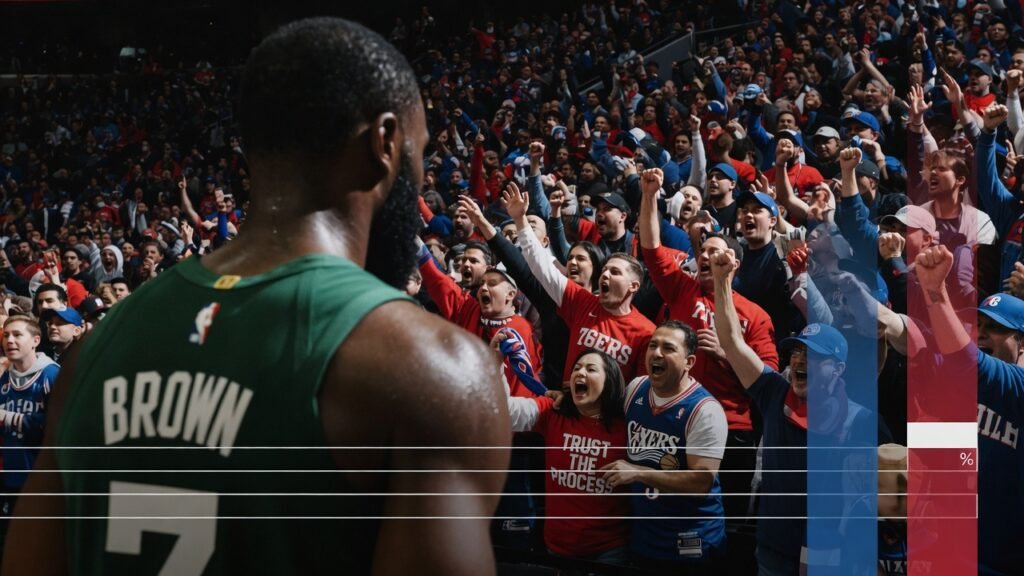
Trading a 2024 Finals MVP inside your own division for an older wing and four draft picks requires either extreme cap desperation or a front office convinced it can survive the fallout. After dropping 27 points on 9-of-19 shooting with five assists and three steals to beat Milwaukee 127-116 on his 30th birthday Saturday night, Jaylen Brown made sure Boston feels every ounce of that decision.
“Jayson comes from a wonderful family,” Brown said after pushing Philadelphia to a 3-0 start, per ESPN and CBS Sports. “We’ve accomplished some great things. He’s a hell of a basketball player. He’s got a great PR team. There’s no beef, but it might be a little lamb chops and some gravy. He should stay ready at all times.”
Most people are treating the lamb chops line like a comedy routine or social media fodder. I read it as the sharpest indictment yet of how Boston managed the exit of a five-time All-Star who carried the franchise for an entire year. While Jayson Tatum spent the 2025-26 campaign rehabbing an Achilles tear, Brown posted 28.7 points, 6.9 rebounds, and 5.1 assists per game, earning All-NBA Second Team honors, finishing sixth in MVP voting, and dragging the Celtics to 56 wins and the Eastern Conference’s No. 2 seed.
Why the Cap Emoji Exposes Boston’s Front Office Math
When a player takes on that kind of primary creation load and keeps a title contender near the top of the conference, trading him to the rival 76ers on July 1 for Paul George, first-round picks in 2028 and 2031, and second-rounders in 2028 and 2030 is a cold asset-management pivot. Boston cashed out Brown’s prime to reset its future draft cupboard and change its wing profile. That is a defensible front-office calculation under the modern CBA’s second-apron roster restrictions, where paying two homegrown supermax wings forces brutal compromises across the rest of the rotation.
What insults my intelligence is the public relations tour trying to sell the move as a total shock to the franchise cornerstone. On Thursday’s episode of his video series, Tatum described learning of the deal in Las Vegas from player development coach God Shammgod Jr., saying, per CBS Sports, “I was just as much caught off guard as the rest of the world.”
Celtics president Brad Stevens has backed that version of events since July, maintaining that he intentionally kept Tatum and the locker room out of the loop before shipping Brown down Interstate 95. I can understand why Stevens and Tatum’s camp push that line: insulating your franchise face from the decision preserves locker-room plausible deniability and keeps Tatum above the transaction fray.
Brown blew a hole straight through that shield with a single blue baseball cap emoji under the clip. In modern NBA front offices, trading a nine-year co-star who won Eastern Conference Finals MVP and Finals MVP during the 2024 championship run rarely happens in a vacuum without taking the temperature of the remaining superstar. Even if Stevens never asked Tatum for a formal stamp of approval, Brown knows how organizational hierarchy works… and his “great PR team” jab tells you everything about how choreographed he found that Las Vegas towel story.
Tatum tried to lower the temperature after Boston beat the Knicks on Friday night. “This ain’t no f—in’ Shaq and Kobe,” Tatum told reporters, per ESPN. “There’s no beef. It’s not about that. It should be more praise, and I understand that don’t necessarily sell. Drama gets clicks and views, but that’s not my thing.”
How This Trade Reshapes the Atlantic Division Matchup
I care less about whether the two former teammates ever sit down for dinner and far more about what this resentment means for the tactical geometry of the Eastern Conference. During their nine seasons together in Boston, Brown and Tatum operated in tandem against opposing wing stoppers, forcing defenses into impossible cross-matches and punishing switches against weaker perimeter defenders. Now that dynamic flips into a head-to-head schematic war.
Consider the structural shift on both sides of the ball:
* **Point-of-Attack Downhill Pressure:** In 2025-26, Brown proved he could function as a high-usage primary engine, generating 28.7 points per night by attacking tilted half-court shells and getting to his midrange pull-up and the free-throw line, just as he did going 6-for-6 at the stripe Saturday against Milwaukee.
* **Two-Way Wing Insulation:** By swapping Brown for George, Boston traded downhill physical force and point-of-attack bruising for perimeter spacing and off-ball length alongside Tatum, while handing a direct division rival the exact rugged scorer built to punish Boston’s perimeter switches.
* **Playoff Matchup Leverage:** This dynamic puts a premium on wing matchups every time these two rivals meet.
When Brown tells reporters that Tatum “should stay ready at all times,” I hear a specific basketball challenge aimed at November 10, when the 76ers host the Celtics in Philadelphia for their first regular-season meeting. For nearly a decade, Brown absorbed the secondary billing in Boston while guarding the opponent’s toughest perimeter assignment and filling every schematic gap. Come November 10 in South Philadelphia, every isolation possession at the elbow will test whether Boston traded away the physical edge that made its title window work in the first place.