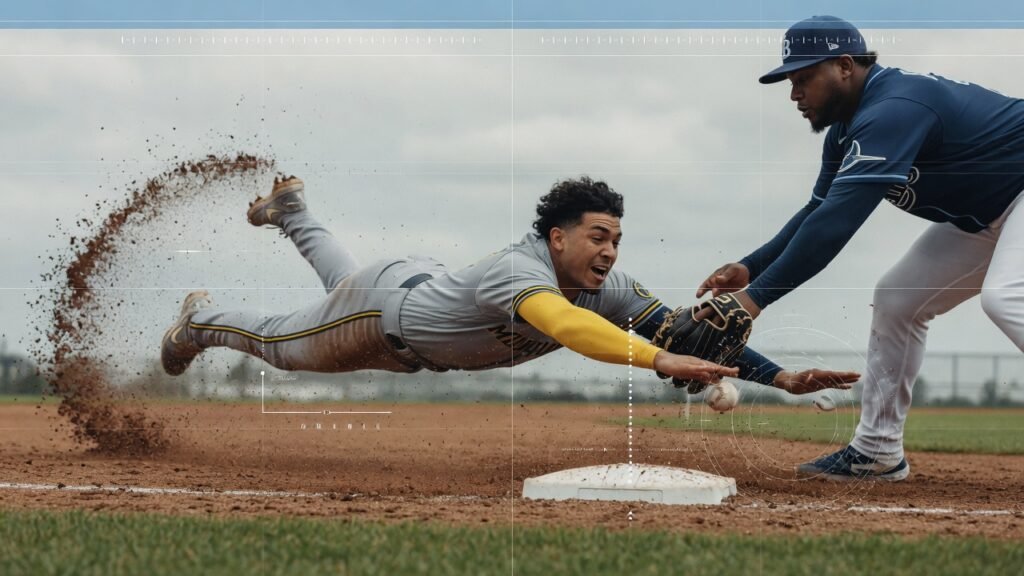
Two hundred and forty-one point eight million dollars is the combined 2026 payroll of the Milwaukee Brewers and Tampa Bay Rays, and on Friday night at American Family Field, Rob Manfred stood on the grass before Game 1 of the World Series and used that exact bargain-bin miracle to demand a hard salary cap. You have to respect the sheer nerve required to look at a pennant matchup between the 19th-highest payroll in baseball ($146.2 million for Milwaukee) and the 28th ($95.6 million for Tampa Bay) and tell the public that small-market clubs cannot compete without ownership intervention. While the New York Mets are sitting at home after lighting $346.8 million on fire and missing the postseason entirely, Manfred is pointing at the two smartest front offices in the sport as proof that the economic sky is falling.
“I think it shows that we leave a lot on the table in some of our smaller markets by not having them have an opportunity to compete on a regular basis,” Manfred told reporters Friday via ESPN. “The Brewers have been a well-run franchise forever. It’s been 40 years since we’re here. Once every 40 years is not enough.”
I had to read that line twice to make sure he actually said it out loud. First off, Milwaukee has not been a well-run franchise forever; the Brewers posted 12 consecutive losing seasons from 1993 through 2004 because their player development pipeline was a wasteland, not because George Steinbrenner stole their lunch money. More importantly, using a 40-year pennant drought in a 30-team league as evidence of structural failure ignores basic math and modern roster construction. The Rays are playing in their third World Series since 2008 and won their second American League pennant in seven seasons, while the Cleveland Guardians just reached the ALCS on a league-low $74 million payroll.
The Parity Myth Meets the Three-Wild-Card Reality
Manfred and the owners want fans to believe that without a hard ceiling, October belongs exclusively to coastal oligarchs. In his Friday media session, Manfred leaned straight into that framing: “No one ever said that differences in economics are perfectly outcome determinant. If you look at the data, our larger markets have a very statistically significant advantage in terms of making the playoffs and going deeper into playoffs.”
The commissioner’s argument falls apart the second you look at the actual postseason distribution since the three-wild-card format became permanent in 2022. Over that span, 24 of the league’s 30 franchises have reached the playoffs, and 17 of the 30 have played in a League Championship Series over the last decade. By the time the Brewers or Rays dogpile on the infield dirt next week, Major League Baseball will have crowned its third first-time World Series champion in eight years, joining the 2019 Washington Nationals and the 2023 Texas Rangers.
I look at the six teams that have missed the playoffs entirely since 2022 and see front-office malpractice in pitch design, amateur scouting, and roster allocation rather than a revenue death spiral. Modern baseball parity is driven by pre-arbitration surplus value, high-leverage bullpen platoon splits, and player development engines that turn sixth-round arms into wipeout relievers. Tampa Bay and Milwaukee out-leveraged the $338 million Los Angeles Dodgers and $346.8 million Mets by dominating the margins of the 40-man roster… and Manfred wants to use their triumph to cap player earnings.
The Proposal Exposes the Real Balance-Sheet Play
If this fight were genuinely about lifting up the bottom of the league, the owners’ economic framework would look completely different. MLB proposed a $243.5 million hard salary cap paired with a $171.2 million salary floor, with limits on contract length and size. Run those exact thresholds against this season’s payrolls and the motive jumps off the spreadsheet:
* **The Cap Compression:** Eight high-spending clubs would be forced to slash a combined $578 million in player payroll to get under the proposed ceiling.
* **The Floor Illusion:** Twelve franchises would have to add a combined $617 million to reach the $171.2 million floor, including both World Series participants (Milwaukee sits around $143.5 million to $154.7 million in CBT payroll, and Tampa Bay is at $113.2 million).
* **The Star Crusher:** The proposal caps individual free-agent contracts at a maximum of $265 million over six seasons and restricts any single player to 15 percent of a team’s total payroll.
That third bullet is the whole ballgame for me. Putting a six-year, $265 million hard ceiling on free agency does zero to help the Pirates or Marlins develop a third starter, but it guarantees that no owner ever has to write another 15-year, $765 million check like the one Juan Soto signed with the Mets. It artificially suppresses the open-market value of elite, six-win free agents in their late twenties and transfers every dollar of that saved surplus straight into franchise equity valuations.
“The salary cap is the opposite of competition,” MLBPA interim executive director Bruce Meyer told ESPN on Friday. “The salary cap tells teams you can’t compete too much. The results of these playoffs obviously further undermine their argument for why they think they want it. But again, that’s not the reason why they want it.”
Meyer called the league’s proposal a “nuclear bomb,” and my reading of the cap mechanics backs him up completely. Manfred boasted Friday that “we have an unprecedented level of unanimity among ownership that this is something that we need to do,” which makes total sense when a hard cap turns every franchise into a guaranteed, cost-certain cash cow regardless of whether the owner hires a competent analytics department. With the collective bargaining agreement expiring at 11:59 p.m. ET on December 1, the owners are preparing to lock out the players and risk the first work stoppage to wipe out regular-season games since the 1994-95 strike, wagering that fans will blame greedy stars while the trophy is literally being handed to a $95.6 million roster or a $146.2 million roster.