An expired registration tag on a Dodge Charger in Carmel, Indiana, is how the final chapter of Anthony Richardson Sr.’s tenure in Indianapolis begins to write itself.
According to court records and an affidavit provided to ESPN by the Hamilton County prosecutor’s office, a Carmel patrol officer pulled the 24-year-old quarterback over on October 12 over questions about his vehicle’s registration. Per the affidavit, the officer smelled marijuana, detained Richardson in handcuffs while searching the car, and allegedly found a small amount of marijuana along with 500-milligram THC-infused gummies in the glove compartment. Richardson, who according to the affidavit admitted to smoking inside the vehicle so he could avoid doing it at home around his children, left with a citation for the expired registration and a summons before prosecutors officially filed a misdemeanor marijuana possession charge on Monday.
As a single father myself, I understand the instinct to keep adult habits away from your kids, even if getting pulled over in a car with an expired registration is a brutal lapse in judgment. From a pure roster-construction and salary-cap lens, however, I view this misdemeanor summons as the exact leverage shift the Indianapolis front office needed to finalize its quarterback succession plan.
The Backup Quarterback Math Leaves Zero Margin for Distraction
To understand why a misdemeanor charge matters so much here, you have to look at the depth chart mechanics and the contract picture. Per People’s reporting, Richardson has not played a single snap this season following the return of starter Daniel Jones. When an organization pivots its offensive structure around a veteran starter and parks a former top pick on the bench with zero live-game reps, the backup’s entire value proposition comes down to two variables: low-maintenance readiness and pristine institutional trust.
“We are aware of the situation involving Anthony Richardson and are currently gathering additional information,” the Colts said in their official statement, adding, “We will have no further comment at this time.”
That boilerplate response is standard public relations protection, yet the roster reality underneath it is cold and mathematical. The window to evaluate and commit to a young quarterback is tight, and I’d argue every week spent holding a clipboard behind Jones shrinks Richardson’s trade value and developmental runway. In Shane Steichen’s RPO-heavy, timing-dependent offensive scheme, the backup quarterback has to master the playbook mechanics in the film room without the benefit of starter practice volume. Add an off-field legal distraction to a player logging zero offensive snaps, and the return on investment for keeping him on the 53-man roster craters.
Why Shane Steichen’s Status Quo Defense Falls Short
The counterargument coming out of the Indianapolis building is that a minor misdemeanor summons changes nothing about the team’s 2026 quarterback room. Head coach Shane Steichen leaned right into that stance on Friday, telling reporters the franchise would “keep all the stuff internal, in-house” while confirming that Richardson remains the team’s No. 2 quarterback heading into their scheduled matchup against the Minnesota Vikings. Even outlets like The Sporting News noted that Richardson’s alleged misdemeanor is far less severe than recent league legal trouble such as Keenan Allen’s three-game suspension following drunk driving charges.
I look at the calendar and the contract mechanics, and Steichen’s status quo defense rings hollow. Keeping a 24-year-old backup in the No. 2 slot on a Friday afternoon in October costs a head coach nothing when the game plan for Minnesota is already installed around Daniel Jones. The real roster friction hits when the legal timeline collides with the back half of the season… and that collision date is already on the docket.
The January 4 Bench Trial Sets Up an Offseason Break
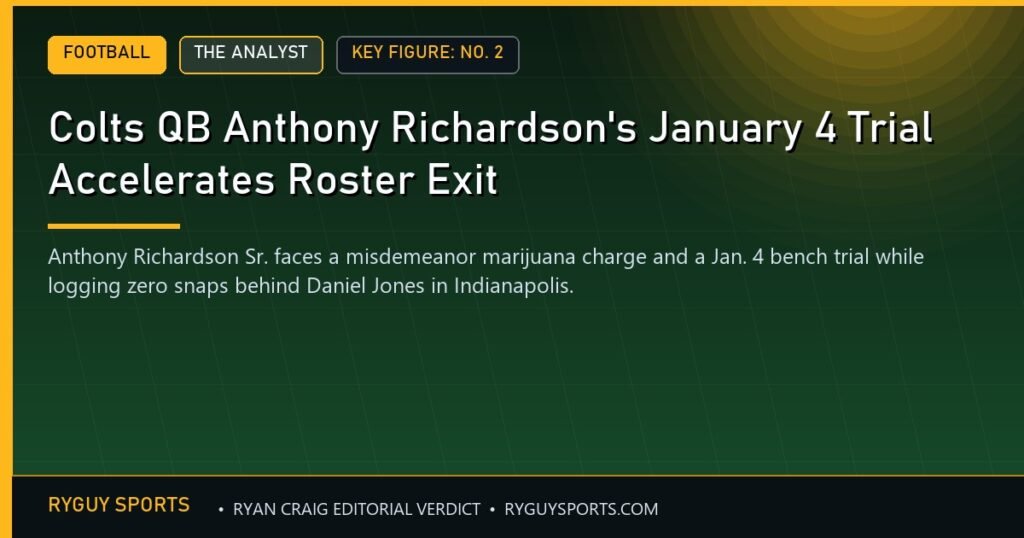
Look closely at the court schedule in the Hamilton County records: Richardson’s case is currently set for a bench trial on January 4. That date lands late in the season, close to when front offices start looking ahead to the offseason and deciding which developmental contracts to carry forward.
When a backup quarterback who has not taken a regular-season snap all year walks into the first week of January facing a bench trial over an alleged misdemeanor marijuana possession and an expired registration stop, I expect the front office to treat the offseason as a clean parting of ways. Watch how Indianapolis manages its active game-day quarterback elevation list between now and that January 4 court date in Hamilton County, because the moment the Colts dress a third quarterback on Sundays, the separation has already begun.