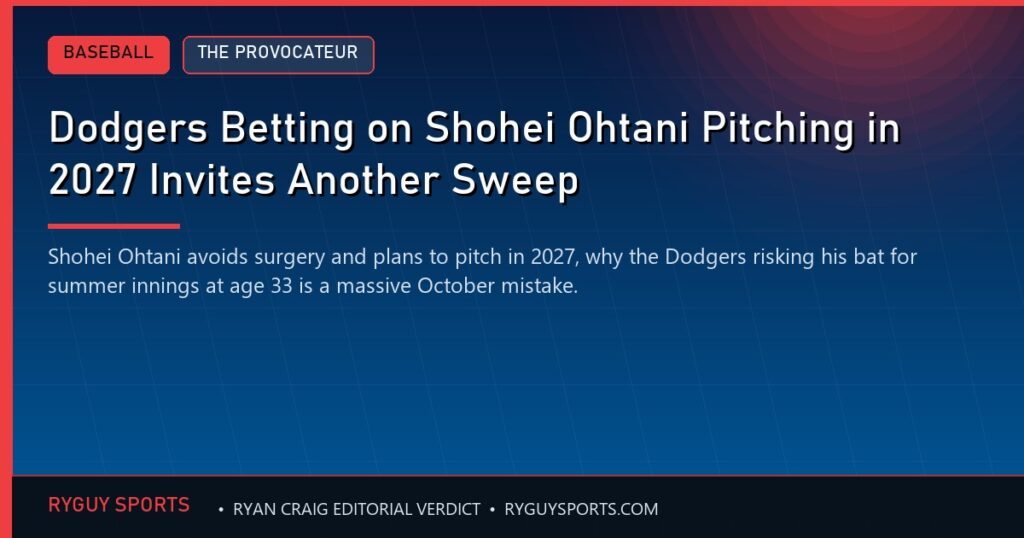
Andrew Friedman stood at a Dodger Stadium podium on Wednesday and pitched the biggest front-office fantasy in baseball with a straight face. Fresh off getting swept out of the National League Championship Series by the Milwaukee Brewers, the Los Angeles Dodgers president of baseball operations announced that Shohei Ohtani will skip offseason surgery on his balky left knee and right biceps, rest up, and return as a full-time two-way player in 2027. I look at that medical update and see a franchise voluntarily putting its best offensive weapon back into the woodchipper before the bruises from October have even faded.
“I fully expect him to pitch next year,” Friedman told reporters on Wednesday. “And I’m not only expecting him to pitch; we’re excited about him pitching. So now it’s about: How do we do that? How do we manage through a long season and have him at his best going into October? That’s a challenge.”
Running the exact same two-way experiment back next year after watching it wreck his swing from August through mid-October is front-office malpractice dressed up as optimism. Ohtani is a 99-overall create-a-player when fresh, and Friedman’s strongest argument for keeping him on the mound is the absurd 1.79 ERA and 95 strikeouts across 85 2/3 innings he posted in 14 starts before July 3. You do not casually throw away ace production when a guy owns a 2.83 career ERA across 114 regular-season starts.
Here is the problem with that math: those 85 2/3 innings in the spring and early summer cost the Dodgers their franchise hitter when the games actually mattered.
How July’s Mound Grind Nerfed October’s Bat
Doing the two-way tightrope act at age 32 proved far more punishing on Ohtani’s body than it was at 29. Even after the Dodgers shut down his arm following his July 3 outing, the physical toll of preparing to pitch never left the building. He tried throwing bullpen sessions and facing hitters in live batting practice in late August to ramp back up, and the compounding pain in his left knee and right biceps bled directly into his mechanics in the batter’s box.
For a left-handed power hitter, that specific combination of injuries is a mechanical death sentence. The left knee is the back-leg anchor that holds ground force during the load phase, while the right biceps controls the lead-arm path that keeps the barrel in the hitting zone. Once Ohtani lost stability in his back leg and strength in his lead arm, his kinetic chain came unglued.
Up through August 18, Ohtani looked like a runaway MVP, slashing .294/.390/.558 with 30 home runs and seven steals. Then the physical wear turned him into an automatic out. Across his final 26 games of 2026, postseason included, Ohtani slashed a brutal .167/.298/.240 with a single home run. He closed the regular season with 11 hits and 29 strikeouts over his final 70 at-bats, waited until after Labor Day to finally go on the 15-day injured list, and had just five regular-season games to find his timing against major league velocity before October arrived.
By the time the playoffs started, his bat was completely cooked. He went 4-for-22 with zero extra-base hits across his first seven postseason games, dragging down a Dodgers lineup that posted a .590 team OPS in October and went 4-for-27 with runners in scoring position against Milwaukee. His lone postseason homer in Game 4 of the NLCS was his first deep ball since August 18… and it came too late to save the Dodgers from the sweep.
Why Unprecedented Means Flying Blind
When reporters asked Friedman on Wednesday if the organization could have handled Ohtani’s two-way workload differently to protect him for October, he said he didn’t know the answer, and elsewhere in the news conference he stressed that the territory is uncharted. “This is unprecedented, what he’s doing,” Friedman said. “So obviously for us it’s unprecedented. We don’t have any experience to draw from. We can’t go look at how other situations have played out to try to learn from the good and the bad. We have to all just figure it out together.”
Actually, I have an entire season of evidence for Friedman to draw from, and it just ended in four games against Milwaukee. Even Ohtani sounded like a guy searching for answers after the Oct. 15 elimination loss, admitting through his interpreter that he was “not quite satisfied with how things shaped up on the pitching side.”
“I haven’t been able to really come to grips with what I’ve learned overall this season,” Ohtani said that night. “It’s something that I’m going to go back to the drawing board in terms of treatment, training programs and see what I can come up with for next season.”
When both the player and the front office openly admit they do not have the blueprint for surviving 162 games without breaking down, doubling down on the same plan is pure hubris. Friedman is already keeping Dave Roberts’ entire coaching staff intact while declaring it “business as usual” under owner Mark Walter, who is currently under federal investigation over alleged multibillion-dollar self-dealing. Meanwhile, deadline acquisition Tarik Skubal is heading toward free agency alongside key bullpen arms Alex Vesia and Evan Phillips.
Instead of using Ohtani to patch a rotation hole that Skubal’s potential departure might leave behind, I would lock the two-way unicorn in a bubble-wrapped cage as a full-time designated hitter or save his right arm strictly for late-season relief bursts. Letting him grind through May and June starts just to watch him strike out 39 times across his final 96 combined regular-season and playoff at-bats is a suicide pact for a championship window.
If Tarik Skubal walks in free agency this winter and the Dodgers hand Shohei Ohtani the ball in April instead of buying another frontline starter, another October sweep will be entirely on Andrew Friedman’s tab.