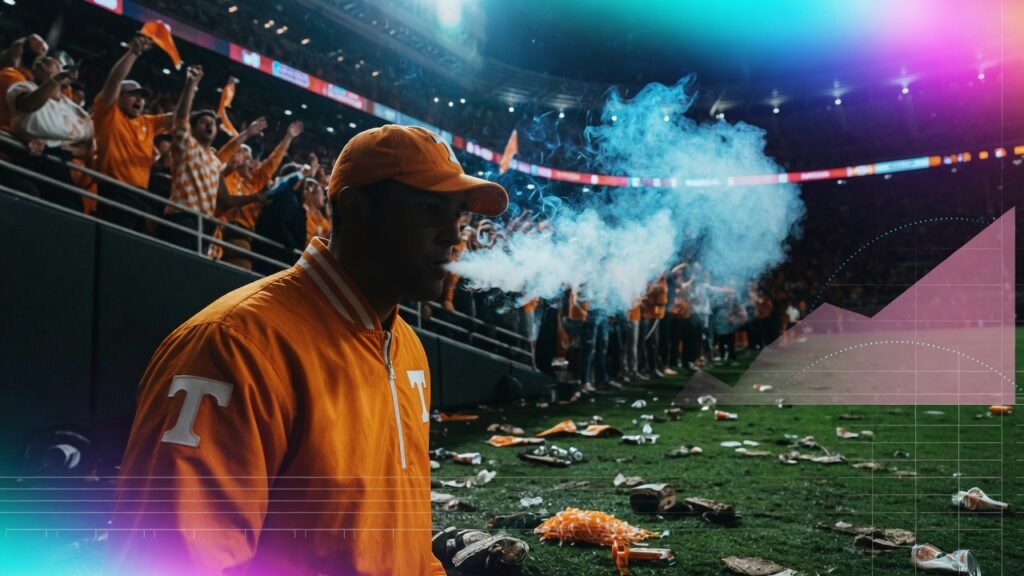
Five hundred thousand dollars sounds like a brutal deterrent until you divide it by the 101,915 fans who packed Neyland Stadium on Saturday night, which works out to a $4.91 cover charge per person to light a victory cigar on the turf. On Sunday, the Southeastern Conference hit Tennessee with that flat $500,000 penalty… payable directly to Alabama… after fans poured out of the stands following a 26-10 win over the sixth-ranked Crimson Tide. If the league office in Birmingham genuinely believed half a million dollars would keep a sellout crowd in its seats after an end-zone interception sealed a third straight home victory over Alabama, its economists need to check the math.
When I break down conference governance, I look at incentive structures rather than press-release scolding. In the 2025 fiscal year, the SEC distributed an average of $72.4 million to each member institution. Charging an athletic department 0.69 percent of its annual conference payout for a primetime celebration is a marketing expense, not a punishment.
“Institutions shall limit access to competition areas to participating student-athletes, coaches, officials, support personnel and properly credentialed or authorized individuals at all times,” the SEC stated in its official release on Sunday. “For the safety of participants and spectators alike, at no time before, during or after a contest may spectators enter the competition area.”
The conference office frames the flat $500,000 tariff, which replaced the old tiered structure of $100,000, $250,000, and $500,000 starting in 2025, as an ironclad safety barrier. Yet the league’s own rulebook reveals the flaw in that logic. The policy drops the fine to $100,000 if the home school proves it made a full effort to hold the line and waits roughly two minutes for visiting personnel and officials to clear the field. Tennessee athletic director Danny White even went on the Neyland video board late in the fourth quarter to beg fans for that exact two-minute buffer, and security kept the goalposts standing, yet the southeast corner near the student section still breached just over a minute after the final whistle while Alabama players were walking off.
The On-Field Stranglehold That Triggered the Breach
You cannot separate the urgency of that crowd surge from the suffocating defensive clinic Tennessee put on over the final 30 minutes. Before Saturday, the narrative around Knoxville centered on offensive firepower, while the Tide arrived at No. 6 expecting to dictate tempo. Instead, Tennessee turned the second half into a defensive vise, holding Alabama scoreless after the break and suffocating its offense to 201 total yards on the afternoon.
Look at the structural breakdown of how Tennessee dismantled Alabama quarterback Keelon Russell and the Tide attack:
– **Third-Down Suffocation:** Alabama converted 2 of 13 third downs (15.4 percent), as Tennessee’s front forced long-yardage passing situations and closed throwing windows.
– **Rushing Erasure:** The Vols held Alabama to 54 rushing yards, eliminating play-action leverage and forcing Russell into 29 dropbacks that yielded 147 passing yards, zero touchdowns, and two interceptions.
– **Four-Turnover Margin:** Tennessee generated four takeaways, culminating in the game-ending interception in the end zone right in front of the student section.
– **Second-Half Ground Control:** Leading 12-10 at halftime after four Cooper Ranvier field goals, Tennessee leaned on DeSean Bishop, who racked up 159 rushing yards and two five-yard touchdowns on 32 carries, while quarterback George MacIntyre completed 21 of 31 passes for 197 yards to push the Vols to 347 total yards.
When a defense squeezes a top-six rival into 54 rushing yards, four turnovers, and a 2-for-13 third-down clip, the emotional pressure inside a 101,915-seat stadium builds for two straight hours. Asking students to sit politely on their hands for 120 seconds after an end-zone interception seals that kind of physical dominance ignores human nature. This mirrors the 2022 and 2024 Tennessee-Alabama finishes in Knoxville, where the exact same rival and similar fourth-quarter tension produced the exact same turf invasion regardless of what the league fine schedule said.
Why the 11-Game Streak Exposes the Fine’s Flaw
Saturday marked the 11th consecutive time home fans have stormed the field following an Alabama road loss, a streak stretching back to Auburn in 2013. That 11-game sample spans two separate fine structures, proving that cash transfers between athletic departments have zero correlation with crowd behavior. My view is simple: fining the school in dollars does nothing because the people jumping the wall aren’t the ones writing the check, and the athletic director can cover a $500,000 invoice with a fraction of a single home gate.
If the SEC actually wanted to end field storms for player safety rather than subsidizing the losing visitor’s travel budget, the mechanism is obvious. Threaten to dock 5,000 student-section tickets for the next conference home game, or strip the home team of 15 yards on the opening kickoff of its next SEC matchup. The moment a field rush costs the coaching staff field position or costs students their seats in November, that two-minute exit clock on the video board will be obeyed to the second.
Until the conference ties the penalty to competitive leverage instead of petty cash, Danny White will gladly keep routing half-million-dollar checks to Tuscaloosa. At 6-1 overall and 3-1 in the SEC while Alabama sits at 5-2 and 3-2, Tennessee bought itself a premier College Football Playoff resume booster and a recruiting commercial that money cannot buy… and $500,000 is the cheapest line item on the receipt.