Twenty-four years in the college football wilderness ended on Sunday afternoon with the Miami Hurricanes sitting on the throne, and they got there by surviving a street fight while the rest of the sport’s aristocracy walked off a cliff. Five of the top seven teams in the Associated Press poll lost on Saturday, a single-day bloodbath that had never happened once since the poll launched in 1936. When the smoke cleared on Sunday, October 18, Miami held 40 of the 70 first-place votes and the No. 1 ranking for the first time since December 8, 2002.
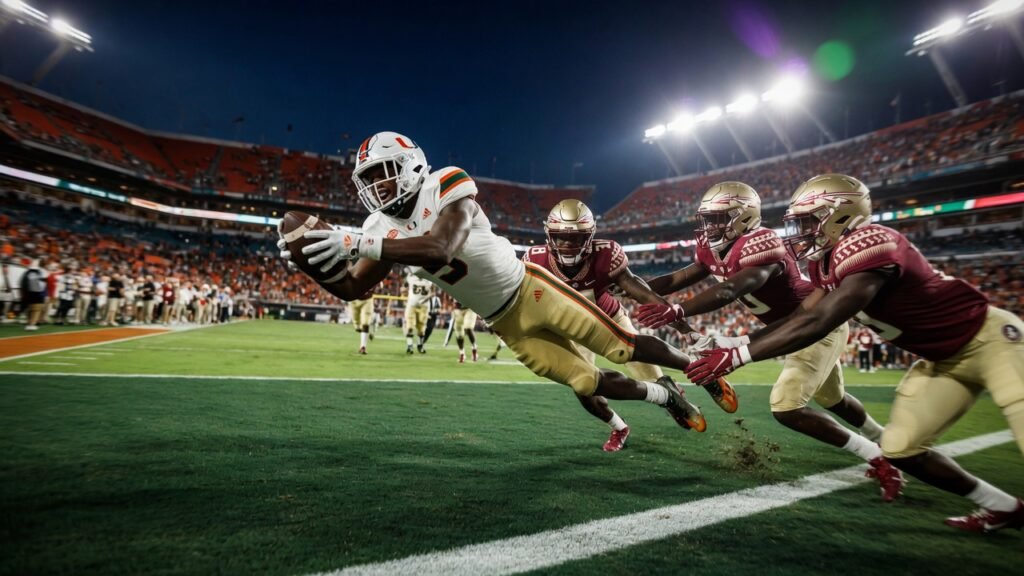
I love the sheer audacity of how they claimed it. Miami did not cruise past an overmatched cupcake while Georgia, Notre Dame, Indiana, Alabama, and Texas collapsed around them. Instead, Mario Cristobal’s squad went to double overtime at home against an unranked Florida State roster that refused to die, pulling out a 43-35 victory only after a holding penalty wiped out one fourth-down desperation heave and Bryce Fitzgerald intercepted the final Hail Mary to seal it. That is the kind of chaotic, fingernails-in-the-dirt survival that turns a talented roster into a team of destiny.
Of course, the resume police and the 20 AP voters who handed their first-place ballots to No. 2 BYU argue that jumping from No. 8 to the top spot belongs to a Cougars team that knocked off then-No. 2 Notre Dame 28-24 rather than a Miami squad that needed two extra periods to shake an unranked rival. It is a fair point on paper, especially with BYU sitting just 22 poll points behind Miami at 1,675 to 1,697, and No. 3 Ohio State lurking another 26 points back after ending defending national champion Indiana’s 22-game winning streak. Yet that argument ignores what happens inside the white lines when a bitter in-state rival empties its playbook with nothing to lose.
How Malachi Toney Broke the Overtime Geometry
College football’s current overtime rules are designed to compress the field and turn the second extra period into a two-point conversion chess match, where defensive coordinators bracket primary reads in tight red-zone windows. Florida State quarterback Ashton Daniels had carved up Miami’s secondary for 298 passing yards and four touchdowns all afternoon, pushing the Hurricanes to the brink after Miami let a late regulation lead slip away. In that moment, a lesser coaching staff turtles up and runs into a stacked box.
Miami instead leaned into its offensive versatility and forced Florida State’s defensive backs to defend horizontal and vertical stress simultaneously. Quarterback Darian Mensah finished 23-of-34 for 326 yards and three touchdowns, while running back Javian Mallory battered the front for 108 rushing yards and two scores to keep the linebackers honest. The real skeleton key, however, was wide receiver Malachi Toney, who hauled in 11 receptions for 154 yards and two touchdowns, added 31 rushing yards on two carries, and completely broke FSU’s red-zone leverage in the second overtime.
Mensah found Toney for the go-ahead touchdown in that second extra frame, and then Miami dialed up the ultimate gut-punch on the mandatory two-point attempt: putting the ball in Toney’s hands to throw the conversion pass to Cooper Barkate. When your primary boundary weapon is catching 11 balls, taking jet sweeps, and throwing two-point darts in double overtime, defensive keys become useless. You cannot bracket the No. 1 receiver and play honest assignment football against trick-play motion at the goal line at the same time.
The Poll Inertia Trap and Cristobal’s Blindfold
What makes me laugh about Sunday’s rankings is how desperately the voters tried to protect the teams that face-planted. Georgia lost 27-24 at home to an unranked Auburn team on Alex McPherson’s walk-off 34-yard field goal after Gunner Stockton turned the ball over three times… and the Bulldogs barely slid from No. 1 to No. 5. Notre Dame fell two spots to No. 4, and Indiana dropped a single rung to No. 6, meaning the top six is still packed with one-loss bluebloods waiting for an unbeaten to blink.
Cristobal knows how toxic that rat poison is when three different programs have worn the No. 1 crown in three consecutive weeks. “I think we have a good enough sample size of 2026 to know that’s absolutely insignificant and irrelevant with the changing of the guard from week to week,” Cristobal said after the Florida State win, per 247Sports and the Sun Sentinel. “I don’t see it as a (big deal). I honestly really don’t. Just has no value to our processes and whatnot. But all I’ll focus on the real one that’s important, the 1-0.”
Every head coach in America recites that Saban-tree process sermon, yet Cristobal actually has the receipts from Saturday’s carnage to make his locker room believe it. Unranked teams have now knocked off back-to-back AP No. 1 squads for the first time since 1990, with Oklahoma ambush-hunting Texas the week before Auburn walked into Athens. Wearing the bullseye in October 2026 has been a death sentence for teams that start reading their own press clippings.
Miami currently holds a 1-0 mark against the present Top 25 thanks to an earlier 33-20 win over No. 17 Wake Forest, which gives the Hurricanes a two-week runway starting Saturday, October 24 against unranked Pittsburgh before their November 7 trip to South Bend to face a fourth-ranked Notre Dame squad desperate to reclaim the top-two seed line.