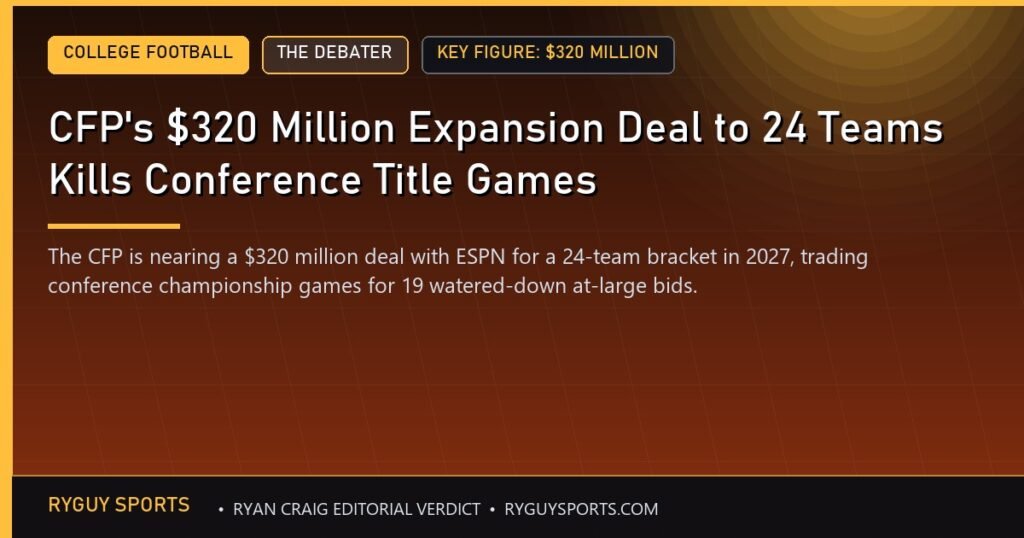
An execution warrant has been drafted for the conference championship game, and the price tag on the signature is $320 million.
While fans spent Thursday debating Saturday matchups like Alabama visiting Tennessee or Auburn heading to Georgia, the power brokers of the College Football Playoff moved within inches of a 24-team expansion deal for 2027, as CBS Sports’ Matt Zenitz confirmed. My verdict on the proposed “19+4+1” format is simple: the Big Ten and SEC are trading the sport’s regular-season tension and December title-game pageantry for a bloated bracket built entirely to protect media revenue and mediocre heavyweights.
Look at the architecture of this 24-team behemoth. Four automatic bids go to Power Four champions, one goes to the highest-rated Group of Six champion, and a staggering 19 spots are handed out as at-large invitations. For a decade starting in 2014, four teams fought for the crown. Even when the bracket expanded to 12 teams in 2024, where Ohio State became the first champion of the four-team era and then the first to conquer the 12-team field, an autumn Saturday loss still left a scar. Handing out 19 at-large bids turns October and November into a glorified seeding scrimmage.
Greg Sankey Traded His Championship Game for a $320 Million Check
Consider the position of SEC commissioner Greg Sankey. For months, Sankey publicly backed a 12- or 16-team format specifically to preserve the SEC Championship Game, while the Big Ten pushed hard for 24 teams. Then September arrived, and the resistance evaporated once Sankey laid out his real terms in a memo: require at least 10 regular-season games against power-conference opponents and offset the lost revenue from killing the conference title game.
Every principle in college athletics has an exact dollar figure attached to its surrender. As CBS Sports’ Brandon Marcello reported, the existing conference championship games carry a combined value of nearly $250 million, and CFP executives expected to seek roughly $70 million to $80 million on top of that to make the commissioners whole. That brings the price of this expansion to more than $320 million in additional annual rights fees stacked onto an existing agreement that already averages $1.2 billion to $1.3 billion a year.
“They’re gonna be gone,” CBS Sports’ John Talty said Thursday on College Football Insiders regarding conference championship games. “That’s the reality of the situation.”
Talty is stating the obvious because the calendar physics and financial wiring leave no other outcome. Expanding to 24 teams devours the December window on the schedule, and ESPN already holds the broadcast rights to the SEC, ACC, and Big 12 championship games while Disney Advertising manages the corporate sponsorship packages for the SEC and ACC. Instead of writing two separate checks, the network can simply redirect those championship-game rights fees straight into an expanded playoff bucket.
Nineteen At-Large Bids Destroy the Value of an October Upset
After the CFP’s exclusive 30-day negotiating window with ESPN expired on October 9, playoff officials triggered a five-business-day extension clause to review the numbers. On Thursday, the CFP released a statement full of boardroom velvet: “Constructive discussions with ESPN continued this week. We have enjoyed a strong partnership with ESPN since our inception and are appreciative of the productive dialogue we have had throughout the negotiating period and continuing over the last several days.”
Behind that polite press release sits an act of competitive negligence. Miami’s Mario Cristobal has opposed the 24-team format, and his pushback highlights the exact flaw in this blueprint. I expect the pitch for a 24-team bracket paired with a 10-game power-conference schedule to be that it creates more high-stakes games across the entire map in November. That pitch ignores how roster math and human nature actually work inside a football building.
When 19 at-large bids are floating in the ether, a three-loss program from the SEC or Big Ten is virtually guaranteed a seat at the table. My problem with this structural shift is what it does to roster management in late November. Why would a head coach sitting on nine wins risk his starting quarterback’s knee in the fourth quarter of a rivalry game when the 18th seed is already locked up? You are importing load management into college football. You are telling players that conference banners are obsolete relics and that surviving a 10-game power-conference grind at 8-4 is the new standard of excellence.
The Big Ten and SEC hold ultimate authority over this format, and their self-imposed deadline to finalize the decision sits on December 1. Once the ink dries on that $320 million surcharge before the calendar flips to 2027, the final weekend of the regular season will stop being an elimination gauntlet and start looking like a corporate inventory dump where the fourth-best team in a super-conference gets the same January lifeline as an undefeated champion.