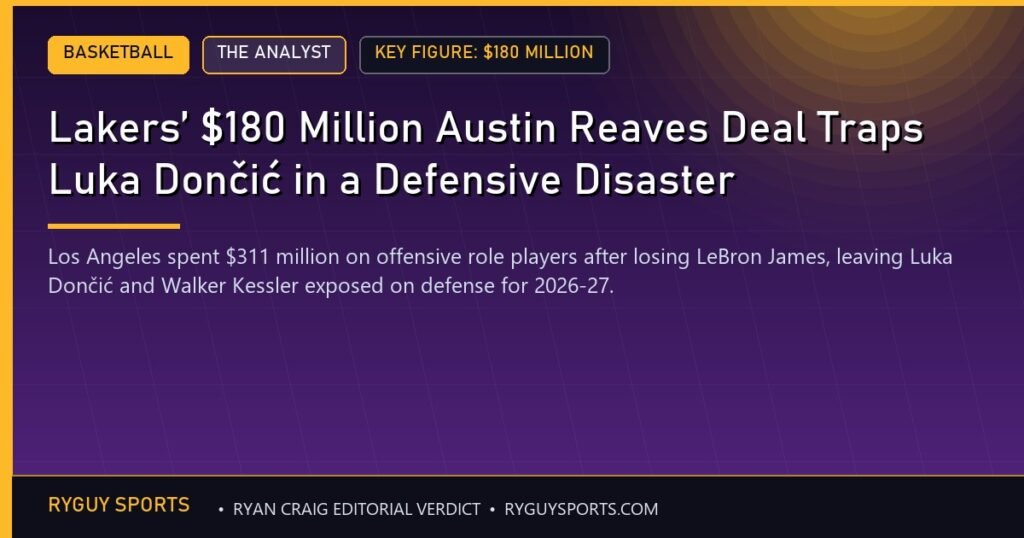
A 4-0 sweep at the hands of the Oklahoma City Thunder in the Western Conference semifinals should have terrified the Los Angeles Lakers into building a fortress. Instead, the front office spent the summer assembling a pricey turnstile on the perimeter and expecting one rim protector to bail out an entire roster.
Look at the ledger from a 53-29 campaign that ended in total humiliation against Oklahoma City. LeBron James packed his bags and signed with the Philadelphia 76ers. Marcus Smart walked out the door to join the Houston Rockets. Rui Hachimura defected across the hallway to the LA Clippers, Luke Kennard left for the Phoenix Suns, Jaxson Hayes went to the Utah Jazz, and Deandre Ayton was shipped to the Washington Wizards. The institutional muscle and perimeter grit walked right out of the building.
How did Los Angeles respond? They handed Austin Reaves a four-year, $180 million contract extension, gave Quentin Grimes four years and $60 million, paid Sandro Mamukelashvili $52 million over four years, and gave Collin Sexton $19 million over two years. When you add those four deals together, the Lakers committed $311 million to a collection of guards and forwards who cannot stop a nosebleed on the perimeter. That is roster negligence of the highest order.
Luka Dončić Cannot Win an MVP On One Side of the Floor
The national optimists and the preseason pollsters who slotted Los Angeles at No. 6 in their power rankings are intoxicated by the offensive ceiling. The bull case runs through a No. 1 seed, with Luka Dončić arriving in the best shape of his career alongside a deeper group of role players, and an elite offense paired with the trade acquisition of center Walker Kessler from Utah giving Dončić a clear runway to his first MVP trophy.
That fantasy evaporates the second you examine who actually has to guard the ball twenty-five feet from the basket. Kessler is a phenomenal interior anchor. Over his career, opponents shoot 50.6% against him within six feet of the rim, which drops their efficiency 13.3% below their normal average in those spots. He sets bruising screens, rolls hard to the paint, makes quick passing reads, and even flashed a spot-up three-pointer last season. None of that changes the geometry of modern playoff basketball when your perimeter defenders are getting cooked on every single screen.
Kevin O’Connor put the indictment on the record in the season preview: “We’re gonna find out how much perimeter defenders actually matter.” He did not stop there, noting of the roster construction: “There is no doubt about what they can become offensively, but winning a title typically requires more success on defense than what the Lakers project to offer.”
Look at the depth chart head coach JJ Redick is forced to deploy. Dan Titus noted in his fantasy report: “Quentin Grimes seems locked in as a starter; he’s started all three preseason games and is trending toward a rotation lock on the wing.” Jake LaRavia holds the early edge at power forward. Neither Grimes nor LaRavia is a lockdown stopper. Dončić and Reaves have never been mistaken for defensive hounds, and calling on Mamukelashvili or Sexton off the bench only pours gasoline on the fire. Meanwhile, Redick is already dealing with developmental headaches at the end of his bench, publicly admitting of Bronny James that “I don’t think he’s played well” in preseason games.
The 46.5 Win Total Tells the Real Story
While the preseason rankings hand Los Angeles the sixth spot in the league, the oddsmakers in the desert are looking straight through the hype. The sportsbooks set the Lakers’ win total at 46.5, priced them at -145 to win the Pacific Division, and hung a +3500 number on their NBA Finals odds.
A 46.5 win projection for a team coming off a 53-win season is a massive red flag. Vegas knows that Matisse Thybulle on a one-year, $3.3 million deal and Kevon Looney at one year and $3.9 million cannot patch the holes left by a starting backcourt that gets blown by constantly. Kessler has not even debuted in the preseason because of a finger injury. Even when he is healthy, he cannot play forty-eight minutes a night.
Nekia highlighted the razor-thin margin for error hovering over this top-heavy roster: “Because of how vital Dončić and Reaves are to their offense, the Lakers can’t really afford to lose either of them for an extended period.”
The exact same vulnerability applies to Kessler at the rim. The moment Kessler sits down for an eight-minute breather, or the moment a smart playoff opponent drags him out to the three-point arc in five-out spacing, the Lakers have zero resistance at the point of attack. Paying Austin Reaves $45 million a year to pair with Dončić guarantees fireworks in November, yet it leaves the backline completely exposed against the Western Conference elite in May.
The truth will surface immediately when the curtain rises on October 21 against the Golden State Warriors and two nights later on October 23 against the Clippers. When opposing stars start hunting switches at the top of the key and forcing Kessler far away from the basket, who on this $311 million perimeter is going to fight over a screen to save Luka Dončić’s championship legacy?