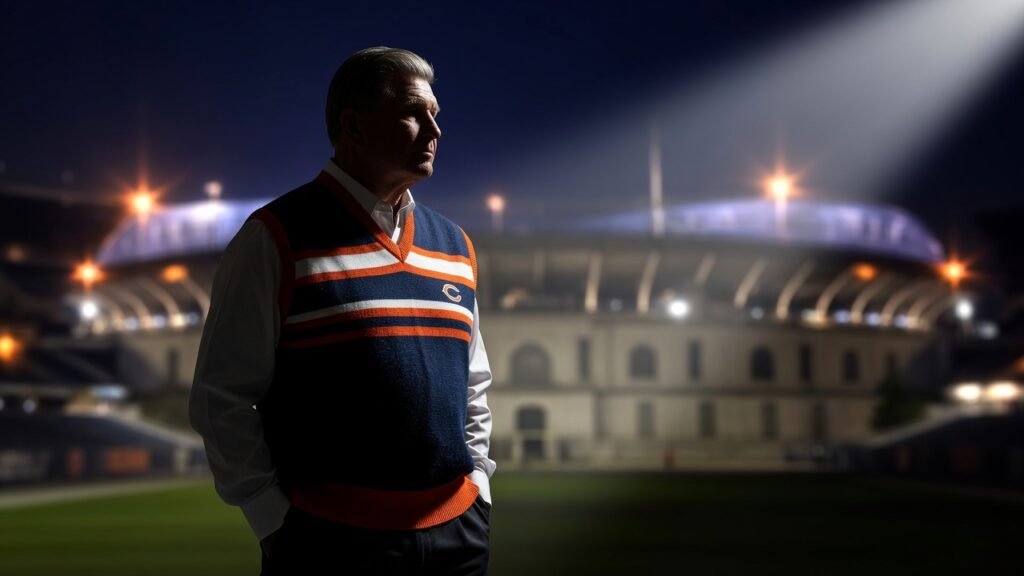
Mike Ditka existed in a state of permanent combustion. He operated on a frequency of pure, unfiltered hostility that the modern National Football League has spent the last two decades trying to legislate out of existence. The news broke Friday morning that he died at 86, and my timeline immediately flooded with images of sweater vests, aviator sunglasses, and chewing gum. I look at his legacy and see a foundational architect of the sport’s violence who shaped the strategy of the game from two different sidelines.
The modern tight end position owes its entire DNA to the fifth overall pick in the 1961 draft. I evaluate his rookie numbers and struggle to comprehend the sheer physical dominance required to post them in that era: 56 receptions, 1,076 yards, and 12 touchdowns. No tight end had ever crossed the 1,000-yard mark before he arrived in Chicago, and the tape from those early seasons shows a player running through defensive backs like they were blocking sleds. He grabbed a championship as a player with the Bears in 1963, caught a touchdown from Roger Staubach to win Super Bowl VI with the Dallas Cowboys, and proved that raw aggression could translate directly into elite offensive production.
Combustion As A Leadership Strategy
As a head coach, Ditka mastered the art of managing chaos by turning it outward. I constantly hear Chicago sports radio callers argue his tenure was a massive underachievement, insisting that a roster anchored by the greatest defense in NFL history should have secured multiple rings before his vicious feuds with Jim McMahon and Buddy Ryan derailed the dynasty. The math dismantles that complaint. He posted a 121-95 regular-season coaching record, reached the NFC title game three times, and delivered the franchise’s only Super Bowl by navigating an 18-1 overall campaign in 1985. He kept a powder keg intact just long enough to crush New England 46-10 on the biggest stage.
That friction fueled the entire machine, and the league recognizes exactly what it lost.
“Mike Ditka epitomized football over so many years,” NFL Commissioner Roger Goodell said in a statement. “He brought intensity, authenticity, and an unmistakable personality to everything he did.”
Intensity reads like a massive understatement. The archival tape shows a man who coached football as if every single snap contained a personal insult against his family. He demanded absolute submission to his brand of physical football, and I respect how he carried that reckless, all-in mentality to his later stops. His three-year run with the New Orleans Saints ended with a miserable 15-33 record, but I still consider trading eight draft picks—including two first-rounders—to move up for Ricky Williams in 1999 to be the wildest personnel move in modern league history. He dressed in a tuxedo alongside Williams in a wedding gown for an ESPN The Magazine cover, projecting the total confidence of a coach completely unbothered by convention. He wanted his guy, and he mortgaged the entire franchise to get him.
The Irreplaceable Blueprint
The league will never produce another figure capable of dominating it from every conceivable angle. Ditka sits in an exclusive club alongside Tom Flores as the only two people to win a Super Bowl as a player, an assistant coach, and a head coach. I look at the current regime in Chicago and see a coaching staff operating under a shadow that stretches across four decades.
“He’s a legend around here, as a player, as a coach,” current Bears coach Ben Johnson said. “His impact is still being felt to this day, and as the head coach of the Bears, I feel humbled to be in that same chair that he was once in. It’s a sad day hearing that he’s passing on.”
The tributes rolling in from across the sports landscape all hit the exact same chord of reverence.
“It’s with a heavy heart that I’m sharing the Ditka family has announced the passing of Mike Ditka this morning,” Jarrett Payton posted on X. “Da Coach. Hall of Famer. The heartbeat of the ’85 Bears and a Super Bowl champion. Chicago won’t be the same. Prayers to Diana and the family. RIP, Coach.”
The Bears retired his No. 89 in 2013 and declared it would be the final number ever retired by the franchise. I cannot think of a more fitting honor for a singular force. The Pro Football Hall of Fame inducted him in 1988, cementing his status as the first tight end to ever receive a bronze bust.
Every modern offense running out of a two-tight-end set owes a residual check to the blueprint he finalized. Look at the massive targets stretching the seams of defenses this weekend and recognize that none of their route trees exist without the path he carved through the 1960s. The entire league evolved into a polished, multibillion-dollar passing spectacle precisely because one player was so violently dominant that he forced every defensive coordinator in football to change how they scheme the middle of the field.