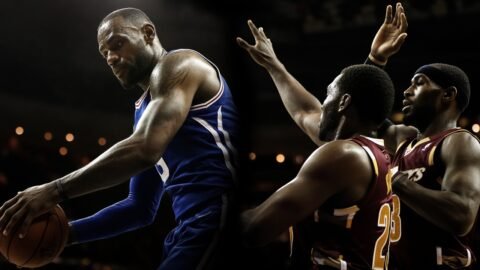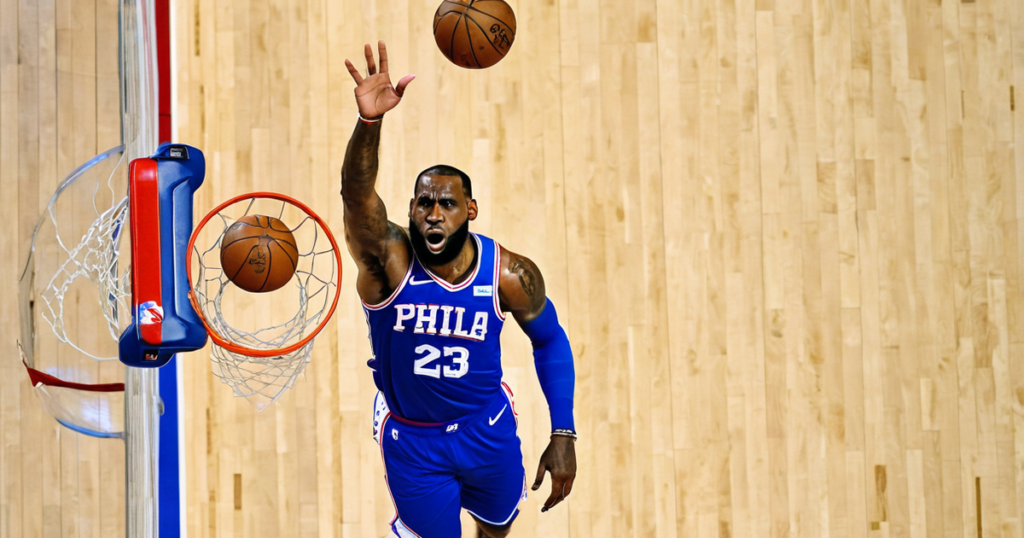
Philadelphia is 4-1 after the first week of the season, and half the league is already praying the salary cap police step in to stop what is happening in the Eastern Conference. Put LeBron James, Joel Embiid, Tyrese Maxey, Jaylen Brown, and VJ Edgecombe on the same court, and you do not have an NBA rotation. You have a custom 2K roster built by a teenager who turned trade override on and maxed out every slider.
Before training camp opened, the loudest basketball purists swore a roster packed with this many alpha scorers would choke on its own usage rate because there is only one basketball to go around. The Yahoo Sports film breakdown buries that argument in five games. Philly is not taking turns running stagnant isolation sets while four guys stand around watching. They are weaponizing their stars as decoys, screeners, and transition triggers, turning Maxey into an off-ball terror who makes opposing defensive game plans look completely cooked.
Tyrese Maxey Setting Screens For LeBron James Is Unfair
Everyone knows what Maxey does with the ball in his hands or flying down the floor in transition. What makes this 4-1 start genuinely terrifying for the rest of the East is how Philadelphia uses him when he gives the ball up. As Yahoo Sports pointed out, the Sixers are deploying Maxey as an off-ball screener, specifically hunting matchups that defenses refuse to switch.
Picture the geometry on the floor when Maxey sets a pick for a 41-year-old LeBron James. If two defenders panic and trap LeBron, Maxey slips the screen into open space with a full head of steam. If the defense tries to fight over the top, Maxey catches a crease and launches off a secondary pindown or stagger before his man can recover.
Take the possession from their recent matchup against the Indiana Pacers. Philly ran an Iverson cut for Maxey to the right wing, flowing straight into an empty-side pick-and-roll with Embiid. That empty-side alignment forces the weak-side help to choose its own funeral from the baseline and the nail. When Kelly Oubre committed near the top of the key, the ball whipped out to Edgecombe, who attacked the gap, forced a rotation, and kicked to Brown. One extra pass later, LeBron was standing all alone for an open three. Defenses cannot load up on a seven-foot, two-time scoring champion at the elbow when Maxey is blurring past staggers and three different wings can punish a late closeout.
A 41-Year-Old Point Forward Turning Philly Into A Track Meet
The real cheat code in this lineup is how a 41-year-old Hall of Famer has decided to play quarterback for the younger legs around him. At The Philadelphia Inquirer, beat writer Chris Hine was asked what surprised him most during LeBron’s first month with the franchise since media day in late September.
“The willingness to adapt and set up the talent around him,” Hine wrote in The Inquirer. “He clearly recognizes what the Sixers have when it comes to their ability to play in transition, and he’s willing to push and condition his body at age 41 to play an up-tempo style of basketball.”
My knees ache just thinking about conditioning to run the floor with Maxey and Edgecombe at 41, yet the tape shows LeBron firing hit-ahead passes to spark fast breaks before the defense even crosses half-court. And whenLeBron isn’t the one igniting the break, the seven-foot, 2023 MVP is doing it himself. Against Milwaukee, Embiid grabbed a defensive stop and brought the ball up the floor himself, forcing Ryan Rollins to pick him up in transition. Having a guard try to stop Joel Embiid with a live dribble is a mismatch that breaks a defensive shell on contact.
The Twelve-Second Shot Clock Trap Waiting In The Half-Court
For all the fireworks, I still see one glaring flaw that could nerfed this offense when the playoffs arrive and transition buckets dry up. When Philadelphia tries to get too cute with its half-court choreography instead of flowing quickly into space, the shot clock eats them alive.
Look at another sequence from that same Pacers game. Edgecombe called for a stagger screen for Brown on the right side using both LeBron and Embiid as the walls. Brown cut backdoor to the left, Embiid released to set an on-ball pick for Edgecombe, and Maxey lifted out of the left corner to turn the action into a stack pick-and-roll, setting a backscreen on Embiid’s man. On a whiteboard, that looks like coaching genius. On the floor, it took forever… by the time they actually triggered the pick-and-roll, the shot clock was down to 12 seconds. Indiana big man Jay Huff showed at the level of the screen and retreated cleanly with Embiid’s roll, while Andrew Nembhard stunted at the threat and recovered to Maxey, trapping Philly in a bailed-out, late-clock possession.
Add in the reality that LeBron and Embiid will sit out games for veteran workload management across an 82-game grind, just like we saw during the shorthanded 106-93 loss to Detroit on Monday. My take is simple: Philadelphia’s ceiling depends on ditching the slow-developing, 12-second set pieces and living in that empty-side speed where Maxey and Edgecombe force rotations on the fly. With the New York Knicks coming to Philadelphia next, the Sixers cannot afford to burn half the shot clock admiring their own playbook when the games tighten up.