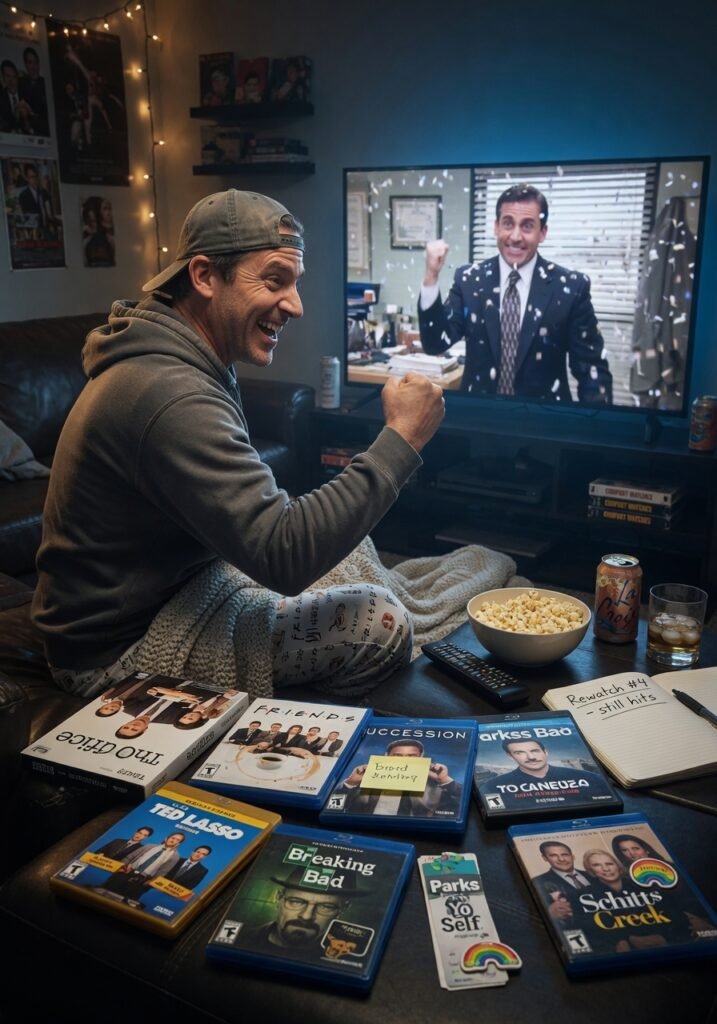
There’s a particular thrill that hits when a show you’ve already devoured suddenly feels brand new on the second lap, and Dyah’s Collider piece got the door open with The Boys and Schitt’s Creek before the real conversation even begins. These aren’t comfort-food background noise. They are engineered for repeat viewings, where every prop placement, every costume shift, and every line of dialogue you missed the first time around turns into evidence of something larger. The best rewatches don’t just hold up; they reveal the architecture that made the first pass so electric.
The Boys earns its spot at the top because its satire is built on misdirection that only tightens on rewatch. The early episodes plant visual gags about Vought’s corporate control that pay off seasons later, and the performances layer in details you can’t catch when the plot is still pulling you forward. Antony Starr’s Homelander starts as pure menace, but the second time through you see the precise micro-expressions that track his descent into something more pathetic and therefore more dangerous. The show keeps promising catharsis and then withholding it until the exact moment the audience has almost given up. That rhythm is deliberate, and it rewards anyone willing to map the “almosts” across five seasons.
Schitt’s Creek sits right beside it for the opposite reason. Where The Boys weaponizes power, this series weaponizes vulnerability. The Rose family’s slow recalibration of what success even means plays differently once you know where every character lands. Eugene Levy’s Johnny starts the series performing competence he no longer possesses; on rewatch the cracks in that performance read as quiet grief rather than comedy. The town itself functions as a character whose quirks stop feeling random and start feeling like a mirror the Roses need. The series never lectures about class or reinvention. It simply shows the cost of learning those lessons in real time, and the payoff feels earned precisely because the show refuses to rush it.
The rest of the list follows the same principle: stories whose construction becomes visible only after the first viewing. The Wire rewards map-making. Every season plants the institutions that will collapse or mutate in the next, and the dialogue is so dense that second and third passes turn background conversations into thesis statements. Mad Men hides its thesis in the production design. The same painting or piece of furniture reappears at key emotional pivots, tracking how characters refuse to change even as the world around them does. Six Feet Under makes its final episode feel inevitable on rewatch because the show has been staging literal and figurative funerals for its own characters since the pilot.
Breaking Bad operates like a chemistry experiment that only makes sense once you know the final yield. Every early decision by Walter White reads as inevitable once you have seen the full chain reaction, and the color shifts in his wardrobe track the moral decay more precisely than any monologue. The Office and Parks and Recreation both function as long-game character studies disguised as mockumentaries. The seemingly throwaway talking heads in season one become devastating callbacks by the finale because the writers were tracking micro-evolutions in real time. Lost, for all its reputation, still delivers the most satisfying rewatch in the mystery-box genre because the island’s rules are consistent from the first episode. The confusion was never the point; the emotional through-lines were.
These seven shows share one structural trait: they treat the audience as a participant rather than a passenger. The first watch is about momentum. Every subsequent watch is about architecture. That distinction matters more now than ever, when algorithms push viewers toward the next thing instead of deeper into the thing they already love. The shows that survive this environment are the ones that make you feel smarter for returning, not dumber for staying.