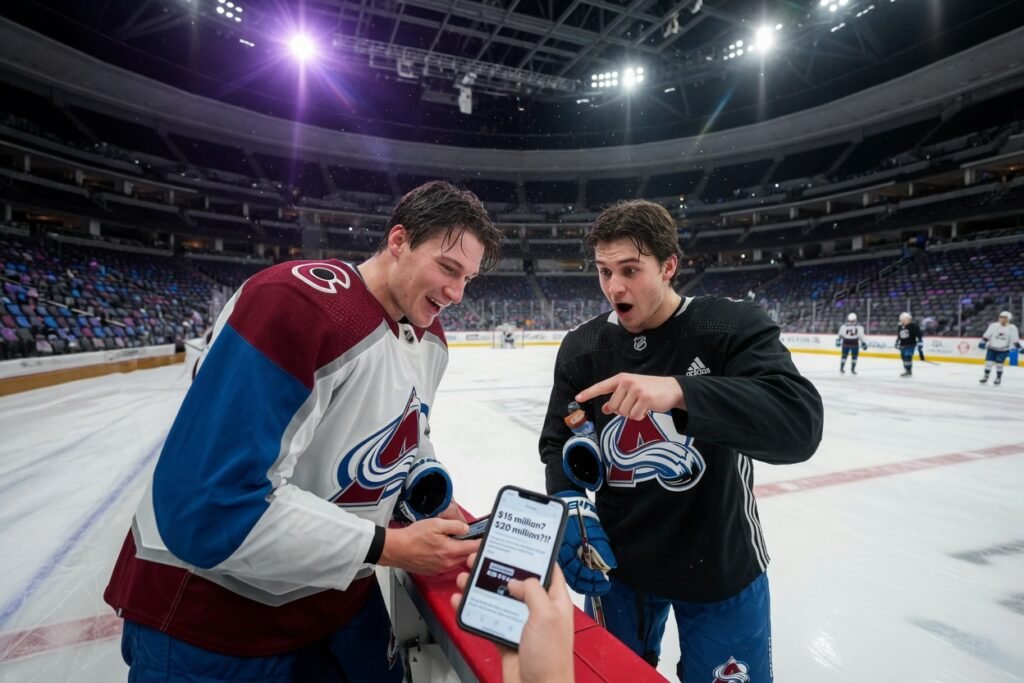
I’m telling you, when I heard the whispers turn into a roar – $15 million, maybe $20 million, for Quinn Hughes and Cale Makar – I felt that familiar cold dread worm its way into my gut. It’s not just money; it’s a seismic shift, a *Godfather* moment where the NHL finally decides to go to the mattresses on player salaries, and every GM is about to feel the shrapnel. This isn’t just a market correction; it’s an earthquake, and the aftershocks are going to shatter rosters across the league.
I always thought the NHL was different. That it had this weird, almost quaint charm compared to the NBA or NFL, where mega-contracts were a given. We’ve seen guys like Drew Doughty and Erik Karlsson push the envelope to $11 million, $11.5 million a year, which felt like the absolute ceiling for a blueliner. That was the big score, the *Casino* heist that set you up for life. But $20 million? That’s a different kind of score, a whole new level of larceny.
“The talk on the street right now is it’s anywhere between $15 and $20 million a year, depending upon the term,” an agent told ESPN, and my chest actually tightened reading that. Think about what that means. We’re not just talking about the highest-paid defenseman in the league; we’re talking about a salary that would rank 72nd in the NFL and 95th in the NBA. This isn’t just the NHL catching up; it’s the NHL finally realizing its superstars are worth more than a handful of magic beans.
The league’s been playing catch-up for years, held hostage by a flat cap after the COVID shutdown. It was like living in a time capsule while the rest of the sports world zoomed ahead. But that’s over. “What you’re now seeing is with the new change in the cap system, the cap hits have gone up, with the NHL and the NHL Players Association taking out a lot of the slack that was in the system,” another agent explained. Yeah, they took out the slack alright. They ripped the whole damn rope apart.
Hughes, fresh off a Norris Trophy and transforming the Wild into a Cup contender (I still can’t believe that trade, a real betrayal by the Canucks, a total Fredo moment, but I digress), and Makar, a two-time Norris winner with a Cup ring already on his finger, they are the vanguard. They’re the guys who deserve it, no doubt. Makar himself, back when he signed his current $9 million deal in 2021, said, “For me, it was always about getting a long-term deal done… I’m just excited to get back to work and hopefully bring another Cup back to Colorado.” He got his long-term deal, he got his Cup, and now he’s about to get paid like the generational talent he is. Good for him.
But what about everyone else? This isn’t just a new ceiling; it’s a new gravitational pull. Bowen Byram just inked a $12.5 million AAV deal with the Blackhawks, and he’s not even in the same tier as Hughes or Makar. “The interesting thing about Byram is he had a year left on his deal and he wasn’t interested in re-signing in Buffalo,” another agent noted. See? Players are already leveraging the rising cap and their own situations. This is a *Heat*-level standoff, only it’s between players and their GMs, not cops and robbers.
This isn’t just a raise for the top dogs; it’s a total reimagining of roster construction. You pay Hughes or Makar $20 million, and suddenly your entire salary structure shifts. You can’t afford that solid third-pairing guy, or your depth scoring forward. GMs are going to be making impossible choices, cutting loose good players just to keep their superstars. It’s a zero-sum game, a brutal calculation where every dollar spent on one guy is a dollar not spent on two others.
I’m telling you, this isn’t parity. This is a new class system being forged in front of our eyes. The teams with the deep pockets and the generational talent will thrive, but the rest? They’re going to be left scrambling, trying to find value in the bargain bin while their fans watch their favorite players walk for greener pastures. This isn’t just the price tag; this is the price of the soul of your franchise. And for some GMs, it’s going to cost them everything.